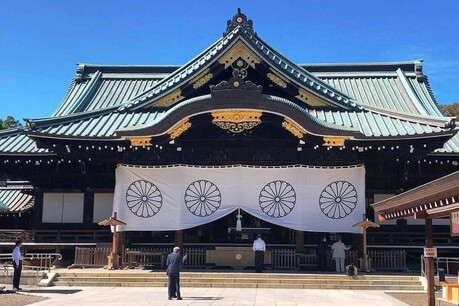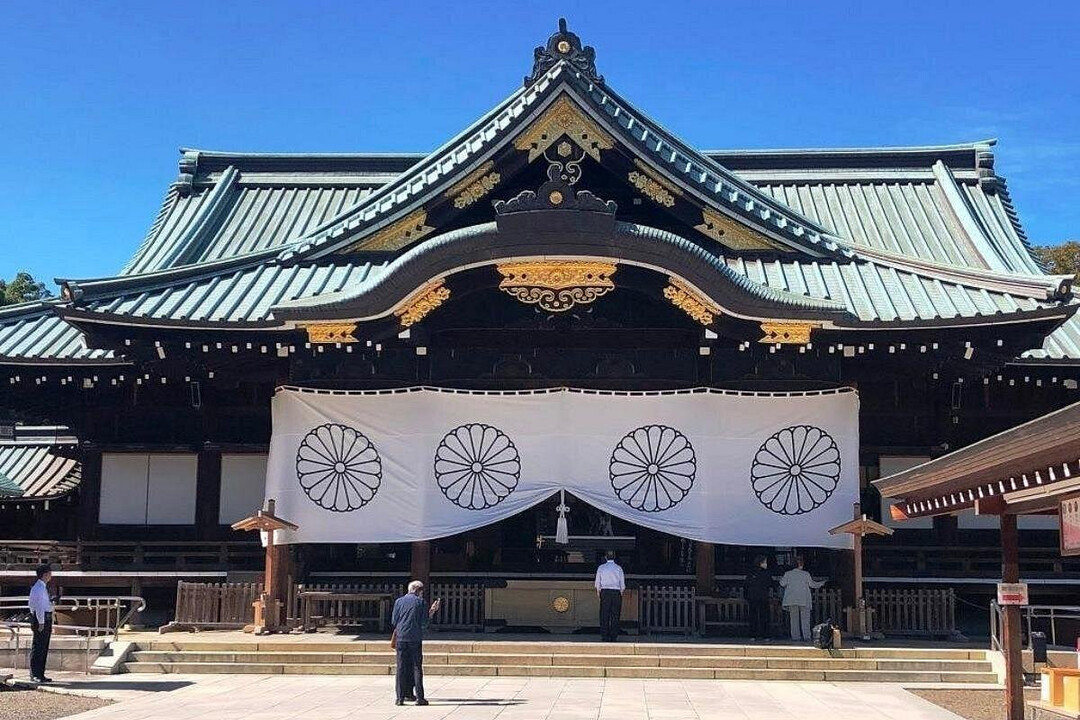
Every year on August 15, which Japan calls the "National Memorial Day for War Dead," Tokyo’s Yasukuni Shrine presents a surreal sight. People dressed in World War II-era Japanese military uniforms march proudly behind the Rising Sun flag, greeted by admiring gazes and applause. Some individuals even roam the grounds wearing Nazi German uniforms—sharing the common thread of aggressive invasion and mass slaughter across neighboring nations. Honoring those who died in various wars waged by Japan, the shrine also enshrines 14 Class-A war criminals of the Pacific War, including Hideki Tojo. For these reasons, Yasukuni stands as the sacred sanctuary of Japanese right-wing nationalism.
On designated occasions—such as the National Memorial Day and the spring and autumn festivals—Japanese politicians either visit the shrine in person or send ritual offerings (masakaki). The actions of the prime minister draw intense domestic and international scrutiny, as they symbolize Japan’s historical attitude toward the suffering inflicted on its neighbors during the imperialist era. While direct visits were once prominent, sending ritual offerings has become the more frequent approach in recent years.
◆ A Vicious Cycle
Prime Minister Sanae Takaichi sent a ritual offering under the name "Sanae Takaichi, Prime Minister" on October 17, marking the occasion of Yasukuni’s autumn festival. In response, South Korea's Ministry of Foreign Affairs expressed deep disappointment and regret through a spokesperson's commentary, criticizing Japan for "repeating ritual offerings and visits to the Yasukuni Shrine, which glorifies past aggressive wars and enshrines war criminals." Similarly, a spokesperson for the Chinese Embassy in Japan posted on social media, stating, "The Yasukuni Shrine is the spiritual tool and symbol of Japanese militarism. China strongly condemns Japan's negative developments regarding the Yasukuni Shrine."
It has become an annual routine: whenever the Japanese prime minister sends an offering, the foreign authorities of South Korea and China step forward to issue criticisms. Since taking office in 2025, Prime Minister Takaichi has opted to send offerings instead of making direct visits. Her predecessors, Fumio Kishida and Shigeru Ishiba, also sent offerings during their tenures. Each time, diplomatic authorities from Seoul and Tokyo's other neighbors voiced deep disappointment, urging Japan to face history squarely and demonstrate genuine remorse and apologies through concrete actions.
Direct visits were once quite common. Prime Minister Zenko Suzuki visited Yasukuni on August 15 each year from 1980 to 1982. Prime Minister Yasuhiro Nakasone also made an official visit on the same day in 1985. Ryutaro Hashimoto became the next prime minister to visit in 1996, an interval of 11 years. Prime Minister Junichiro Koizumi’s six visits between 2001 and 2006 protracted diplomatic tensions. In December 2013, Prime Minister Shinzo Abe’s direct visit caused massive diplomatic fallout.
◆ Between Visits and Offerings: The Politics and Diplomacy Behind Yasukuni
Both forms of engagement are fundamentally identical in that they reflect Japan's reluctance to acknowledge its war of aggression or repent for the profound damage inflicted on neighboring countries. However, they carry distinct diplomatic implications.
For Japan's conservative base, Yasukuni Shrine is a memorial for those who sacrificed their lives for the state. Whichever leader holds power must cater to this sentiment among conservatives, making some form of remembrance unavoidable. The dilemma lies in the reaction of neighboring countries. Direct visits provoked fierce condemnation from South Korea and China, and even raised concerns from the United States, Japan's closest ally. This is why Prime Minister Nakasone refrained from visiting in 1986 following the fierce backlash from Seoul and Beijing over his 1985 visit. Following Prime Minister Abe’s December 2013 visit, South Korea-Japan and China-Japan relations deteriorated sharply, prompting the U.S. government to issue a statement expressing disappointment that "Japan’s leadership has taken an action that will exacerbate tensions with its neighbors."
Consequently, sending offerings has emerged as a compromise—a way to partially meet the expectations of the domestic conservative base while dialing down the intensity of diplomatic friction.
◆ Unresolved Outrage
Yasukuni Shrine remains the clearest manifestation of "unrepentant Japan." As a result, it has frequently become a target of fury and attacks not only by diplomatic authorities, but also by outraged South Korean and Chinese citizens. Incidents surrounding Yasukuni vividly illustrate the clash of historical memories between Japan and its neighbors.
In December 2011, a Chinese national set fire to the front gate of Yasukuni Shrine, causing partial damage. The same individual had previously been arrested for throwing a firebomb at the Japanese Embassy in Seoul; however, when the Japanese government requested his extradition, a South Korean court rejected the request.
In November 2015, a South Korean national named Jeon Chang-han planted an explosive device in a public restroom inside the Yasukuni Shrine, damaging the ceiling. A Japanese court sentenced him to four years in prison.
In May 2024, a Chinese national spray-painted the English word "TOILET" in red on a stone pillar at the shrine entrance and posted the video on social media, causing a major uproar. Chinese-language graffiti was discovered on the same pillar in August of that year, prompting Japanese police to launch an investigation.
[Copyright (c) Global Economic Times. All Rights Reserved.]