
![[등록] 2026-09-01 15:48:31](/support/_updata/banner2/tl181982910_6749.png)


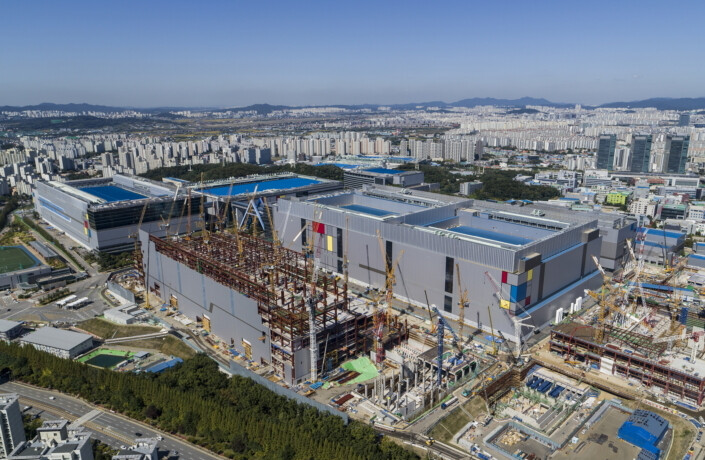
[SEOUL] — As the global semiconductor landscape shifts, Samsung Electronics finds itself in an increasingly precarious position. While the South Korean tech giant battles internal labor disputes and the high-stakes race for sub-3nm supremacy, Chinese foundry players are quietly mounting a formidable challenge. By pivoting away from the sanctioned "bleeding-edge" tech and doubling down on "mature nodes," Chinese firms like SMIC are now within striking distance of Samsung’s second-place market share.
The 80% Opportunity: Beyond the Nanometer Race
According to recent data from Counterpoint Research, the foundry market remains a lopsided hierarchy. TSMC holds a commanding 72% share, followed by Samsung at 7%. However, China’s SMIC has surged to 5%, fueled by a strategic realization articulated by its founder, Richard Chang.
At a recent semiconductor forum in China, Chang challenged the industry’s obsession with 2nm and 3nm processes. "The success of the semiconductor industry is not solely determined by the leading-edge race," Chang stated. He pointed out a critical market reality: over 80% of global semiconductor demand exists outside the realm of advanced nodes. This "legacy" or "mature" market includes the essential components for the modern world: automotive chips, power semiconductors, and Display Driver ICs (DDI).
Strategic Resilience Under Sanctions
U.S. export controls have effectively barred Chinese firms from acquiring Extreme Ultraviolet (EUV) lithography equipment, capping their progress at the 7nm threshold. In response, China has adopted a "Practical Interest Strategy." Instead of fighting a losing battle for AI processors, they are saturating the market for Edge AI, industrial controls, and wearable devices.
Market analysts at TrendForce note that the demand for "Edge AI"—where data is processed locally on devices rather than in the cloud—is creating a goldmine for custom-made chips that do not require the most expensive transistors. This allows Chinese foundries to utilize older Deep Ultraviolet (DUV) equipment to maintain high fab utilization rates, which are projected to hit 90% for 8-inch facilities this year.
A Pincer Movement on Korean Foundries
The Chinese offensive is creating a two-front war for South Korea. On one hand, Samsung Electronics is facing production uncertainties stemming from recent labor-management tensions. This instability provides an opening for Chinese competitors to lure global clients with the promise of stable, low-cost supply chains.
On the other hand, specialized Korean foundries like DB HiTek are finding themselves directly in the crosshairs. DB HiTek’s business model relies heavily on mature processes—the exact segment where China is currently dumping massive investment and government subsidies. As China localizes everything from raw wafers to core design software, the price-to-performance ratio offered by SMIC and Hua Hong Grace is becoming difficult for mid-sized Korean firms to match.
The Outlook: A New Supply Chain Reality
The global semiconductor supply chain is bifurcating. While TSMC and Samsung focus on the "pinnacle" of technology for data center GPUs, China is building a "foundation" of essential, everyday semiconductors.
Industry experts warn that if China succeeds in domesticating the entire supply chain—from materials to manufacturing—they will not only secure their own technological sovereignty but also dictate the pricing of the world’s most widely used chips. For Samsung, the challenge is clear: it must resolve its internal operational risks and innovate in specialty processes to prevent its 7% market share from being eroded by a neighbor that sees the value in what the leaders have overlooked.
[Copyright (c) Global Economic Times. All Rights Reserved.]














