![[등록] 2026-09-01 15:48:31](/support/_updata/banner2/tl181982910_6749.png)


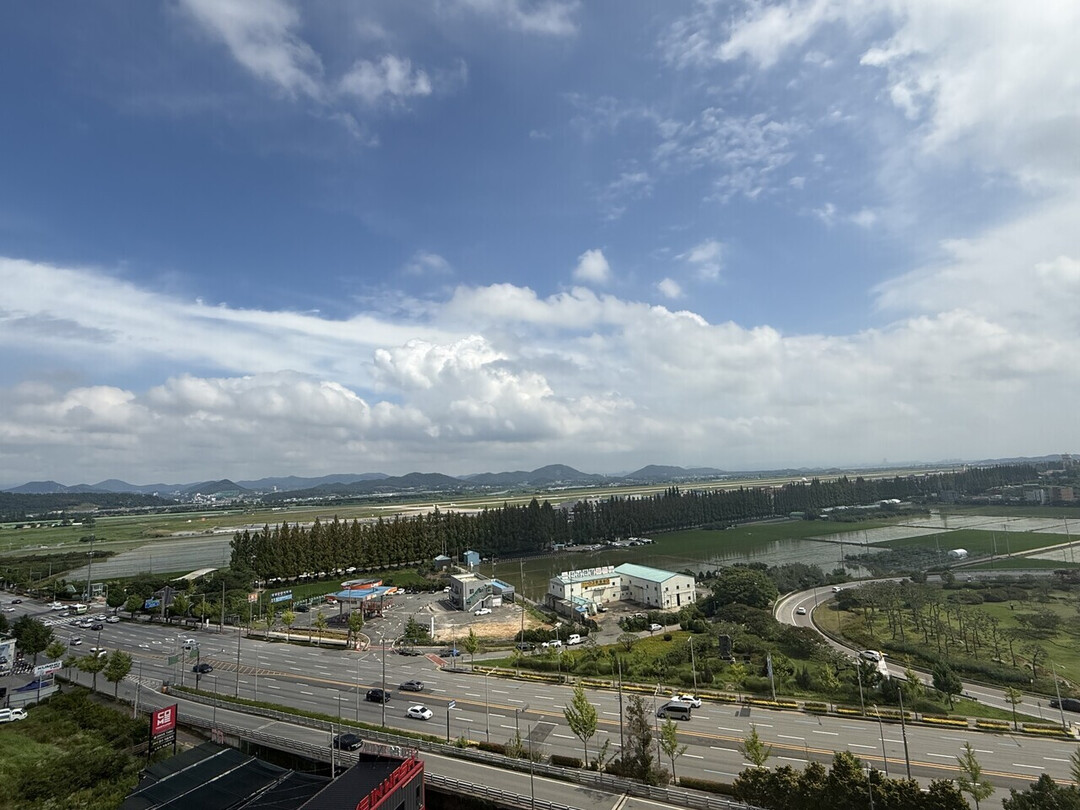
Analysis shows that the total project cost for the Honam Semiconductor National Industrial Complex, to be established on the site of the Gwangju Military Airport, will be approximately 9 trillion won, with an estimated development cost of 5.14 million won per pyeong (approx. 3.3 square meters). Concerns have been raised that this estimated development cost exceeds twice the sale prices of neighboring industrial complexes, which could increase the land cost burden for tenant companies.
On the afternoon of the 13th, fighter jets fly over the Gwangju Military Airport in Gwangsan-gu, Jeonnam-Gwangju, which has been selected as the site for the semiconductor cluster. The Ministry of Land, Infrastructure and Transport will designate a total of 364.19 ㎢ around the scheduled site for the Honam Semiconductor High-Tech National Industrial Complex as a land transaction permission zone for two years starting on the 14th. 2026.7.13 mhk0226@yna.co.kr
On the 12th, Representative Kang Dae-shik of the People Power Party, a member of the National Assembly's Land, Infrastructure and Transport Committee, analyzed data from the Ministry of National Defense and the Korea Land and Housing Corporation (LH), estimating that the total project cost for the Honam Semiconductor National Industrial Complex will reach approximately 9 trillion won. This figure is the sum of the 5 trillion won acquisition value for the former site and 4 trillion won in development costs. If 1.75 million pyeong—accounting for 70% of the total 2.5 million pyeong site—is supplied for a fee, the development cost per pyeong will be approximately 5.14 million won. Of this, industrial land is expected to account for 1,575,000 pyeong, and commercial land and others for 175,000 pyeong. The estimated development cost is 2.1 times the average sale price of industrial land in the Cheomdan District 3 of the Gwangju Research and Development Special Zone, which was sold in 2024 (2.41 million won), and 6.7 times the sale price of industrial land in the Bitgaram National Industrial Complex (Note: Bitgreen National Industrial Complex), which was sold in 2020 (7.7 hundred thousand won / 770,000 won).
However, 5.14 million won is an estimated development cost, and the actual sale price of the industrial land has not been finalized. The possibility has also been raised that costs related to the military airport relocation project may be reflected in the development cost of the national industrial complex. Rep. Kang’s office estimated that while the pre-development value of the military airport site is about 4 trillion won, the LH acquisition value—reflecting post-development value—is estimated at about 5 trillion won. Furthermore, if LH takes over the 4 trillion won in development costs previously borne by the Gwangju municipal government, a total scale of 5 trillion won—including the 1 trillion won difference in land value—could be reflected in the development cost and passed on as a burden to companies. It is reported that the government and LH are also reviewing plans to lower the industrial land sale price to between 3 million and 4 million won per pyeong. Rep. Kang’s office estimated that based on the estimated development cost of 5.14 million won, supplying 1,575,000 pyeong of industrial land at 4 million won per pyeong would generate a deficit/difference (revenue shortfall) of about 1.8 trillion won, and at 3 million won per pyeong, about 3.4 trillion won. Rep. Kang’s office pointed out that a review is needed on whether the national or local governments should support this difference through fiscal funds, or whether LH should bear it. Rep. Kang stated, "We must thoroughly examine whether the costs previously borne by the Gwangju municipal government are being reflected in the national industrial complex's development cost and passed on to companies," adding, "The government must transparently disclose the scale of the burden on companies and the public."
[Copyright (c) Global Economic Times. All Rights Reserved.]