![[등록] 2026-09-01 15:48:31](/support/_updata/banner2/tl181982910_6749.png)


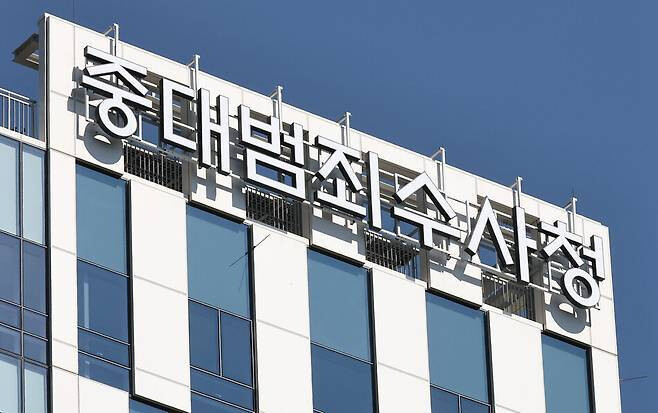
Workers install a sign for the Prosecution Service while removing the prosecutors' office sign at the Seoul Western District Prosecutors' Office building on the 29th, ahead of the launch of the Prosecution Service (Gongso-cheong). Photo by Nam Dong-gyun
The new "triple investigation system"—reorganized into the National Police Agency, the Serious Crime Investigation Agency (SCIA), and the Corruption Investigation Office for High-Ranking Officials (CIO)—will launch on the 2nd of next month. However, a "traffic control" mechanism to adjust overlapping investigative powers among the three agencies remains incomplete.
During a regular briefing held at the Government Complex Gwacheon on the 29th, a CIO official stated regarding the issue of overlapping investigative powers with the SCIA, "Nothing has been settled. It is a matter that needs to be reviewed moving forward," adding, "While we can review methods if a specific problematic situation arises, we cannot predict in advance what will happen at this point."
The SCIA also views the issue of overlapping investigative powers as a task to be resolved in the future. In its recently submitted "2027 Performance Plan" to the National Assembly, the SCIA mentioned the possibility of delayed investigations due to jurisdictional conflicts and procedural dualism with the CIO and the police.
In the actual new investigation system, cases involving intersecting jurisdictions among the three agencies could occur. The SCIA investigates seven major crimes, including corruption, economic crimes, defense acquisition, narcotics, insurrection, foreign aggression, cybercrimes, and the crime of distorting the law. As its scope expands beyond corruption and economic crimes—which were previously subject to direct investigations by prosecutors—it will overlap with the investigative domains of both the police and the CIO.
In particular, if a high-ranking official is involved in any of the seven major crimes, the investigative scopes of the SCIA and the CIO are likely to overlap. Although high-ranking official crimes such as bribery and abuse of authority are the primary targets of the CIO, both agencies can investigate crimes directly related to their respective jurisdictions. Furthermore, the police can theoretically investigate a broad range of crimes, creating situations where multiple investigative agencies simultaneously detect a single case, or where charges falling under another agency's jurisdiction are additionally uncovered during the course of an investigation.
Individual transfer mechanisms to be utilized in case of overlapping jurisdictions already exist. The CIO Act stipulates that if an investigation overlaps with another investigative agency, the head of the CIO may request a transfer considering the progress of the investigation and controversies over fairness. The SCIA Act also dictates that if the SCIA determines it appropriate to handle an investigation overlapping with another agency and requests a transfer, the other agency must comply barring "justifiable grounds."
However, detailed criteria for applying such regulations in actual cases remain unclear. Even the scope of "justifiable grounds" that can justify refusing the SCIA's request for transfer is ambiguous. When multiple agencies simultaneously detect a case or additional charges under another agency's jurisdiction arise during an investigation, judgments may clash over which agency should continue the investigation.
A separate statutory body to mediate disagreements between agencies will not be operational upon the launch of the new system either. The "Investigative Jurisdiction Adjustment Committee," established under the amended Criminal Procedure Act, will not take effect until February 5, 2027. This means an institutional vacuum will exist for about four months starting from the 2nd of next month, when the new investigation system is launched.
The vacancies in the heads of the police and the SCIA are also factors increasing uncertainty. The post of the Commissioner General of the National Police Agency has been vacant for 1 year and 9 months, and the inaugural head of the SCIA has not yet been finalized. If conflicts over jurisdiction materialize before the adjustment body becomes operational, they are likely to rely on individual consultations between agencies for the time being.
Each agency maintains that preliminary consultations are underway to reduce confusion ahead of the full-scale operation of the new criminal justice system.
The SCIA stated in its performance plan, "It is necessary to establish standards for case transfers and handovers. We will minimize investigative confusion through continuous consultations on institutional settlement and information linkage via close cooperation with other investigative agencies."
Hong Seok-ki, head of the National Office of Investigation under the National Police Agency, also stated, "Since May, we have been consulting with the SCIA preparation team on methods for notifying and cooperating on serious crime investigations," adding, "The consultations will soon be concluded, and there will be no problem in starting operations."
How the three agencies will coordinate when jurisdictions actually collide is expected to be the first test of the new system.
Yoon Hae-sung, a senior research fellow at the Korean Institute of Criminology and Justice, noted, "With both the head of the SCIA and the Commissioner General of the police vacant, acting heads have limitations in coordinating interests among agencies. Appointing chiefs and organizing the organizations must come first. Conducting consultations on a case-by-case basis without proper organizational readiness will ultimately end up as a patchwork response."
He further advised, "If we plunge into the new system without measures [to reduce confusion], the damage will ultimately fall back on the public," adding, "It is necessary to consider alternative plans, such as utilizing the authority of a third party or a higher-level organization to mediate if disagreements arise between agencies."
[Copyright (c) Global Economic Times. All Rights Reserved.]