![[등록] 2026-09-01 15:48:31](/support/_updata/banner2/tl181982910_6749.png)


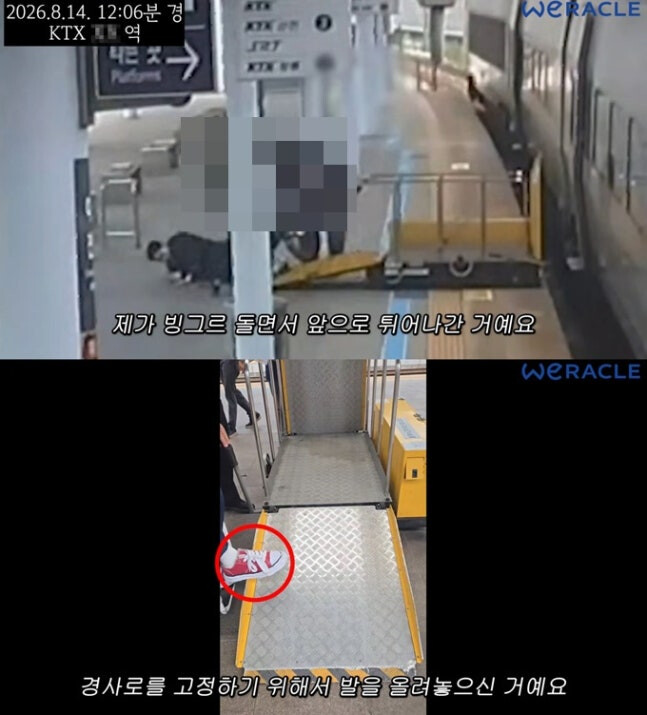
Following the release of Closed-Circuit Television (CCTV) footage capturing a fall accident during his exit from a KTX train by wheelchair-user YouTuber Park Wee, the fierce criticism directed at Park has escalated into anti-disability hatred. Critics point out that the fundamental issue—ensuring the right to safe mobility—has been pushed to the background.
On the 21st of last month, Park posted CCTV footage of the incident on his YouTube channel, explaining that his intention was to highlight a dangerous situation where he fell after getting caught on a public service worker's foot. The YouTube comments section flooded with criticisms, accusing him of singling out and targeting the specific public service worker in the video.
Although Park deleted the video and issued an apology the next day, the critical backlash did not subside. Hatred and disparagement targeting not only Park but disabled people at large began to surge. In online community posts and YouTube channel comment sections discussing the controversy, reactions expressing aversion toward disabled people continued to appear, such as "Their level is exactly like Jeonjangyeon (Solidarity against Disability Discrimination)," "Disabled people and the vulnerable are inevitably bound to be evil," and "Vulnerable status is a privilege." Some even tracked down the social media accounts of other disabled influencers or creators with large subscriber bases to leave comments comparing them to Park.
Experts pointed out that using the criticism against Park as a pretext to disparage people with disabilities is problematic. They concurred that discussions must pivot toward ways to guarantee mobility rights, including addressing the core issues of the accident: equipment defects in the lift and blind spots in safety management.
Han Sang-won, an attorney at Law Firm Duru who has long been active in the field of disability human rights, stated, "This accident must not spiral into blame targeting an individual public service worker, private sanctions, or condemnation of people with disabilities." He added, "Given that the right of transport-disadvantaged individuals to move safely and conveniently is a fundamental right guaranteed by the Constitution and laws, we must move forward to build public consensus for safe public transportation usage."
Cho Han-jin, a professor of social welfare at Daegu University, noted, "As a wheelchair user, I felt that because the end of the lift's inclined plate does not touch the ground and remains suspended by at least 5cm, the structure cannot be secured in the field without stepping on it with a foot." He added, "Due to the steep slope and equipment defects, users always board with the risk of overturning or falling." Prof. Cho remarked, "While Park's method of raising the issue is open to criticism, structural defects in the lift equipment and inadequate training for support services must be discussed simultaneously."
In response to the controversy, Korea Railroad Corporation (Korail) explained, "Even if the inclined plate is not stepped on, once a wheelchair moves onto it, the weight of the wheelchair naturally forces it flush against the ground." They added, "Stepping on it to secure it is not the principle under our manuals," while acknowledging, "It appears there were cases where some staff members stepped on it to secure it."
In response, attorney Han remarked, "Does the existence of a practice of stepping on it not mean that the public institution already knew the equipment itself was unstable?" He stressed, "Instead of shifting the blame onto an individual public service worker, this is an issue where we must contemplate safe mobility, including equipment defects."
[Copyright (c) Global Economic Times. All Rights Reserved.]