![[등록] 2026-09-01 15:48:31](/support/_updata/banner2/tl181982910_6749.png)


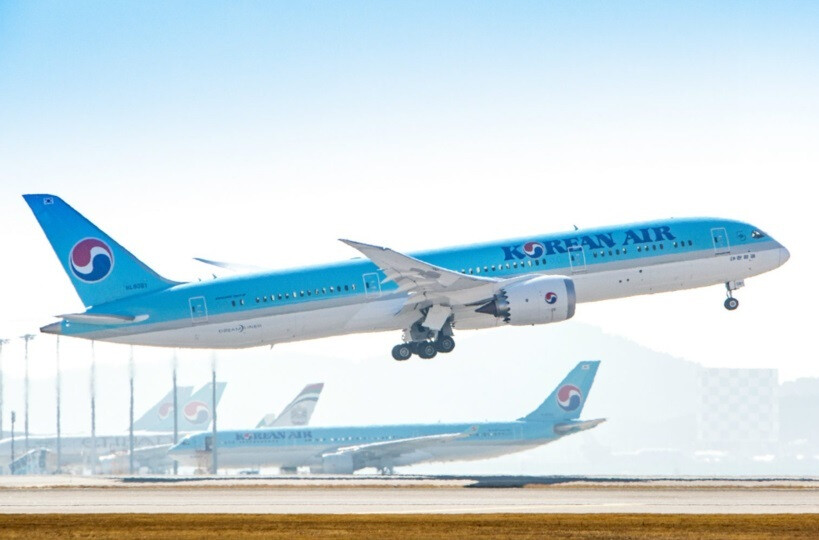
SEOUL — International flight ticket prices to long-haul destinations, including the United States and Europe, are expected to decline as international fuel surcharges turn downward for the first time in a month. This adjustment is poised to serve as a welcome relief for travelers planning overseas trips ahead of the peak summer vacation season.
According to aviation industry sources on the 18th, Korean Air, South Korea’s leading flag carrier, will lower its international fuel surcharge threat level from level 33 to level 27, effective June 1. This significant six-step markdown comes as the Mean of Platts Singapore (MOPS) jet fuel price—the benchmark for domestic fuel surcharges—plummeted by approximately 20% month-on-month to settle at 410.02 cents per gallon.
Industry analysts attribute this sharp decline to a temporary stabilization of global crude oil prices, driven by growing market expectations surrounding geopolitical negotiations between the U.S. and Iran. However, experts note that current fares remain relatively high compared to the historic peaks seen in 2022, when global energy prices skyrocketed in the immediate aftermath of the Russia-Ukraine war.
With the downward adjustment of fuel surcharges, total ticket prices across international routes are projected to drop simultaneously. For short-haul destinations in Asia, such as Japan and China, total round-trip costs—including fuel surcharges and ancillary fees—are expected to fall to around 123,000 won, down from the previous average of 150,000 won.
The most substantial financial benefits will be felt on long-haul routes to the Americas and Europe. According to industry simulations, travelers flying to major East Coast cities in the U.S., such as New York and Atlanta, could save at least 200,000 won or more on a round-trip ticket.
Based on the June issuance criteria, estimated round-trip ticket prices for major U.S. routes (standard economy class during the off-peak season) are projected as follows:
Los Angeles (LA) route: Expected to range between 900,000 won and 1.3 million won.
Washington, D.C. route: Forecasted to hover between 1.1 million won and 1.6 million won.
Aviation experts emphasize that actual pricing may vary considerably depending on the departure date, seat sub-class, layovers, and the exact time of booking.
Furthermore, aviation experts advise consumers to fully understand how fuel surcharges are applied to maximize savings. Crucially, the surcharge is determined by the "ticketing date" (payment date) rather than the actual departure date. For instance, even if a passenger is scheduled to fly in mid-June, purchasing the ticket before the end of May will lock in the current, higher surcharge rate. Therefore, travelers with flexible schedules are highly recommended to issue their tickets after June 1 to secure the lower fare.
"The recent cooling of international jet fuel prices from their peak will serve as a positive catalyst, not only reviving outbound travel demand weighed down by high inflation and exchange rates but also accelerating the normalization of airline operations," an official from a prominent domestic travel agency stated.
However, the official added a note of caution: "Given the persistent geopolitical instability in the Middle East and the inherent volatility of the global oil market, it remains to be seen whether this downward trend will sustain into the second half of the year." The agency also hinted that airfares could rebound in July and August as surging demand during the peak summer holiday season could offset the fuel surcharge cuts.
[Copyright (c) Global Economic Times. All Rights Reserved.]