• 2025.12.13 (Sat)
  • All articles
  • LOGIN
  • JOIN
Global Economic Times
APEC2025KOREA가이드북
  • Synthesis
  • World
  • Business
  • Industry
  • ICT
  • Distribution Economy
  • Well+Being
  • Travel
  • Eco-News
  • Education
  • Korean Wave News
  • Opinion
  • Arts&Culture
  • Sports
  • People & Life
  • Column
    • Cho Kijo Column
    • Lee Yeon-sil Column
    • Ko Yong-chul Column
    • Cherry Garden Story
  • Photo News
  • New Book Guide
MENU
 
Home > Synthesis

Korea Mint Launches Goods Using Currency By-products... Seeks Survival Strategy in a 'Cashless Society'

Desk / Updated : 2025-03-25 09:56:53
  • -
  • +
  • Print
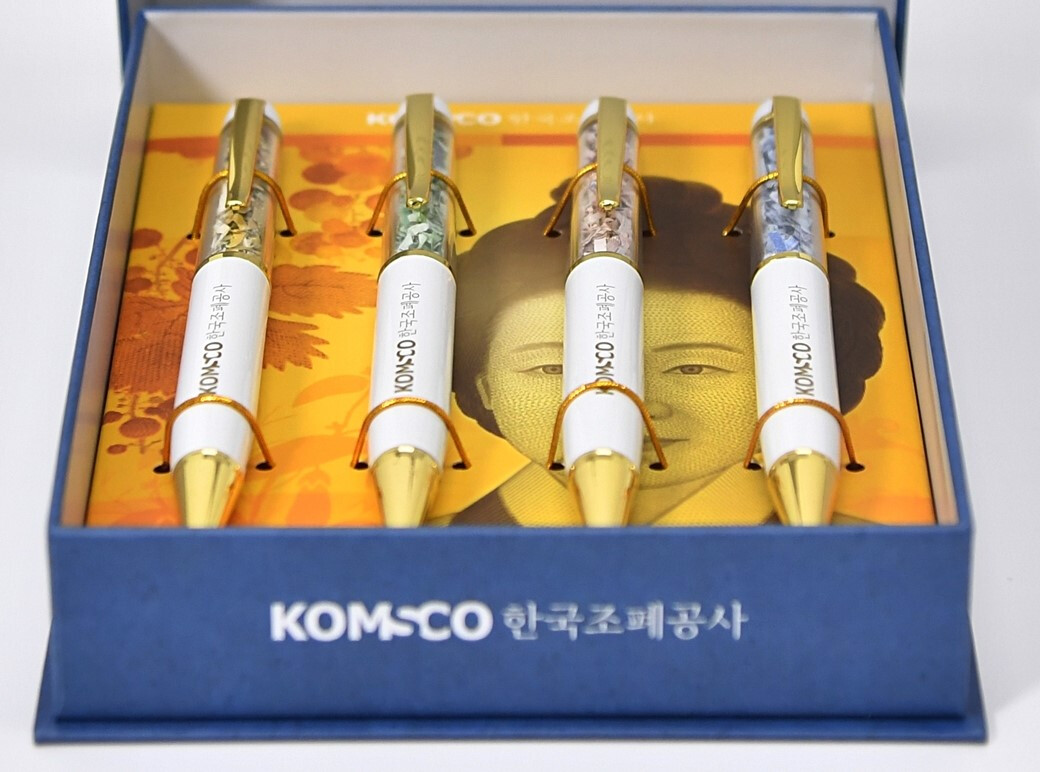
Korea Mint Launches 'Money Pen' Using Currency By-products

On the 21st, the Korea Mint launched 'Money Pen', a product utilizing by-products from the currency manufacturing process. The transparent pen contains finely cut paper scraps of printing defects from the production of 1,000 won, 5,000 won, and 50,000 won banknotes. This repurposes the 500 tons of defective currency and blank paper that are produced annually, transforming them into a marketable product instead of incineration.

Accelerating 'Cashless Society'... Changes at the Korea Mint

Korean society is rapidly transitioning into a 'cashless society'. Cash payments account for only 10% of transactions in Korea, and the issuance of banknotes and coins has decreased by 37% and 98% respectively over the past decade. Consequently, the proportion of the Korea Mint's revenue from currency business is also sharply declining.

In response to these changes, the Korea Mint is exploring new business areas such as mobile IDs, local currency gift certificates, digital anti-counterfeiting technology development, and artistic coins. Last year, they produced and sold out a limited edition intaglio print of Gyeomjae Jeong Seon's landscape painting 'Inwangjesaekdo', utilizing currency manufacturing technology.

Global Trend Towards a 'Cashless Society'

The shift towards a cashless society is accelerating not only in Korea but also worldwide. According to a report by the fintech company Worldpay, cash transactions accounted for 16% of global payments in 2023 and are expected to decrease to 11% by 2027. Countries like Norway, Sweden, and China are leading this trend.

Concerns Over Digital Exclusion

However, there are concerns that a cashless society may lead to the exclusion of digitally vulnerable groups and low-income workers. According to a survey by the Bank of Korea, the percentage of respondents who experienced cash payment refusal increased sharply from 0.5% in 2018 to 6.9% in 2021.

Consequently, there is a growing demand to ensure the 'right to choose cash' for financially vulnerable groups. The Bank of Korea emphasized the importance of cash use, stating, "For some, cash is the only means of payment."

[Copyright (c) Global Economic Times. All Rights Reserved.]

  • #globaleconomictimes
  • #글로벌이코노믹타임즈
  • #한국
  • #중기청
  • #재외동포청
  • #외교부
  • #micorea
  • #mykorea
  • #newsk
  • #nammidonganews
  • #singaporenewsk
Desk
Desk

Popular articles

  • Korean Fashion Brands Set Sights on China: Dunst Opens Pop-up in Shanghai

  • Alliance in a Dilemma: The Fallout of Trump's Advice to Takaichi Not to 'Provoke Taiwan' 

  • South Korea Lauded as 'Model Ally' After Committing to 3.5% GDP Defense Spending

I like it
Share
  • Facebook
  • X
  • Kakaotalk
  • LINE
  • BAND
  • NAVER
  • https://www.globaleconomictimes.kr/article/1065574534048734 Copy URL copied.
Comments >

Comments 0

Weekly Hot Issue

  • International Organizations Raise China's Growth Forecasts, Citing Stimulus and Exports
  • US-Japan Counteract Sino-Russian Drills with Joint Bomber Exercise in East Sea Airspace
  • Thailand-Cambodia Conflict Escalates: 22 Dead, Over 100 Injured as Border Clashes Spread
  • Swiss Economy Minister Guy Parmelin Poised to Lead as President in 2026
  • Russia Claims Downing Record 278 Ukrainian Drones Overnight, 40 Targeting Moscow Region
  • ZTE Faces Massive US Fine Over Alleged Foreign Bribery; Potential Settlement Could Exceed $2 Billion

Most Viewed

1
A Garden Where the City's Rhythm Stops: Dongdaemun's 'Cherry Garden', Cooking Consideration and Diversity
2
The Sudden Halt of Ayumi Hamasaki's Shanghai Concert: Unpacking the Rising Sino-Japanese Tensions
3
Choi Bun-do, Chairman of PTV Group, Assumes Presidency of the Korean Chamber of Commerce and Industry in South Central Vietnam
4
The Paradox of the 'Juvenile Offender' (Chokbeop Sonyeon): Impunity or Unfinished Rehabilitation?
5
South Korea Unveils 'K-Med': A Gigantic leap in Medical AI, Challenging Global Tech Giants
광고문의
임시1
임시3
임시2

Hot Issue

Mexico Hikes Tariffs on 'Strategic Goods' from South Korea, China, and Other Non-FTA Nations

Tech Tensions Flare: DeepSeek Allegedly Smuggles Banned NVIDIA Blackwell Chips for New AI Model

Netflix Stock Plummets 10% on Credit Downgrade Fears Following Blockbuster Warner Bros. Acquisition

LG Innotek Develops Eco-Friendly Next-Gen Smart IC Substrate, Reducing Carbon Emissions by Half

Let’s recycle the old blankets in Jeju Island’s closet instead of incinerating them.

Global Economic Times
korocamia@naver.com
CEO : LEE YEON-SIL
Publisher : KO YONG-CHUL
Registration number : Seoul, A55681
Registration Date : 2024-10-24
Youth Protection Manager: KO YONG-CHUL
Singapore Headquarters
5A Woodlands Road #11-34 The Tennery. S'677728
Korean Branch
Phone : +82(0)10 4724 5264
#304, 6 Nonhyeon-ro 111-gil, Gangnam-gu, Seoul
Copyright © Global Economic Times All Rights Reserved
  • 에이펙2025
  • APEC2025가이드북TV
  • 독도는우리땅
Search
Category
  • All articles
  • Synthesis
  • World
  • Business
  • Industry
  • ICT
  • Distribution Economy
  • Well+Being
  • Travel
  • Eco-News
  • Education
  • Korean Wave News
  • Opinion
  • Arts&Culture
  • Sports
  • People & Life
  • Column 
    • 전체
    • Cho Kijo Column
    • Lee Yeon-sil Column
    • Ko Yong-chul Column
    • Cherry Garden Story
  • Photo News
  • New Book Guide
  • Multicultural News
  • Jobs & Workers