![[등록] 2026-09-01 15:48:31](/support/_updata/banner2/tl181982910_6749.png)


(C) Pixabay
Gyeomjae Jeong Seon was a master of Jingyeong Sansuhwa (True-View Landscape Painting) in the late Joseon Dynasty. He established the tradition of sumukhwa (ink wash painting) by drawing the actual mountains and rivers of Korea, such as Geumgangsan and Inwangsan, using his unique brushwork. Even if people don't know his face, almost everyone knows his name. Danwon Kim Hong-do, famous for his genre paintings (Pungsokhwa) in the late Joseon Dynasty, was also an outstanding painter in various fields, including landscape and figure painting using sumuk (ink and wash). His genre paintings still vividly appear in my mind.
Meok (ink stick) is written as '묵 (muk),' and a painting drawn with meok is called '묵화 (mukhwa).' Sumukhwa is a painting that expresses distance or strength/weakness by adjusting the concentration using a single color of meok. The difference between dark and light concentration is called '농담 (nongdam),' and even a single meok color can achieve over a hundred different levels of nongdam.
Then, should other colors not be added to this meok color? Why shouldn't they be? Teacher Seo Young-ho of Dachon in Changwon added a slight blue color to the meok to draw dark bluish pomegranate leaves. Although the red pomegranate, fully ripened and burst open to reveal its flesh, is beautiful, I was instantly captivated by the painting because the dark bluish leaves were so dignified. It was one of the few things in my life I decided on at first sight without hesitation. Even I, an art novice, can recognize something good and wonderful.
Though I don't know much as an outsider, it seems there are many artists in this era who still bring out the flavor of meok color in landscape paintings, literati paintings (Muninhwa), and folk paintings (Minhwa). I cannot distinguish between or draw a cat and a tiger, nor do I know how to express distance using color. I don't know why I was not blessed with such talent. Art class was the most uncomfortable time for me. Supplies cost money, and since I couldn't properly prepare them, I felt ashamed and couldn't stand tall. A person sitting in front of an easel topped with a white canvas felt like someone from another country to me. Art has always been a distant world.
Munbangsau (The Four Friends of the Study) refers to the four essential tools used by ancient scholars for academic and artistic activities: paper (ji), brush (pil), ink stick (muk), and ink stone (yeon). Water is needed to grind the meok on the yeon, which is a hard, heavy stone slab. The water is stored in an yeondeok (water dropper) and dripped drop by drop. These porcelain yeondeoks are also works of art. I tried to practice calligraphy, not brush writing, but I long ago changed my focus to 'let's just write well with a pen.'
When making meok, soot from burning pine wood is sometimes used, but 'homa-yu' (sesame oil), which is used to make oil-soot ink (yuyeonmuk), is sesame oil. The process involves burning sesame oil, collecting the soot, mixing the soft soot powder into water with dissolved glue until it thickens, adding ash to shape it, and finally making the meok. High-quality glue uses swim bladder glue from the croaker fish and is used as an adhesive. In addition, small amounts of aromatic or medicinal ingredients like yongnoe (borneol), sahyang (musk), and janghyang (a type of herbal fragrance) are added to the meok to enhance its scent and quality. Thus, one should not underestimate meok just because it is black.
The natural ink is the one squirted by a squid. Black substances include barley smut, charcoal, soot, and coal. Charcoal (tan) is solid carbon made by the incomplete combustion of wood or material, and soot is fine carbon particles produced when oil or wood burns, appearing as a light, soft powder or dust. These days, the popular squid ink is not used to make meok. Squid ink is considered good for the body and is cooked or used to make bread.
A natural black color, not pitch black like squid ink, is called meoksaek (ink color). What a sophisticated color it is! I wonder if mixing 2% of red or blue into it would result in the astonishing '묵적 (mukjeok, "Silent Red")' or '먹청 (mukcheong, "Ink Blue")' of '묵적 (mukjeok, "Silence").'
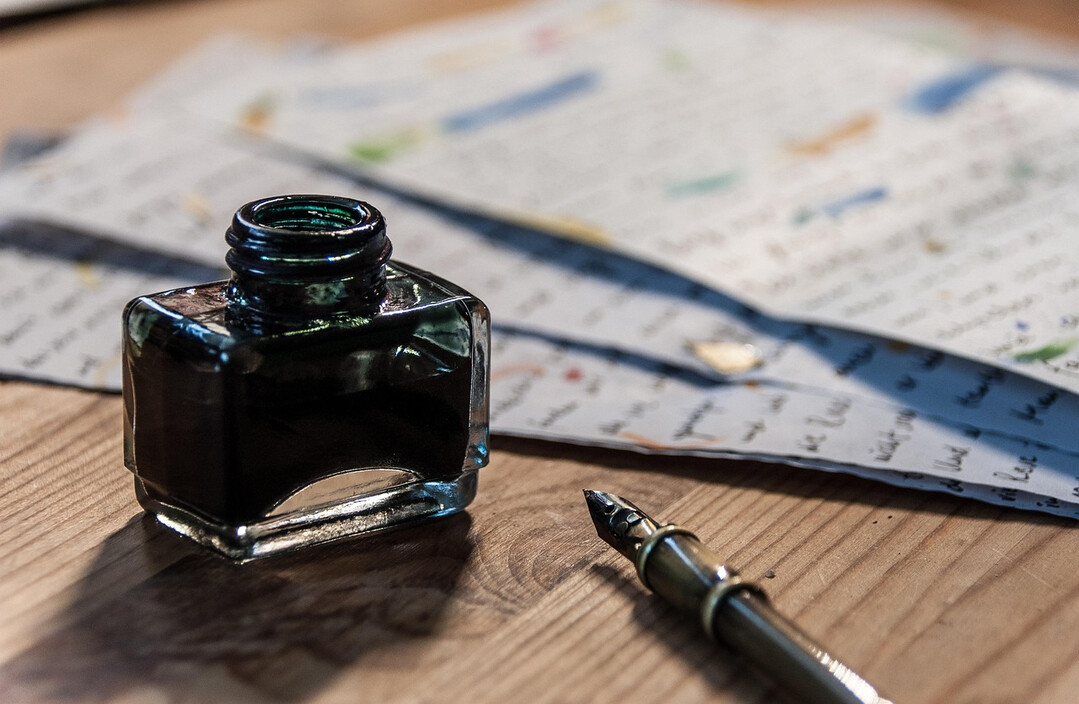
I once visited a museum dedicated to a famous painter. There, I could immediately tell whether the painting was done with meok or with ink. People put ink into fountain pens, not meok ink. Ink is for writing with fountain pens or ballpoint pens, and meok ink is decidedly for writing with a brush. Of course, there's no reason why meok ink cannot be used with a pen or regular ink with a brush. However, next to the mukhwa (painting drawn with meok), it was written in English as "ink painting." Although meok is a type of ink, so it's not wrong, couldn't '먹' just be called 'Meok'?
Just as our ginseng, cultivated in Kaesong and a specialty of Geumsan, went to the US via Japan and became 'ginseng,' resembling the Japanese 'kinsen (人蔘),' our game of Baduk (Go) was passed to Japan during the Baekje era and then to the US through Japan, becoming 'go' in English, which is the Japanese pronunciation of the Chinese character '棋' (Baduk/Go).
Meok is categorized as Chinese ink, Japanese ink, and Korean ink, but the English term 'Sumi ink,' derived from the Japanese word 'sumi' (墨), seems to be used more often. However, our things should be called by our own names. Culture and art shine when they are confident. Meok is our word, our color, and it is 'Meok,' not ink. Meok is also another 'Meokgeori' (something to eat/a topic of conversation). Let's expand our cultural territory with Meok. Thinking about Meok makes my heart heavy (먹먹해진다 - a play on words).
[Copyright (c) Global Economic Times. All Rights Reserved.]