

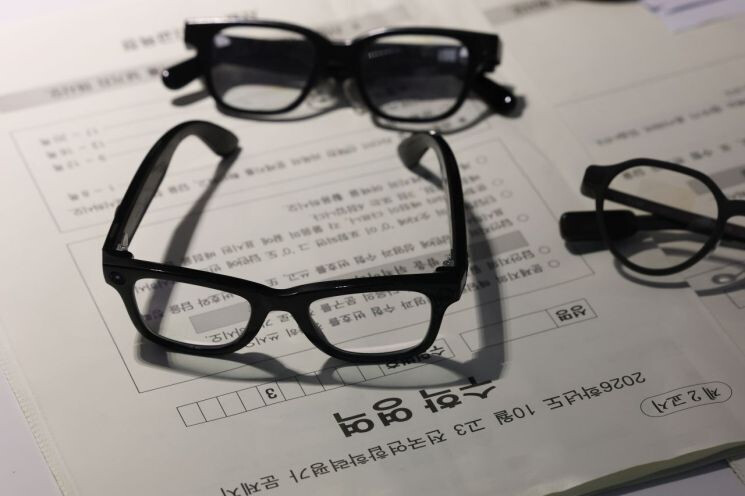
SEOUL — Recent scandals involving artificial intelligence (AI)-powered smart glasses used for cheating during national qualification exams have brought to light critical structural weaknesses in exam oversight. Data shows that external personnel make up nearly two-thirds of all site supervisors at these high-stakes testing venues.
According to documents submitted by the Ministry of Employment and Labor to lawmaker Kim Wi-sang of the People Power Party on November 16, external individuals account for 64.2% (69,354 out of 108,025) of the chief administrative commissioners responsible for managing state qualification test sites. Furthermore, 55.4% of the Korea Human Resources Development Service (HRD Korea) employees who do participate are lower-level staff (Grade 5 or below).
HRD Korea has repeatedly emphasized that experienced internal staff must take on supervisory roles to swiftly handle safety incidents, cheating attempts, and test-taker complaints.
The challenges on the ground are severe. The agency noted that smart glasses are virtually indistinguishable from regular eyewear to the naked eye, leaving proctors heavily dependent on observing abnormal behavior. To combat this evolving threat, HRD Korea requested an additional 6.5 billion won ($4.7 million) in government budget allocations. This funding was intended to purchase 7,200 radio wave detectors (priced at 500,000 won each) and deploy 24,000 specialized monitoring personnel known as "smart inspectors."
However, the government’s budget proposal submitted to the National Assembly in September omitted these critical equipment and surveillance line items. Consequently, HRD Korea has been forced to independently run a makeshift "AI inspector" monitoring system since last month without dedicated funding. Ministry officials defended the omission by claiming past requests focused heavily on raising proctor allowances rather than purchasing detection gear, while remaining unclear on whether separate funding for equipment was ever formally pursued.
Meanwhile, compensation for testing site staff remains stagnant. The daily allowance for an exam proctor stands at 105,000 won—less than half the 226,000 won average offered by other state-entrusted testing institutions. Although the Labor Ministry initially planned to incrementally increase the allowance by 10,000 won annually until it reached 158,000 won, the state budget proposal for next year reflects a complete freeze.
Lawmakers across both ruling and opposition parties are pressing for urgent countermeasures. The National Assembly’s Environment and Labor Committee is scheduled to review budget increases as early as November 17.
During previous parliamentary audits, lawmakers from various political backgrounds sharply criticized the government's passive response. Opposition and independent representatives pointed out that relying solely on teachers to visually spot high-tech cheating devices is entirely inadequate, urging authorities to reallocate funds—such as trimming newly established future-response reserve funds—to guarantee the fundamental fairness of national examinations.
[Copyright (c) Global Economic Times. All Rights Reserved.]