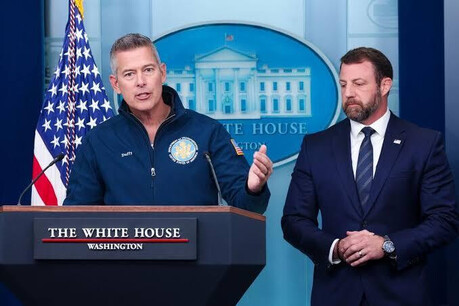


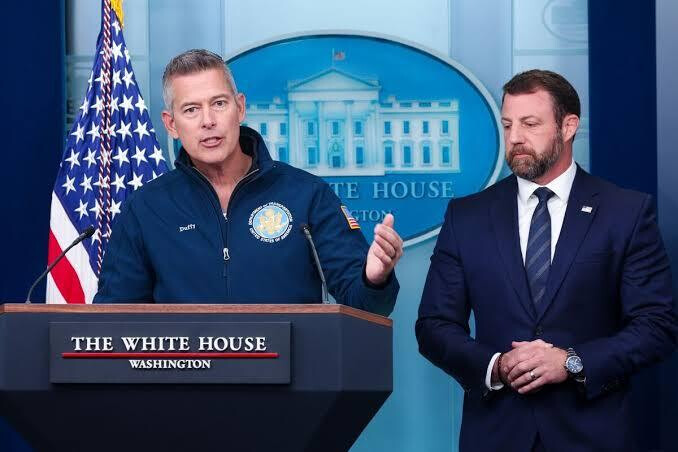
WASHINGTON — Following a nationwide ground stop that halted U.S. flights for over four hours, the severe vulnerabilities of America’s air traffic control infrastructure—which relies heavily on decades-old copper wiring and outdated equipment—have been thrust into the spotlight. Seizing on the crisis as a lever to enact change, U.S. Transportation Secretary Sean Duffy is mounting an aggressive push for massive investment in aviation communication systems.
According to The Wall Street Journal, Secretary Duffy warned Congress on Sunday that failing to approve $50 billion by the end of the year could lead to further disruptions—and potentially worse consequences. The Department of Transportation initially requested $30 billion for Federal Aviation Administration (FAA) modernization, but Duffy asserts that an additional $20 billion is urgently needed.
Throughout the weekend, Duffy made appearances across five television networks and held two press conferences to persistently make the case for expanded investment. Speaking on NBC’s Meet the Press, he remarked, “You can’t blame either the Republicans or the Democrats. This is the result of underinvestment spanning 25 and 30 years, for which both parties are responsible.”
However, his appeal has met with some skepticism in Congress, as a lame-duck legislature navigates a major transition of power. Rep. Jim Himes (D-Conn.), appearing on CBS’s Face the Nation, questioned how funds previously allocated by Congress were utilized, pointing out that the current crisis is “a matter of priorities, not necessarily an immediate spending issue.”
$12.5 Billion Approved, but It’s Just a Drop in the Bucket—“Some Equipment Is 25 Years Old”
Last year, Congress approved $12.5 billion as initial funding to kickstart the modernization of the air traffic control system. Significant portions of copper wiring have already been replaced with fiber-optic cables, and new runway safety technologies have been introduced at dozens of airports. Staffing shortages have also begun to ease following the introduction of financial incentives and retention bonuses for controllers who completed training programs in 2025.
Even so, the need for further investment remains undeniable. According to reports from The Washington Post and the U.S. Government Accountability Office (GAO) on Sunday, the U.S. air traffic control network has relied on copper-line infrastructure installed as far back as the 1960s. Some equipment has reportedly been held together using electrical tape, while core communication routers include devices roughly 25 years old that should have been replaced back in 2006. The Washington Post noted that the copper-based network has grown so technologically obsolete that telephone companies no longer support the relevant technology.
The recent aviation chaos occurred precisely during the process of replacing this aging network. According to the FAA, during modernization efforts on Friday to install new equipment, excessive data generation at facilities in Arkansas and Texas overwhelmed the nationwide air traffic control network. With connection signals flooding in at a rate of over 1,000 requests every 4 to 5 seconds, communication networks at 17 of the nation's 22 air route traffic control centers destabilized, ultimately forcing the FAA to issue a nationwide ground stop.
A November 2023 report commissioned by the FAA from aviation safety experts warned that unexpected disruptions during the decade-long transition to a new communication system could risk severing communications across the U.S. air traffic control network. Similarly, the FAA designated the air traffic control network as one of the highest-level risks to national airspace safety in July of that year. Furthermore, a September GAO report criticized the FAA for prioritizing the speed of modernization projects over cost uncertainty and the risk of flight disruptions.
The report pointed out that while the FAA’s modernization initiative involves more than 11,000 individual tasks, the agency lacks a comprehensive, integrated master schedule to manage them collectively. Despite these shortcomings, federal officials maintain that the aging system must continue to be replaced. FAA Administrator Bryan Bedford emphasized that modernization efforts must push forward, stating, "If we don't replace it, it's going to keep breaking."
[Copyright (c) Global Economic Times. All Rights Reserved.]