![[등록] 2026-09-01 15:48:31](/support/_updata/banner2/tl181982910_6749.png)


On June 22, 2025, Paraguay faces deep environmental challenges, amidst the legacy of a famous remark by a former president: "Use and abuse Paraguay to your heart's content." This statement opened the door to a new form of exploitation of Paraguay's rich resources, a problem that has accumulated over a long time but has never been so blatantly evident until now.
Extensive land grabbing by foreign capital, monoculture farming using environmentally harmful pesticides and seeds banned in other countries, and the current reality of cryptocurrency mining and the construction of other energy-intensive large-scale industrial facilities demonstrate that Paraguay's national project is moving towards increasingly marginalizing its people for the benefit of a few.
What has been mentioned so far merely retraces the familiar workings of economic and political power. In Paraguay, this power often consists of the same entities or is closely intertwined. However, what we rarely consider is what happens when their plans don't go as intended. For example, what if the toxicity of a seed is proven, and it can no longer be distributed? What about pesticides?
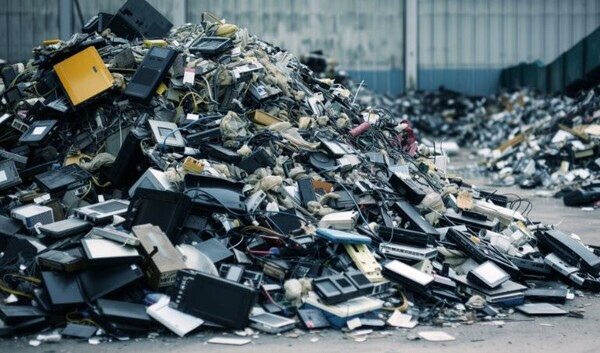
The Food and Agriculture Organization of the United Nations (FAO) defines 'obsolete pesticides' as all pesticides remaining in stock that can no longer be used for their original purpose for any reason. This includes substances banned internationally or nationally, unlabeled products, those with altered containers, or unknown products exposed to moisture or high temperatures. This literally constitutes toxic waste. Globally, hundreds of thousands of tons of hazardous obsolete pesticides are left unattended, threatening humans and the environment, with insufficient funds and facilities to manage them.
The Paraguayan state, too, has accumulated enormous quantities of pesticides and toxic waste in various agencies under the former Cotton and Tobacco Inspection Office (OFAT) for a long time. In 2003, a large fire in the Asunción office, where insecticides and pesticides mixed with other substances, generated vast amounts of toxic waste. This incident served as a warning about the environmental risks posed by stored toxic materials. At the time, the spillage of toxic substances reached the Paraguay River, and there were approximately 2,500 tons of expired pesticide-treated cotton seed stocks. A significant portion of this was professionally disposed of in the UK about 15 years ago.
However, the problem is ongoing. This April, the National Service for Plant and Seed Quality (Senave) issued a highly ambiguous tender, seemingly blocking the possibility of a solution. The tender conditions do not require safe destruction and make no mention of international standards. Even more concerning is that it allows the contractor to decide whether to "store" or "dispose" of the residues. How will they dispose of them? Bury them in forgotten villages? Incinerate them in the open air? Dump them in rivers? The document does not specify, so we do not know.
This is clearly an obscene act. While other serious countries send hazardous waste to specialized treatment facilities, Paraguay is playing Russian roulette with public health. If the state is incapable of properly managing poisons, what legitimacy does it have to regulate pesticides used on farmlands? What moral authority does it have to speak of "sustainable development" in international forums?
Paraguay's waste management infrastructure is extremely vulnerable. Although an environmental impact assessment system was introduced in 1993, a lack of personnel makes it difficult to maintain and verify the implementation of environmental impact mitigation facilities, and there is an urgent need to establish a systematic post-management system. In 2009, a new law on waste management was enacted, placing responsibility and financial burdens for waste on producers and requiring local governments to establish waste laws, but legislation for hazardous substance treatment is still insufficient. The number of waste management personnel per 10,000 people is far below the average for Latin America, as well as neighboring countries like Brazil and Uruguay.
This situation is a result of the state avoiding environmental responsibilities and focusing solely on short-term economic gains. The complete mismanagement of toxic waste can cause irreversible damage to the health of the Paraguayan people and the natural environment. Without the establishment of a responsible and transparent waste management system, any discussion of "sustainable development" will be nothing but an empty cry. Even on this sunny Sunday, we cannot help but feel bitter as we ponder these questions. Where will Paraguay's future truly lead?
[Copyright (c) Global Economic Times. All Rights Reserved.]