

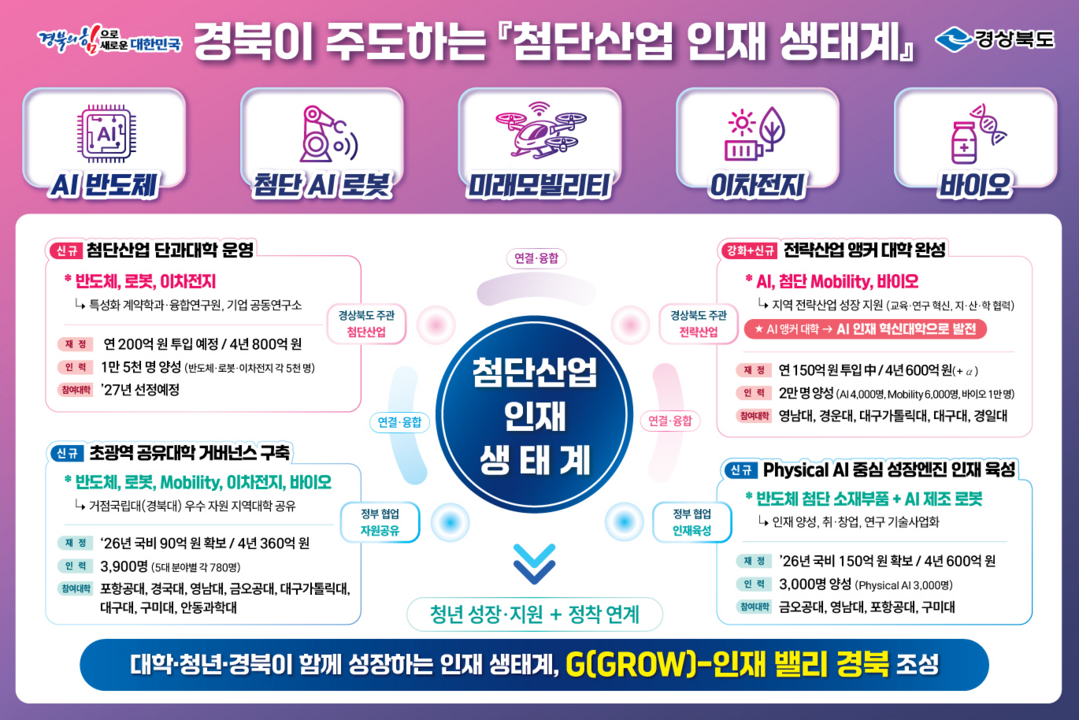
Gyeongsangbuk-do concentrates resources on nurturing talent needed for the 5 major advanced and strategic industries in the Daegu-Gyeongbuk region.
Transforming local universities into core hubs for advanced industries and establishing a joint talent development system with businesses.
Governor Lee Cheol-woo: "More authority and fiscal power must be transferred to local governments, along with strengthened accountability."
Gyeongsangbuk-do (North Gyeongsang Province) will invest 236 billion KRW over four years to focus on nurturing talent needed in the five major advanced and strategic industries of the Daegu-Gyeongbuk region: ▲AI Semiconductors, ▲Advanced AI Robotics, ▲Future Mobility, ▲Secondary Batteries, and ▲Bio.
On the 24th, the province announced its plan to build a Gyeongbuk-led "Advanced Industry Talent Ecosystem" through a press briefing, stating it will cultivate approximately 42,000 specialists in advanced and strategic industries. The goal is to secure industrial competitiveness and attract related companies by supplying the right talent in a timely and abundant manner.
Governor Lee Cheol-woo of Gyeongsangbuk-do stated, "In the era of artificial intelligence, nurturing and securing creative talent is paramount. Centered around universities—the cradle of talent development—we will supply high-tech talent abundantly and on time."
He emphasized, "We will open a new era of growth for Gyeongbuk by ▲turning local universities into core hubs for advanced industries, ▲building a joint talent development system where local universities and companies raise talent together, and ▲creating a youth growth pathway where young people learn, work, and settle in the region."
Governor Lee also stressed, "For high-tech industry promotion policies to succeed, more authority and financial resources must be transferred to metropolitan local governments that best understand local realities, accompanied by stronger accountability. The central government must empower local sites and support local governments in preparing for the future on their own so that talent development—a century-long national plan—can be continuously pursued."
The Gyeongbuk-led "Advanced Industry Talent Ecosystem" will be implemented through four interconnected and converged projects: ▲Operating Advanced Industry Colleges, ▲Completing Strategic Industry Anchor Universities, ▲Building a Supra-Regional Shared University Governance, and ▲Nurturing Growth Engine Talent.
The total project budget for the four initiatives is 236 billion KRW, with 59 billion KRW allocated for 2027. The funding has already been secured through central government public contest selections and Gyeongbuk anchor project funds.
First, Operating Advanced Industry Colleges is an 80 billion KRW project aimed at nurturing talent in three core sectors: semiconductors, robotics, and secondary batteries. Universities and companies will become co-designers of talent development, establishing specialized contract departments (customized education), specialized convergence research institutes, and corporate joint research centers. Through this, the province plans to train 15,000 specialists and will select training institutions early next year via a public contest among universities in the province.
Completing Strategic Industry Anchor Universities invests 60 billion KRW in cultivating talent in AI, advanced mobility, and bio sectors, supporting regional strategic industry growth through educational/research innovation and industry-academia-research cooperation. In particular, it aims to train 20,000 specialists by operating the Gyeongbuk AI Convergence Center, conducting joint corporate projects in aerospace and defense, and running bio-convergence majors. Five universities—Yeungnam University, Kyungwoon University, Daegu Catholic University, Daegu University, and Kyungil University—are participating.
The Supra-Regional Shared University Governance project shares the outstanding resources of Kyungpook National University (the flagship national university of the Daegu-Gyeongbuk region) with specialized local universities. With an investment of 36 billion KRW, eight universities in Gyeongbuk, universities in Daegu, companies, and research institutes will participate. Focusing on the five major industries (robotics, semiconductors, secondary batteries, mobility, and bio), the project will promote joint curricula, industry-academia joint research, sharing of top resources, and collaboration on basic academic and liberal arts tasks to nurture 3,900 talents. Students will utilize inter-university credit exchanges and joint certifications, while companies will gain access to technologies and equipment across multiple universities.
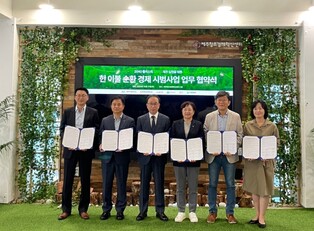
Nurturing Growth Engine Talent is hosted by Gyeongsangbuk-do and Kumoh National Institute of Technology (KIT), with participation from Daegu City, regional universities, companies, high schools, and research institutes. Having received an "S" grade in a government contest, it will receive 60 billion KRW. Together with eight regional universities including KIT and local semiconductor and robotics firms, Gyeongbuk plans to train 3,000 specialists in Physical AI-based semiconductor materials/parts/equipment and AI manufacturing robotics. Core initiatives include "One-Campus" (mutual recognition of joint education and credits among 8 universities), "One-Career" (linking employment/startups with regional settlement), and "One-Chain" (combining corporate-demand joint research and technology transfer).
Gyeongsangbuk-do plans to link and converge these four projects to maximize synergy. To achieve this, the province will launch an "Advanced Industry Talent Ecosystem Task Force (TF)" composed of universities, companies, and public/research institutes to establish governance for sector-specific training, joint research, and equipment sharing, while continuously fostering talent in emerging technologies.
Furthermore, the province will integrate university development with youth talent policies to create a model where young people learn, work, grow, and settle in Gyeongbuk—nurturing talent through the university anchor system, supporting growth and challenges via youth policies, and connecting to regional settlement through initiatives like K-U City.
[Copyright (c) Global Economic Times. All Rights Reserved.]