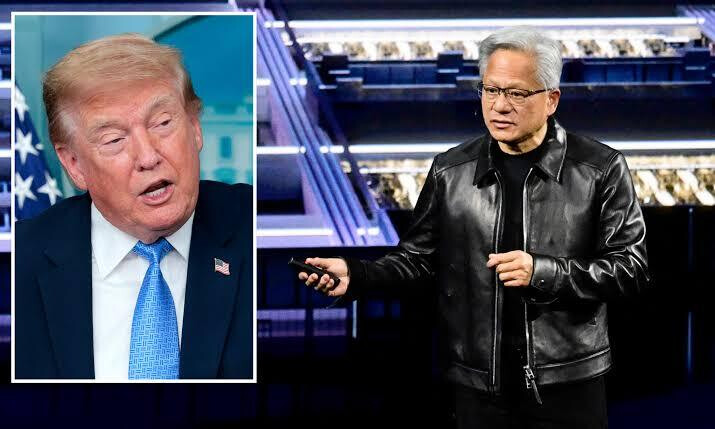
WASHINGTON — U.S. President Donald Trump and Vice President JD Vance played pivotal roles in engineering the sudden reinstatement of Nvidia Chief Executive Officer Jensen Huang on Monday, driven by urgent economic concerns and fierce artificial intelligence competition with China.
According to multiple sources familiar with the matter, Trump took direct command of the effort to bring Huang back to the helm of the chipmaking giant following his recent ouster. Over the weekend, Trump reportedly instructed Vance—who maintains deep ties to Silicon Valley—to hold private talks with Huang and lobby Nvidia’s board of directors. Trump himself also joined a board meeting remotely on Sunday to advocate for Huang's return, reassuring directors that the executive faced no criminal prosecution and posed no threat to national security.
The administration's extraordinary intervention into the governance of a private technology firm highlights the critical role Nvidia plays in the broader U.S. economy. As the world's leading supplier of AI semiconductors, Nvidia anchors a massive capital ecosystem in which its investments in data centers and AI startups routinely cycle back into purchases of its next-generation graphics processing units (GPUs).
Financial analysts note that the White House viewed Huang's controversial departure as a manageable risk compared to the potential destabilization of the booming AI sector and the stock market.
"I persuaded them and got it done," Trump stated in a broadcast interview on Monday, adding on his social media platform, Truth Social, that Huang’s return was essential to guaranteeing "the continued success and prosperity of not only the company, but the American economy." Following the announcement of Huang's reinstatement, Nvidia's stock saw an immediate rebound.
Vance’s involvement proved instrumental in bridging the gap between Washington and Silicon Valley. A former venture capitalist backed by prominent tech investors such as Peter Thiel, and closely aligned with White House science and technology advisor David Sacks, Vance leveraged his network to help ease the board's concerns regarding the recent scandal.
The move has sparked debate among corporate governance experts over the blurring lines between state policy and private enterprise. Shivaram Rajgopal, a professor at Columbia Business School, observed that with the federal government holding significant sway over the company's direction, Nvidia increasingly resembles a state-backed enterprise—operating under the dual perception that the firm is "too big to fail" and its founder is "too vital to fire."
Meanwhile, the development drew sharp reactions in Beijing. China's state-run Global Times framed the Nvidia board’s clearance of Huang on national security grounds as proof that prior allegations of Chinese espionage tied to the company were unfounded. However, Chinese Foreign Ministry spokesperson Guo Jiakun declined to offer official comment on Huang's reinstatement during a regular press briefing on Tuesday.
[Copyright (c) Global Economic Times. All Rights Reserved.]