![[등록] 2026-09-01 15:48:31](/support/_updata/banner2/tl181982910_6749.png)


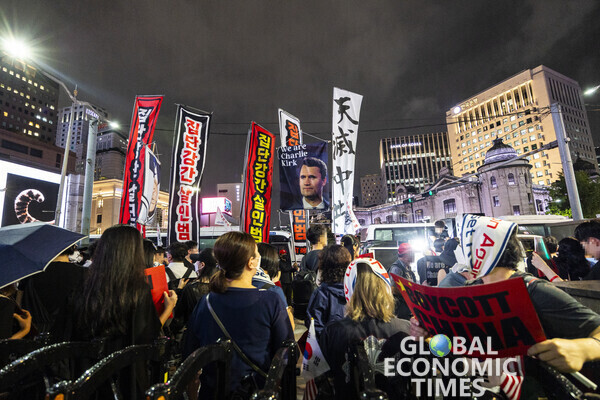
SEOUL, South Korea - South Korea is currently grappling with a rise in anti-China protests led by far-right groups, an unsettling development that is being viewed not merely as a social conflict but as a profound test of the nation's democratic principles. These public demonstrations, featuring xenophobic slogans like "China Out" and calls for a total ban on Chinese entry, have become a visible feature in high-traffic areas like Seoul's Myeong-dong shopping district, attracting sharp criticism from the nation's leadership and stirring a national debate on freedom of expression versus the dignity of minority groups.
The Political Mobilization of Hate
The current wave of anti-China sentiment is not an isolated outpouring of civilian frustration; rather, it's a strategically politically mobilized phenomenon. The protests often frame Chinese nationals as a security threat, spies, or a source of societal destabilization. This rhetoric was notably deployed during the political upheaval following the December 3rd martial law proclamation, where conspiracy theories about "electoral fraud involving China" were circulated to deepen domestic political divides. This mechanism of externalizing social anxiety and political instability by designating a specific group as a threat is a classic tool of political mobilization through hate.
President Lee Jae-myung has publicly condemned the actions, particularly those targeting tourists in Myeong-dong, dismissing them as an uncivilized "nuisance" that damages the national interest and image, not a legitimate exercise of free speech. The president's strong stance has been followed by police warnings against hate speech, though judicial rulings have sometimes suspended restrictions on protests, highlighting the complex legal tightrope South Korea is walking between protecting free assembly and preventing hate speech.
A Mirror to Japan's Anti-Korean Hate Speech
This current landscape in South Korea bears a striking resemblance to the anti-Korean demonstrations (Hate Speech Protests, or Kenkan) that swept Japan starting in the 2000s, primarily driven by the ultra-nationalist group Zaitokukai. Chants like "Koreans out of Japan" and accusations of criminality against the Zainichi Korean community were common, fueled by economic stagnation, historical enmity, and ethnic exclusionism.
The structural parallels are clear:
Framing as a Threat: Both movements categorize the target group—Koreans in Japan, Chinese in South Korea—as an existential threat, whether to national security, purity, or economic well-being.
Political Utility: Both are used by far-right groups to consolidate support and increase political leverage, with the Korean case being particularly alarming as some politicians have reportedly endorsed anti-China discourse, bridging extremist narratives with the political mainstream.
Anxiety Displacement: Economic fears and political friction are deliberately redirected into ethnic antagonism, often relying on outright misinformation (e.g., falsely blaming the opposition for the Yoon Suk-yeol government's visa-free policy).
The Imperative for Institutional Response
Japan's experience, though imperfect, offers a crucial lesson for South Korea. The rise of anti-Korean hate speech ultimately prompted an institutional response: the passage of the Hate Speech Elimination Act in 2016. While lacking criminal penalties, the law was a significant step, officially declaring that hate speech is socially unacceptable in public spaces. Furthermore, landmark civil court cases—such as the one involving the Utoro village, where the court ordered damages for severe dignity violation—significantly curbed the prevalence of aggressive, public hate rallies. Germany provides a more stringent example with its Network Enforcement Act (or 'Facebook Law'), which addresses hate speech even on online platforms.
For South Korea, the consensus among human rights advocates is that legislative action to regulate hate speech is no longer optional.
"Freedom of expression must be respected, but it cannot be a license to trample on the dignity of a specific group," argues one local civil society leader.
Proponents argue that the National Assembly must prioritize the enactment of a comprehensive Anti-Discrimination Act or a dedicated Hate Speech Act. Parallel efforts are also needed at the local government level through hate-response ordinances, coupled with a broader societal effort to cultivate sensitivity against hate .
The current anti-China protests are more than just a passing clash; they are a crucible for South Korean democracy. How the nation responds, whether by implementing robust legal frameworks to protect minority dignity or by allowing hate to fester under the guise of free speech, will determine its trajectory as a mature, inclusive democracy. Tolerance for hate is not an exercise of freedom; it is a toxin that corrodes the democratic social fabric. Moving toward a politics of solidarity rather than hate is now a defining national challenge.
[Copyright (c) Global Economic Times. All Rights Reserved.]