![[등록] 2026-09-01 15:48:31](/support/_updata/banner2/tl181982910_6749.png)


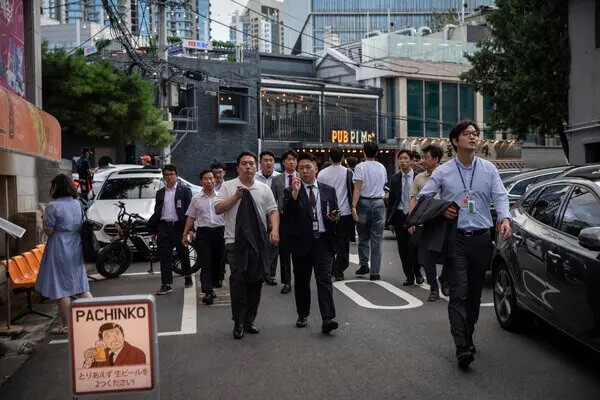
(C) NY Times
The South Korean retail industry is currently experiencing a strong wave of voluntary redundancy—euphemistically termed 'hopeful retirement' (희망퇴직)—as major companies across various sectors, including convenience stores, general retail, food & beverage, duty-free, and e-commerce, rush to cut costs through workforce restructuring. This trend is driven by severe headwinds such as prolonged domestic economic stagnation, high inflation, and rising raw material costs.
Traditionally, voluntary redundancy programs targeted employees in their 50s. However, recent developments show a significant expansion of the target demographic, now including employees as young as 40 years old and even those in lower-ranking, shorter-tenure positions.
Convenience Store Sector Leading the Restructuring
The convenience store sector is a prime example of this trend. According to the Financial Supervisory Service's electronic disclosure system, the combined number of employees at GS Retail, BGF Retail, and Korea Seven (Seven Eleven) totaled 10,261 in the third quarter of 2025, marking a 2.09% (219 people) decrease compared to the same period last year.
Emart24: On December 9, Emart24 announced its 'Career Renewal' program, targeting managers at the Bu-jang (Department Head) level and above. The company offers a competitive package to encourage departures: 24 months of monthly salary plus severance pay, along with a career transition allowance of 10 to 20 million KRW. Alternatively, employees can choose an entrepreneurial support option, receiving 12 months of special severance pay plus start-up funds and costs for opening an Emart24 franchise. Common benefits include a 15 million KRW living allowance, a 2 million KRW travel voucher, and a five-year extension of employee discounts at Emart, Starbucks, and Emart24.
GS Retail (GS25): Last month, GS Retail conducted a similar program for employees meeting certain age and tenure criteria, reportedly offering 1.5 times the annual salary as severance pay, along with support for children's tuition.
Seven Eleven (Korea Seven): This is the second consecutive year that Seven Eleven has implemented voluntary redundancy.
BGF Retail (CU): Due to the slowdown in the industry, BGF Retail even skipped its regular public recruitment drive in the second half of this year.
Major Corporate Groups Follow Suit
Group-level workforce efficiency measures are also prevalent. Lotte Chilsung Beverage, for the first time in its 75-year history, implemented voluntary redundancy for employees with over 10 years of service and born before 1980. The package includes 20 months of severance pay (including base salary, bonuses, and allowances), a 10 million KRW reemployment support fund, and a 10 million KRW allowance for children's education. Similarly, Lotte Wellfood is conducting a program targeting employees aged 45 and above with over 10 years of service.
As of the first half of this year, Lotte Chilsung and Lotte Wellfood saw their respective employee counts drop by 3.29% (175 people) and 4.27% (253 people) compared to the same period last year. Homeplus, which stopped public recruitment in January and only conducts rolling recruitments, experienced the departure of 18% of its staff in the Busan-Ulsan-Gyeongnam region through voluntary redundancy late last year, incurring a cost of 10 billion KRW in severance payments alone.
The growth of e-commerce following the COVID-19 pandemic also drove workforce reductions at major hypermarkets. Lotte Mart’s employee count fell from approximately 13,000 in June 2019 to 10,245 in June 2023, while Emart's dropped from about 25,000 to 23,000. The duty-free sector (Lotte, Shinsegae, HDC Shilla, etc.) is also downsizing through both redundancy programs and the relinquishing of business licenses.
E-Commerce Sector Joins the Trend
E-commerce companies like SSG.com, Gmarket, and 11th Street have also implemented restructuring. Notably, 11th Street included employees with as little as one year of service in its program.
The core reasons for this mass restructuring are the ongoing economic downturn and intense pressure to cut costs. Delayed domestic recovery, coupled with rising raw material, logistics, and labor costs, along with the adoption of AI for efficiency, are accelerating the workforce adjustments.
Industry experts express concern that the thinning of the middle-management layer—epitomized by the departing 'Kim Bu-jangs' (Manager Kims)—could lead to delayed decision-making, the burnout of junior employees, and a decline in service quality. One official commented, "While restructuring is inevitable, it must be paralleled with increased investment in digital transformation, such as AI, to secure long-term competitiveness."
Meanwhile, the political sphere is considering legislation to extend the mandatory retirement age to 65, a move that, if passed, could impact future labor dynamics in the retail sector.
[Copyright (c) Global Economic Times. All Rights Reserved.]