

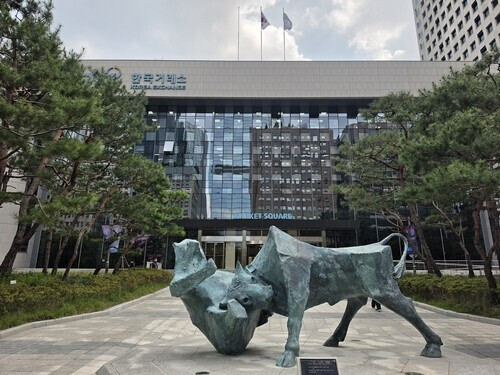
Foreign investors have continued an unprecedented sell-off in the South Korean stock market this year, net-selling over 252 trillion won. As the liquidation has heavily concentrated on major semiconductor heavyweights such as Samsung Electronics (005930) and SK Hynix (000660), Samsung's foreign ownership ratio has plummeted to its lowest level since the global financial crisis.
While the intensity of foreign selling has recently eased, expectations for a supply-demand recovery are gradually emerging. Brokerage industry experts view the return of foreign capital as a core catalyst for a KOSPI rebound. Key upcoming events—such as NVIDIA’s earnings release, Anthropic’s potential listing, and the release of the U.S. Federal Open Market Committee (FOMC) minutes—are expected to serve as turning points for a shift toward net buying.
According to the Korea Exchange on the 17th, Samsung Electronics’ foreign ownership stood at 46.06%, significantly below its long-term average of 50.09% recorded since November 25, 1996.
Notably, on the 9th, the foreign stake briefly dipped to 45.93%, marking the lowest level in roughly 17 years since July 2009, right after the global financial crisis.
SK Hynix is facing a similar trend. As of the 16th, its foreign ownership recorded a yearly low of 47.87%. While still higher than its historical average of 30.7%, it marks the lowest level in about five years, dating back to November 2021.
This sharp decline in foreign ownership stems from massive net selling accumulated throughout the year. Foreign investors have net-sold a staggering 252.58 trillion won in the KOSPI market this year alone. Out of this total, net sales of Samsung Electronics reached 103.37 trillion won, while SK Hynix saw 108.66 trillion won leave the market. Combined, these two stocks account for approximately 84% of the entire net-selling volume.
The intensity of the sell-off has also been remarkably fierce—so much so that it is hard to compare with past market crashes. The top 41 largest single-day foreign net-selling records in history all occurred this year, surpassing even the turbulence seen during the COVID-19 pandemic in 2020 or the sluggish market in 2021.
Market analysts attribute this massive foreign exodus to a mix of uncertainties surrounding artificial intelligence (AI) investments and growing skepticism regarding the sustainability of South Korea's economic growth.
An industry insider noted, "Earlier this year, many U.S. hedge funds with little prior experience in the Korean market rushed in, but they appear to have since withdrawn their capital after realizing the market's structural limitations. Beyond uncertainties in the semiconductor industry, doubts over whether Korean companies can maintain their competitive edge in the global AI hegemony race have also fueled the sell-off."
Nevertheless, signs that the selling pressure is stabilizing offer a glimmer of hope. Foreign investors were net buyers on the KOSPI for three consecutive trading days from the 10th to the 12th. Although they have since returned to a net-selling stance, the overall intensity has softened significantly compared to the periods when they dumped 3 to 4 trillion won worth of shares daily.
Lee Kyung-min, an analyst at Daishin Securities, pointed out, "Since October, the correlation between foreign supply-demand and the KOSPI has reached 0.97, showing how heavily foreign flows dictate the market direction. As the selling pressure moderates and if the strengthening trend in the Korean won continues, a pivot to net buying can be anticipated."
Lee added, "With South Korea's weight in global portfolios dropping from 10.7% in June to 6.7%, foreign investors have ample room to buy back in. If NVIDIA’s earnings and the FOMC minutes trigger concurrent net-buying in both spot and futures markets by foreigners, a re-challenge toward the 6,000 mark on the KOSPI becomes achievable."
In the short term, however, the trajectory of U.S. interest rates remains a critical variable for the return of foreign funds. Even if major events like NVIDIA's earnings and Anthropic's IPO unfold positively, a rise in U.S. Treasury yields could cap foreign buying momentum.
Lee Jae-man, an analyst at Hana Securities, warned, "With the U.S. 10-year Treasury yield hovering above 5%, any further increase could diminish the relative investment appeal of equities compared to bonds. It is necessary to keep the possibility of rising short- or long-term yields in mind ahead of the December 9 FOMC rate decision."
[Copyright (c) Global Economic Times. All Rights Reserved.]