![[등록] 2026-09-01 15:48:31](/support/_updata/banner2/tl181982910_6749.png)


(C) Seoul Museum of History
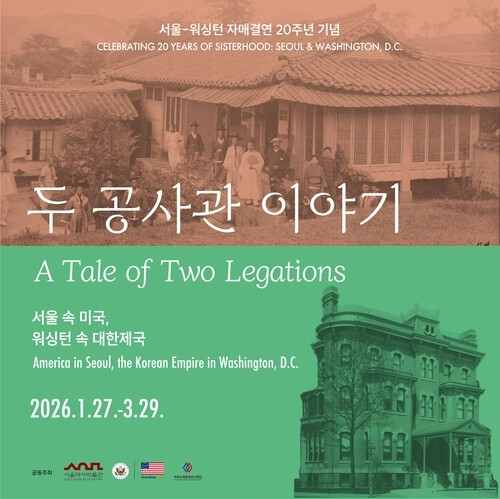
SEOUL — In a poignant tribute to over a century of diplomatic history and two decades of modern partnership, the Seoul Museum of History announced on Monday the opening of a special exhibition: "America in Seoul, Korea in Washington: The Story of Two Legations."
The exhibition, co-organized with the U.S. Embassy in Seoul and the Overseas Korean Cultural Heritage Foundation, commemorates the 20th anniversary of the sister-city agreement signed between Seoul and Washington D.C. in 2006. Running from January 27 to March 29, 2026, the showcase offers a rare glimpse into the architectural and diplomatic roots of the ROK-U.S. alliance.
A First Look at 19th-Century Diplomacy
The centerpiece of the exhibition is the world premiere of the "Layout Plan of the U.S. Legation in Korea," an original document dating back to 1895. This architectural map provides a meticulous record of the U.S. Legation’s grounds in Jeong-dong, a district in central Seoul that served as the primary hub for foreign diplomacy in the late Joseon Dynasty.
The document reveals a fascinating historical nuance: rather than tearing down local structures to build Western-style edifices, early American diplomats chose to reside and work within traditional Korean Hanoks. By adapting these wooden-tiled houses into diplomatic offices, the U.S. mission demonstrated a profound level of cultural respect and coexistence—a gesture that laid the groundwork for the enduring "blood alliance" recognized today.
Parallel Histories: Seoul and Logan Circle
The exhibition invites visitors to compare two distinct physical spaces that served as the front lines of sovereignty:
The U.S. Legation in Seoul (Jeong-dong): Where American officials navigated the complexities of a changing Joseon Dynasty from within the walls of a traditional Korean courtyard.
The Korean Legation in Washington D.C. (Logan Circle): A Western-style Victorian building where the Korean Empire (Daehan Jeguk) fought to maintain its independent voice on the global stage amidst growing imperial pressures in the late 19th century.
"This exhibition is a journey through two different spaces—the Hanok and the Western-style building—that marked the beginning of our diplomatic ties," said Choi Byung-goo, Director of the Seoul Museum of History. "It traces how these sites have evolved from diplomatic outposts to cultural heritages that have been reclaimed, restored, and honored by both nations."
Interactive History and Anniversary Celebrations
To bridge the gap between academic history and modern pop culture, the museum has installed a dedicated photo zone inspired by the hit historical drama Mr. Sunshine. The set recreates the cinematic atmosphere of the early 20th-century U.S. Legation, allowing visitors to step into the shoes of the characters who navigated that turbulent era.
The museum is also planning a series of special events for March 13, the official anniversary date of the Seoul-Washington D.C. sisterhood.
Visitor Information
The exhibition is held in the 1st-floor lobby gallery of the Seoul Museum of History.
Admission: Free
Hours: 9:00 AM – 6:00 PM (Extended until 9:00 PM on Fridays)
Duration: January 27 – March 29, 2026
The Significance of the "Two Legations"
The story of these two buildings is more than a study of architecture; it is a narrative of survival and mutual recognition. The Korean Legation in Washington D.C. holds a particularly emotional place in Korean history. Purchased by King Gojong in 1891, it was the "heart" of Korean diplomacy in the West until it was seized by Japan in 1910. Its successful restoration and reopening as a museum in 2018 became a symbol of Korea’s reclaimed sovereignty.
Conversely, the U.S. Legation in Seoul remains one of the oldest American diplomatic properties in the world. By showcasing the 1895 layout, the Seoul Museum of History highlights a period when the two nations first looked at each other with curiosity and respect, long before the modern geopolitical landscape was formed.
As Seoul and Washington D.C. enter their third decade as sister cities, this exhibition serves as a reminder that the "Global Comprehensive Strategic Alliance" frequently cited by modern leaders began with a simple map of a Hanok and a Victorian house across the ocean.
[Copyright (c) Global Economic Times. All Rights Reserved.]