![[등록] 2026-09-01 15:48:31](/support/_updata/banner2/tl181982910_6749.png)


[SEOUL] — The United States is actively reorganizing its advanced robotics supply chain around trusted allies and strategic partners, mirroring its national strategy for the semiconductor sector. This structural shift provides a historic opportunity for Hyundai Motor Group, backed by its US-headquartered subsidiary Boston Dynamics, to cement itself as a foundational pillar of the North American robotics ecosystem.
This geopolitical alignment is expected to serve as a vital bridge for expanding the South Korea-US advanced industry alliance, potentially catalyzing domestic suppliers to produce critical components for humanoid robots. Industry observers note that this development could also accelerate the South Korean government's newly proposed initiative to foster an Artificial Intelligence (AI) manufacturing hub in the Southeastern Yeongnam region.
US Legislative Push for Strategic 'Friend-Shoring'
According to automotive and tech industry sources on July 13, the foundational blueprint for the "National Robotics Commission and National Robotics Act" was recently outlined during a comprehensive hearing before the US House Committee on Energy and Commerce. The legislative discussions heavily emphasized that the US government must aggressively expand the deployment of advanced robotics technology while providing robust tax incentives to accelerate domestic industrial growth.
Crucially, congressional leaders proposed that the supply chains for key robotic components—including high-precision sensors, computing processors, actuators, ball screws, and specialized cooling systems—must be built and structured exclusively within the US and its allied nations.
This policy directive is widely interpreted as an extension of Washington's "friend-shoring" strategy, specifically aimed at mitigating vulnerabilities arising from an over-reliance on Chinese-dominated supply chains. It signals a paradigm shift where advanced robotics is no longer viewed merely as a commercial commodity, but as a critical strategic asset directly tied to national security and sovereign manufacturing competitiveness, much like semiconductors and electric vehicle batteries.
Hyundai Motor Group's Synchronized Global Strategy
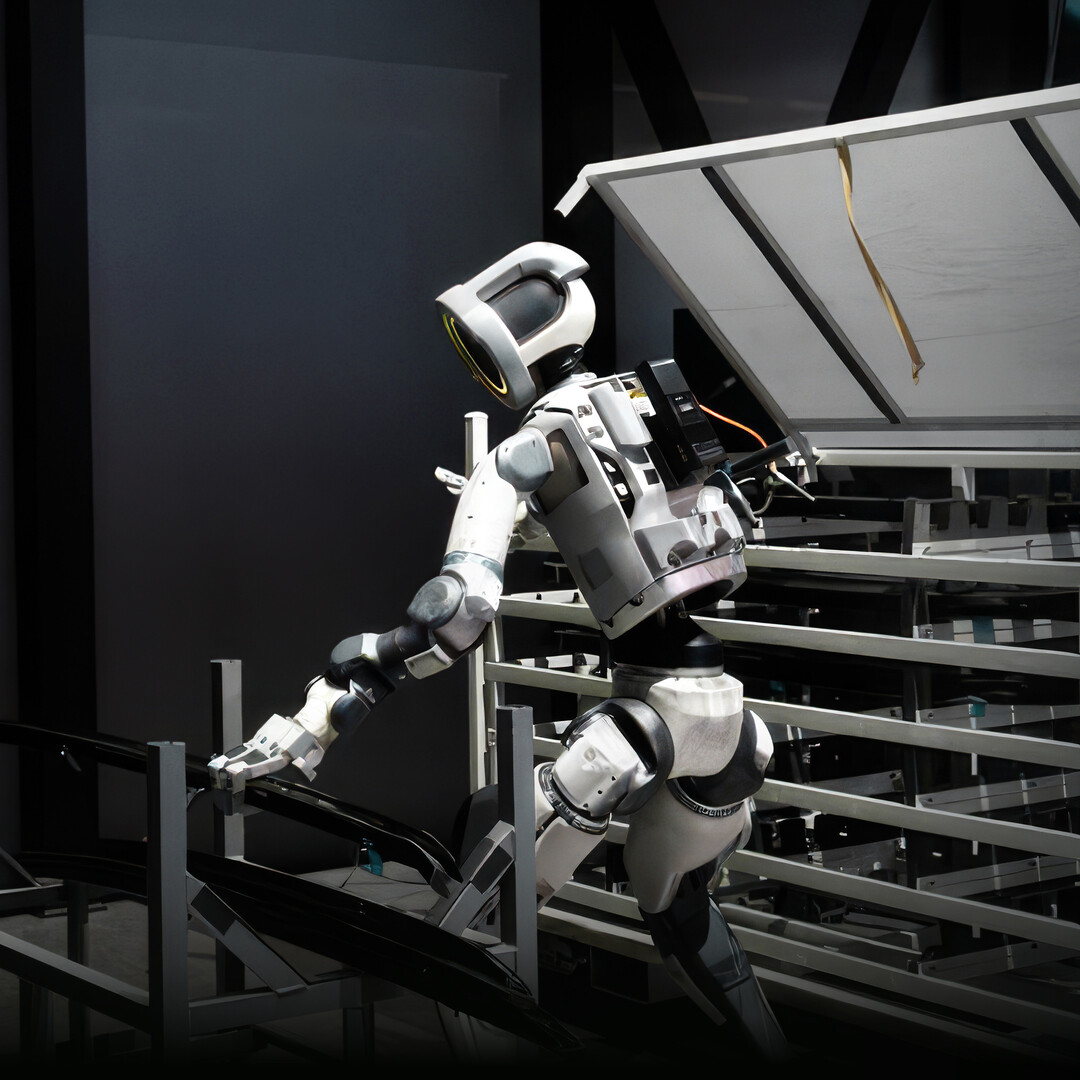
This shifting geopolitical landscape perfectly aligns with the long-term strategic trajectory pursued by Hyundai Motor Group over the past several years. Since its high-profile acquisition of Boston Dynamics in 2021, the South Korean automotive conglomerate has spearheaded the mass production and commercialization of the humanoid robot 'Atlas' and the quadruped robot 'Spot'. The group's ultimate operational objective includes integrating Atlas directly into its global automotive production lines to pioneer the next generation of smart manufacturing innovation.
Prospects for a synchronized Korea-US supply chain have grown increasingly tangible. Boston Dynamics executives recently visited prominent South Korean robotics component manufacturers to evaluate domestic capabilities for supplying core parts, such as next-generation actuators and cycloidal reducers. This move strongly indicates that a highly integrated bilateral value chain—combining American cutting-edge robotic design with South Korean high-precision manufacturing prowess—is rapidly materializing.
Within South Korea, Hyundai Motor Group is systematically parsing out specialized roles across its core subsidiaries to cultivate a robust internal ecosystem:
Hyundai Mobis: Oversees core humanoid actuators and control systems.
Hyundai Wia: Spearheads Autonomous Mobile Robots (AMRs) and logistics automation technologies.
Hyundai AutoEver: Develops integrated System Integration (SI) solutions and centralized control platforms to manage diverse robotic fleets under a unified software framework.
Yeongnam Investment to Anchor the Future Value Chain
The group's massive regional investment strategy in South Korea further reinforces this emerging global robotics roadmap. Hyundai Motor Group recently unveiled a monumental 42 trillion won ($31 billion USD) investment plan spanning the next decade dedicated to the Yeongnam region. The cornerstone of this blueprint is the transformation of the region into an advanced AI manufacturing cluster, anchored by the state-of-the-art Ulsan EV dedicated factory.
Under this regional initiative, Hyundai Mobis will step-by-step deploy specialized assembly lines for battery systems, EV motors, and electronic controllers, while Hyundai Wia will install advanced production infrastructure for thermal management systems. Together, these developments are designed to radically boost future manufacturing competitiveness and serve as the physical production backbone for the global robotics market.
Strategic Outlook and Challenges
Industrial analysts anticipate that as Washington's restrictive robotics supply chain legislation solidifies, Hyundai Motor Group will emerge as an indispensable leader of the transpacific robotics value chain. The organizational synergy is highly compatible with US policy goals: Boston Dynamics handles advanced research, software development, and US-based commercial operations, while South Korean entities provide the high-precision components, manufacturing AI, and scalable production infrastructure.
Nevertheless, experts caution that because the US legislative package is still in its introductory and review phases, anticipating immediate, direct financial windfalls may be premature. Despite these institutional caveats, the consensus remains clear: Washington's formal designation of robotics as a critical national strategy industry will inevitably elevate the intrinsic valuation of the comprehensive robotics ecosystem that Hyundai Motor Group has proactively established.
"The future competitiveness of the robotics industry will no longer be determined solely by isolated individual technologies, but rather by the robustness of the broader supply chain and manufacturing ecosystem," an industry official stated. "As the United States accelerates its friend-shoring initiatives, the strategic footprint and technological contributions of Korean enterprises are bound to expand significantly."
[Copyright (c) Global Economic Times. All Rights Reserved.]