![[등록] 2026-09-01 15:48:31](/support/_updata/banner2/tl181982910_6749.png)


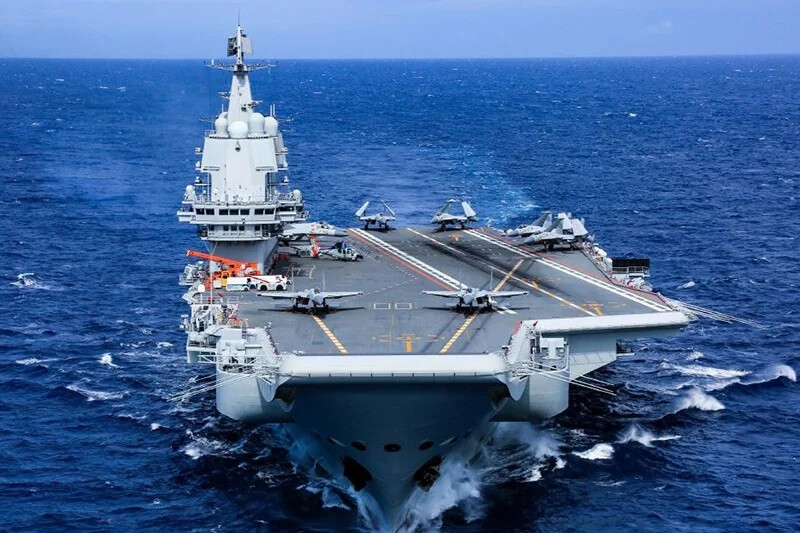
TOKYO, Japan – The Chinese People's Liberation Army Navy (PLAN) aircraft carrier Liaoning (CNS Liaoning, 16) carrier strike group has entered the Pacific Ocean east of the Philippines, setting a new record for its longest-range deployment to date. According to data released by the Japan Joint Staff Office (JSO) on Monday (local time, June 2), the Liaoning carrier strike group sailed further into the Western Pacific than ever before.
Liaoning Carrier Strike Group's Movement Path and Composition
The JSO provided detailed information on the Liaoning carrier strike group's location and composition from May 27 to Thursday (May 29).
Tuesday, May 27, 8 PM: The Liaoning, the cruiser CNS Nanchang (101), and the destroyer CNS Qiqihar (121) were spotted 211 miles south of Miyako Island.
Wednesday, May 28, 8 PM: The Liaoning and the destroyer CNS Tangshan (122) were observed 497 miles south of Miyako Island.
Thursday, May 29, 8 PM: A strike group consisting of the Liaoning, the destroyers Qiqihar, Tangshan, and the fleet oiler CNS Hulunhu (901) was confirmed 640 miles south of Miyako Island.
Over these three days, the Liaoning conducted a total of 140 aircraft launch and recovery operations, including 80 fixed-wing aircraft and 60 helicopter takeoffs and landings. Combining the operations from May 25 and 26, a total of 260 launch and recovery operations were conducted during the five-day observation period. This indicates a gradual improvement in the Chinese Navy's aircraft carrier operation capabilities. In particular, the 80 fixed-wing aircraft launches and recoveries are a key indicator of operational capability, demonstrating a significant level of proficiency and operational efficiency.
Entry into Waters East of the Philippines and Japan's Response
The JSO stated on Friday (May 30) that the Liaoning and several other PLAN vessels sailed south into the Pacific Ocean. According to a map released by the JSO, the Liaoning's position on Friday was marked as being east of Samar Island in the Philippines and west of Guam. This marks the Liaoning's longest deployment, far exceeding its previous deployments which were typically confined to the South China Sea and the Philippine Sea.
The Japan Maritime Self-Defense Force (JMSDF) destroyer JS Umigiri (DD-158) shadowed the Liaoning carrier strike group, and when fixed-wing aircraft launched from the Liaoning, Japan Air Self-Defense Force (JASDF) fighter jets immediately scrambled in response. Japan continues to maintain vigilance over the Chinese Navy's activities and is closely analyzing their impact on its national security.
The JSO's announcement covers the movements of the Liaoning carrier strike group up to Friday, raising the possibility that Japan's tracking and surveillance may have ceased as the strike group moved further away from Japanese waters. The Chinese Ministry of National Defense (MND) has refrained from specific comments regarding this deployment of the Liaoning. However, at an MND press conference last Thursday (May 29), spokesperson Zhang Xiaogang stated that the Liaoning carrier strike group's deployment was a regular and routine exercise in accordance with annual plans. He also dismissed Japan's announcement as an overreaction, stating, "The Liaoning aircraft carrier formation's exercises in the relevant waters are not aimed at any specific country or target and comply with international law and international practice. I think Japan's actions are somewhat of an overreaction."
New Destroyer Enters the Philippine Sea
Meanwhile, last Thursday (May 29), a new People's Liberation Army Navy Type 052D destroyer, along with a PLAN frigate, passed through southwestern Japan and entered the Philippine Sea. The JSO announced on Friday that at 11 PM on Thursday, a Type 052D Luyang III class destroyer with hull number 158 and the frigate CNS Hebi were sighted sailing southeast 74 miles northeast of Miyako Island, subsequently passing between Okinawa and Miyako Island and entering the Philippine Sea. The Japan Maritime Self-Defense Force fleet oiler JS Tokiwa (AOE-423) and a JMSDF P-3C Orion maritime patrol aircraft (MPA) of the 5th Air Group based at Naha Air Base in Okinawa tracked and monitored these PLAN vessels.
Hull number 158 of the Type 052D appears to have been commissioned earlier this year and is known to be part of the Type 052DM (also known as Flight IV) variant of the Type 052D destroyer. This latest variant features improved radar and sonar systems and other upgrades compared to previous Type 052D models. Last December, the first Flight IV, the CNS Dazhou (135), was observed passing through the Miyako Strait into the Philippine Sea. (The lower hull number of the Dazhou is due to the PLAN's practice of reusing the same hull number for new ships with the same name as previous vessels.)
Escalation of Military Tensions in the Asia-Pacific Region
These movements by the Chinese Navy further escalate military tensions in the Asia-Pacific region. China is strengthening its territorial claims in the South China Sea, and military activities around Taiwan are also frequent. The Liaoning carrier strike group's entry into the Pacific is a strong signal that the Chinese Navy is continuously expanding its blue-water operational capabilities. This is interpreted as a potential challenge to the US military presence in the Pacific and a significant tactical move that could shift the regional balance of power.
The United States and its allies are closely monitoring China's naval buildup and aggressive maritime activities and are working to maintain regional stability. In this situation, Japan is one of the countries most closely monitoring the Chinese Navy's movements, preparing for potential threats through intelligence gathering and analysis. The Liaoning carrier strike group's record-breaking deployment is seen as a clear demonstration of China's intent to showcase its naval power and expand its influence. The impact of this on the future security environment in the Asia-Pacific region remains to be seen.
[Copyright (c) Global Economic Times. All Rights Reserved.]