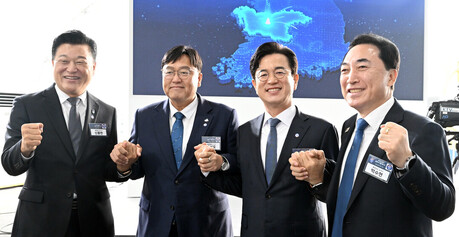
"Just like its name, the national supercomputer No. 6, 'Hangang,' will create a new current of innovation in South Korea's science and technology," said Lee Sik, President of the Korea Institute of Science and Technology Information (KISTI), expressing high expectations during the launch ceremony held at the Daejeon headquarters on the 2nd.
South Korea's First Supercomputer: The CDC-6600 Era
Supercomputers are high-performance systems designed to execute massive calculations and process, analyze, and utilize large volumes of data at high speeds. Officially, a supercomputer is defined as one ranking within the top 500 globally.
The scientific community traces the origins of supercomputing back to 1964, when the United States introduced the transistor-based CDC-6600, capable of performing approximately 1 MFlops (one million floating-point operations per second).
South Korea officially entered the supercomputing era in 1988 with the introduction of Supercomputer No. 1, the CRAY-2S. It featured 1 GB of memory, 40 GB of disk storage, and a measured performance of 1.41 GFlops (1.41 billion operations per second).
The nation’s second supercomputer, the CRAY Y-MP C916/16512, followed in 1993. Equipped with 4 GB of memory and 203 GB of disk storage, it achieved a measured performance of 13.70 GFlops and was widely credited with ushering in an era of popularizing supercomputing applications. Its purchase price at the time was $32.5 million.
Eight years later, in 2001, Supercomputer No. 3—comprising the IBM massive computing system and the NEC high-performance computing system—was introduced, establishing world-class infrastructure.
Subsequent milestones included the deployment of No. 4 systems, Tachyong and Gaia, in 2007, and the launch of No. 5, Nurion, in 2018. Nurion opened the gateway to futuristic research with a theoretical computational performance of 25.7 PFlops (petaflops).
Supercomputer No. 6: 'Hangang'
Designed as a national research infrastructure for the artificial intelligence era, "Hangang" is a massive GPU (Graphics Processing Unit) supercomputer engineered to simultaneously execute large-scale AI training and scientific simulations alongside complex scientific and engineering computations.
Hangang boasts an astounding computational performance of 614.7 PFlops, equipped with 8,496 hard-to-acquire GPUs, 9,936 CPUs (Central Processing Units), and 205 PB (petabytes) of storage space. Ha Jung-woo, Vice Chairperson of the National AI Strategy Committee, evaluated the milestone by stating, "A new stream of South Korean science and technology has opened."
With "peta" denoting one quadrillion, Hangang can perform 61.4 quadrillion calculations per second. Assuming a human performed one calculation per second, it would take roughly 19.4 billion years—surpassing the 13.8-billion-year age of the universe.
Although its official launch ceremony took place on the 2nd, Hangang’s beta service commenced on the 26th of last month. The beta service targeted universities and government-funded research institutes that had previously secured project approvals through an application process opened last May.
As of the 2nd, Hangang has handled 37,771 tasks, is actively processing 493 projects, and has 67 tasks queued. Meanwhile, the 5th-generation supercomputer Nurion supported 1,730 research projects over the past eight years, leading to the publication of 1,520 SCI(E) papers—including nearly 70 papers featured in prestigious journals such as Nature, Science, and Cell and their sister publications—demonstrating exceptional qualitative achievements.
Do We Still Need Supercomputers in the AI Era?
The scientific community expects that even as AI rapidly advances and quantum computers mature, they will remain complementary technologies to supercomputers, as each excels in distinct domains.
Park Chan-yeol, Head of the National Supercomputing Center at KISTI, explained that while AI requires numerous processing units, it primarily infers probable results and does not necessitate ultra-high-performance individual devices. In contrast, supercomputers combine CPUs and GPUs to tackle vastly more complex problems, requiring both a high volume of processors and superior individual performance.
In short, AI learns and infers to generate answers based on patterns and probabilities, whereas supercomputers compute massive-scale science. Meanwhile, quantum computers are anticipated to hold strengths in molecular and material research and cryptography-related calculations.
Traditional domains for supercomputers include meteorological and climate prediction, nuclear fusion and atomic energy research, the development of new drugs and materials, and space and earth sciences—fields that require countless calculations dictated by the physical and chemical laws governing natural phenomena.
Historically, supercomputers have served as catalysts for innovation across industry, academia, and research, facilitating tasks such as domestic automobile crash simulations and engine design, scientific weather forecasting, liquid rocket engine combustion simulations, next-generation battery development, and extreme climate R&D.
Joe Josephides, Vice President of Supercomputing and HPC at NVIDIA, shared in a congratulatory message for the launch event: "Hangang will open new possibilities in high-performance computing application fields, from artificial intelligence to quantum computing. I hope it will serve as core research infrastructure contributing to national projects like the K-Moonshot."
[Copyright (c) Global Economic Times. All Rights Reserved.]