![[등록] 2026-09-01 15:48:31](/support/_updata/banner2/tl181982910_6749.png)


Amid ongoing discussions to expand the list of over-the-counter (OTC) drugs and increase the number of authorized retail stores, a recent survey revealed that a vast majority of existing retailers are failing to comply with legal sales standards.
The findings exposed widespread violations: from stores failing to meet the mandatory 24-hour operation standard, to those neglecting to post usage precautions or selling more than two units of the same item at once. Structural problems were also highlighted, where actual drug sales are handled by part-time shift workers rather than the store owners who received formal safety training.
On the 7th, the Korean Pharmaceutical Association (KPA), in collaboration with Future Consumer Action, released the results of the "2025 OTC Drug Retail Store Inspection" conducted across 1,050 stores nationwide. The KPA asserted that instead of discussing product expansion or easing registration criteria, authorities must first overhaul the management system of the current framework.
97.2% of Retailers Violate Regulations... "Loophole" in 24-Hour Operations and Training
The survey showed that only 2.8% of all surveyed retail stores complied with all legal compliance requirements. Conversely, 97.2% violated at least one regulation.
Among the violating stores, 82.4% simultaneously breached two to four items, with 36.6%—the largest single group—violating three items concurrently.
By violation type, "failure to display the seller's registration certificate" was the most common at 68.8%. This was followed by "selling two or more units of the same item in a single transaction" (55.1%) and "failure to post usage precautions" (50.1%). Cases of failing to maintain 24-hour operations or failing to stock designated products were also confirmed.
Notably, even the fundamental registration requirement of "24/7 round-the-clock operation" was ignored by some stores. Out of the 1,050 stores surveyed, 55 locations (5.2%) were found closed during night hours. For stores outside major convenience store brands (such as CU, GS25, and Seven-Eleven), the night non-operation rate surged to 23.3%.
Given that the OTC drug sales system was originally introduced to secure public access to medicines during late-night hours, a clear gap has emerged between the system's foundational premise and its actual operation.
Blind spots were also identified in seller training. Current regulations require store owners—the registered sellers—to complete safety management training covering drug storage and management, sales compliance, recall of hazardous drugs, and side-effect response.
However, in actual convenience stores, part-time shift workers frequently handle sales to consumers rather than the owners. This creates a structural loophole where the person trained and the person actually selling the medicine can differ.
The KPA pointed out that because medicines, unlike general consumer goods, require proper use and safety management, the current owner-centric training system needs to be expanded to include actual frontline sellers.
Management of usage precautions was also subpar. Usage precautions were missing in 50.1% of the surveyed stores. In an OTC retail environment lacking a pharmacist's consultation, usage precautions serve as essential safety information allowing consumers to verify dosage, administration methods, and potential side effects, underscoring the need for tighter oversight.
Only 12.8% Stock All 11 Items... KPA Urges "Management First, Expansion Later"
The inventory level of drugs in retail stores was also found to be insufficient. Excluding two items whose production has been suspended, there are practically 11 circulating OTC drug items.
However, the survey revealed that stores stocked an average of only 8.2 items. Only 12.8% of all stores fully stocked all 11 items.
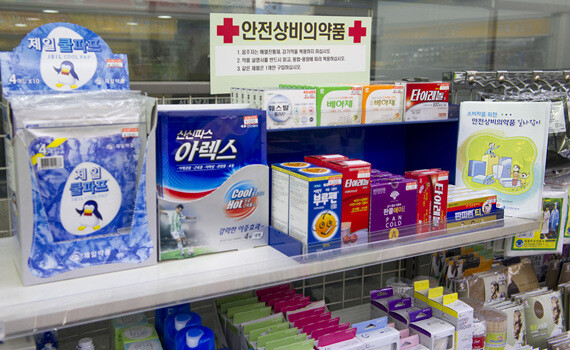
Problems were found not only in product stocking but also in the retail environment. Field inspections uncovered numerous instances where OTC drugs were displayed alongside general goods like food or lifestyle products without being separated into dedicated spaces.
Particularly, some stores displayed painkillers right next to hangover relief beverages.
The KPA warned that such display methods could not only lead consumers to perceive medications as general consumer goods, but also foster dangerous misconceptions, such as thinking "you can take a painkiller together with a beverage if you have a hangover from drinking."
Since acetaminophen-based painkillers require caution when taken after alcohol consumption, the KPA emphasized the necessity of establishing display standards that account for the unique characteristics and safety of pharmaceuticals.
Based on these survey results, the Korean Pharmaceutical Association urged the government to thoroughly inspect the current sales framework before discussing any expansion of OTC drug items or relaxation of store registration criteria.
Specific demands include:
-Conducting a comprehensive nationwide inspection of OTC retail store operations
-Verifying compliance with 24-hour operation standards and tightening oversight
-Reforming the owner-centric training system to encompass actual sellers
-Establishing safe medication display standards
-Strengthening management and supervision of stores violating sales criteria
The KPA maintains its stance that expanding drug accessibility must proceed under the core principle of public safety. They argue that prioritizing a check on whether currently operating stores comply with laws and standards—and closing the blind spots in the management system—must come before increasing the number of products and retail locations.
[Copyright (c) Global Economic Times. All Rights Reserved.]