• 2026.06.27 (Sat)
  • All articles
  • LOGIN
  • JOIN
Global Economic Times
fashionrunwayshow2026
  • Synthesis
  • World
  • Business
  • Industry
  • ICT
  • Distribution Economy
  • Well+Being
  • Travel
  • Eco-News
  • Education
  • Korean Wave News
  • Opinion
  • Arts&Culture
  • Sports
  • People & Life
    • International Student Report
    • With Ambassador
  • Column
    • Cho Kijo Column
    • Cherry Garden Story
    • Ko Yong-chul Column
    • Kim Seul-Ong Column
    • Lee Yeon-sil Column
  • Photo News
  • New Book Guide
MENU
 
Home > Distribution Economy

From Safety Drivers to Fully Autonomous: South Korea to Launch First Unmanned Trucking Service in June

Hwang Sujin Reporter / Updated : 2026-04-19 05:52:40
  • -
  • +
  • Print


SEOUL — The landscape of South Korea’s logistics industry is set for a historic shift this summer. Starting in June, autonomous trucks will officially begin transporting commercial freight on major expressways, marking the nation's first authorized step toward a fully unmanned delivery system.

A Milestone for Autonomous Freight
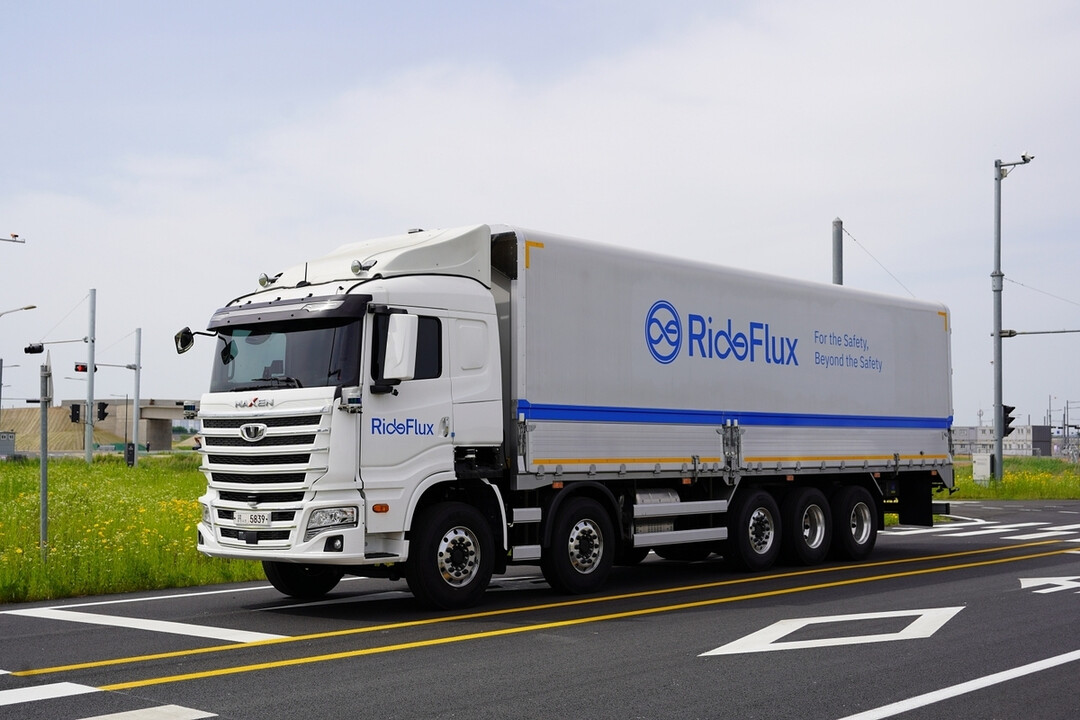
The Ministry of Land, Infrastructure, and Transport (MOLIT) announced on April 16, 2026, that it has granted the first-ever license for paid autonomous freight transportation to RideFlux, a leading domestic autonomous driving startup. This approval signals the beginning of a new era where self-driving technology moves beyond passenger cars and into the heavy-duty world of logistics.

RideFlux is scheduled to operate a 25-ton Tata Daewoo Mobility "MAXEN" truck on a 112-kilometer long-haul route. The route connects the Southeast Logistics Center in Songpa-gu, Seoul, to the Lotte Global Logistics Jincheon Mega Hub Terminal in North Chungcheong Province via the Jungbu Expressway.

Operational Details and Safety Protocols
To ensure safety and minimize disruption to regular traffic, the service will operate three times a week during off-peak hours—specifically between 8:00 PM and 5:00 AM the following day. The truck is programmed to maintain a steady speed of 90 km/h, the standard limit for heavy-duty vehicles on South Korean highways.

The project will follow a rigorous three-stage roadmap to reach full autonomy:

Stage 1 (Current): A safety driver sits in the driver’s seat to intervene if necessary.
Stage 2 (2027 Projected): The safety driver moves to the passenger seat, monitoring the system remotely or via onboard consoles.
Stage 3 (Final): Transitioning to a completely unmanned operation where the vehicle navigates the entire route independently.

Expanding the Horizon of Logistics
The partnership between RideFlux and Lotte Global Logistics is more than just a trial; it is a commercial contract for paid transportation. This economic viability is what sets this project apart from previous pilot tests. Following the initial Seoul-Jincheon route, RideFlux plans to expand its autonomous network to other major hubs, including Jeonju, Gangneung, and Daegu, by the end of this year.

"The first license for paid autonomous freight transport is a monumental leap for the commercialization of this technology," said Park Jun-hyung, Director General for Mobility and Automobiles at MOLIT. "We expect this to address chronic issues in the trucking industry, such as driver fatigue and labor shortages, while significantly enhancing road safety."

The Future of "No-Contact" Delivery
Industry experts suggest that if successful, this initiative will revolutionize the cost structure of the delivery market. Autonomous trucks do not require mandated rest periods, potentially allowing for 24/7 logistics cycles that could reduce delivery times and carbon emissions through optimized fuel consumption.

As South Korea pushes toward a "fully unmanned" goal, the eyes of the global tech community are on the Jungbu Expressway. The success of this 112-kilometer journey could very well dictate the speed at which the rest of the world adopts autonomous freight.

[Copyright (c) Global Economic Times. All Rights Reserved.]

  • #Hormuz Impasse
  • #globaleconomictimes
  • #micorea
  • #mykorea
  • #nammidonganews
  • #singaporenewsk
  • #Samsung
  • #Daewoo
  • #Hyos
Hwang Sujin Reporter

Popular articles

  • Samsung Electro-Mechanics Shifts Focus to AI Servers and Automotive Sectors, Boosting High-Value Components Business

  • South Korea’s Top Five Automakers Suffer Broad May Sales Decline Amid Weakening Domestic Demand and Global Headwinds

  • L&F Plus Secures KRW 220 Billion from National Growth Fund to Anchor South Korea’s First Mass LFP Cathode Production

I like it
Share
  • Facebook
  • X
  • Kakaotalk
  • LINE
  • BAND
  • NAVER
  • https://www.globaleconomictimes.kr/article/1065559860845293 Copy URL copied.
Comments >

Comments 0

Weekly Hot Issue

  • BYD Unveils First Plug-in Hybrid ‘Sealion 6’ in Korea, Targeting Eco-Friendly Market at 37.5 Million Won 
  • Kia’s Strategic Pivot: Accelerating Electrification Through SDV, PBV, and EREV Innovation
  • Devastating Twin Earthquakes Strike Venezuela: Death Toll Rises Amid Humanitarian Crisis
  • Hyundai Motor Prioritizes "Customer Experience" Over Pricing: Aiming for Lifelong Loyalty with the New Avante
  • South Korea's Path to Round of 32 Grows Perilous Following Australia-Paraguay Draw
  • The True Face of Our Politics After Stripping Away the Mask of Fairness

Most Viewed

1
[In-depth Report] The Islamic ‘Halal Barrier’ Just Around the Corner… The Silent Screams of K-Beauty SMEs
2
Asking about the Future of ‘Hangeul City Ulsan’… Special Lecture by Novelist Kim Jin-myung to be Held
3
Embassy of Pakistan in Seoul Hosts Commemorative Event for the 150th Birth Anniversary of Muhammad Ali Jinnah
4
KOSPI Hits Historic 9,300 Milestone as Market Cap Surpasses 8,000 Trillion Won
5
Kim Yoon-ji Appointed as New President of KOCCA: “Leading the Global Expansion of K-Culture”
광고문의
임시1
임시3
임시2

Hot Issue

Devastating Twin Earthquakes Strike Venezuela: Death Toll Rises Amid Humanitarian Crisis

Political Debates Spark Over Semiconductor "Windfall" Redistribution

Google Play Hosts 'ChangGoo Alumni Day' to Accelerate Global Expansion for 760 Korean Startups

Government Slashes Petroleum Price Caps by 150 Won per Liter amid Easing Middle East Tensions

Fashion Runway Show 2026

Global Economic Times
korocamia@naver.com
CEO : LEE YEON-SIL
Publisher : KO YONG-CHUL
Registration number : Seoul, A55681
Registration Date : 2024-10-24
Youth Protection Manager: KO YONG-CHUL
Singapore Headquarters
5A Woodlands Road #11-34 The Tennery. S'677728
Korean Branch
Phone : +82(0)10 4724 5264
#304, 6 Nonhyeon-ro 111-gil, Gangnam-gu, Seoul
Copyright © Global Economic Times All Rights Reserved
  • 향기네무료급식
  • BCB부천방송
  • 반달곰 프로젝트
Search
Category
  • All articles
  • Synthesis
  • World
  • Business
  • Industry
  • ICT
  • Distribution Economy
  • Well+Being
  • Travel
  • Eco-News
  • Education
  • Korean Wave News
  • Opinion
  • Arts&Culture
  • Sports
  • People & Life 
    • 전체
    • International Student Report
    • With Ambassador
  • Column 
    • 전체
    • Cho Kijo Column
    • Cherry Garden Story
    • Ko Yong-chul Column
    • Kim Seul-Ong Column
    • Lee Yeon-sil Column
  • Photo News
  • New Book Guide
  • Multicultural News
  • Jobs & Workers