BEIJING — China has once again rewritten global trade metrics, crossing the $1 trillion trade surplus threshold in the first ten months of the year. Propelled heavily by soaring global demand for artificial intelligence (AI) infrastructure, Beijing’s export machinery continues to break records. Yet, this staggering milestone has ignited a fierce debate among economists and policymakers over whether raw export volume translates into true long-term economic hegemony.
Official customs data released this week indicate that China's merchandise trade surplus reached approximately $1.04 trillion between January and October, marking an 8-percent year-on-year increase. By shattering the $1-trillion mark a month earlier than it did last year, China is on course for an unprecedented annual surplus.
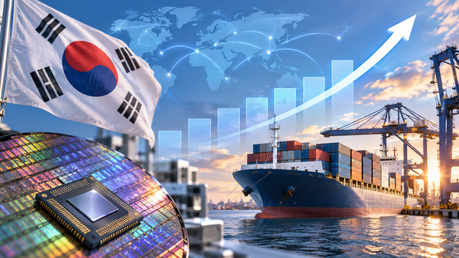
The primary engine behind this surge is advanced technology. Year-to-date figures show semiconductor exports skyrocketing by over 110 percent, alongside a nearly 48-percent jump in advanced technology shipments, largely fueled by worldwide investments in AI hardware.
Lessons from History: Wealth Does Not Equal Hegemony
The sheer magnitude of China’s trade surplus has prompted global analysts to revisit the historical relationship between commercial wealth and geopolitical dominance. Economic history suggests that accumulating massive trade surpluses is no guarantee of lasting supremacy.
Centuries ago, during the Ming and Qing dynasties, China sat comfortably at the center of global commerce. European powers funneled vast quantities of New World silver into East Asia to acquire highly sought-after Chinese silks, tea, and porcelain. Despite this immense accumulation of wealth, the Qing Dynasty failed to transition its commercial success into structural industrial leadership. When Britain initiated the Industrial Revolution in the late 18th century through mechanized production and steam power, China clung to traditional economic models. The resulting technological and military divergence eventually culminated in the mid-19th-century Opium Wars, transforming a global trade titan into a nation vulnerable to external coercion.
A similar arc can be seen in the modern era. Great Britain dominated 19th-century global trade through industrial prowess, advanced finance, and a sweeping naval empire. Yet, British supremacy was eventually eclipsed by the United States, whose abundant domestic resources, rapid technological innovations, and emergence as a financial superpower reshaped the 20th-century global order via the Bretton Woods system.
These historical precedents highlight a fundamental reality: economic hegemony is rarely determined by export statistics alone. It relies on a complex matrix of technological innovation, robust financial systems, institutional resilience, and leadership within the international order.
Navigating Modern Pressures and Regional Impacts
Today, China stands as an undisputed manufacturing powerhouse, leading global production in electric vehicles, batteries, and solar technology while making deep inroads into high-tech sectors. However, maintaining this momentum faces considerable headwinds both internally and externally.
Domestically, persistent property market corrections and sluggish consumer demand threaten long-term stability. Externally, ballooning trade surpluses risk provoking a fierce protectionist backlash. Major trading partners, particularly the United States and the European Union, are increasingly raising tariff walls and tightening import restrictions to shield domestic industries from sudden supply shocks.
For neighboring economies like South Korea, China’s dual trajectory presents both risk and opportunity. While Chinese enterprises are aggressively challenging Korean dominance in traditional export strongholds such as automobiles, steel, and electronics, the rapid expansion of China's AI and tech sectors also opens lucrative avenues for technological collaboration and supply chain integration.
Ultimately, crossing the $1 trillion trade surplus threshold underscores China's formidable industrial capacity. Whether this milestone marks the dawn of a new era of economic hegemony or merely the opening salvo of protracted global trade friction remains one of the defining questions of modern geopolitics.
[Copyright (c) Global Economic Times. All Rights Reserved.]