![[등록] 2026-09-01 15:48:31](/support/_updata/banner2/tl181982910_6749.png)


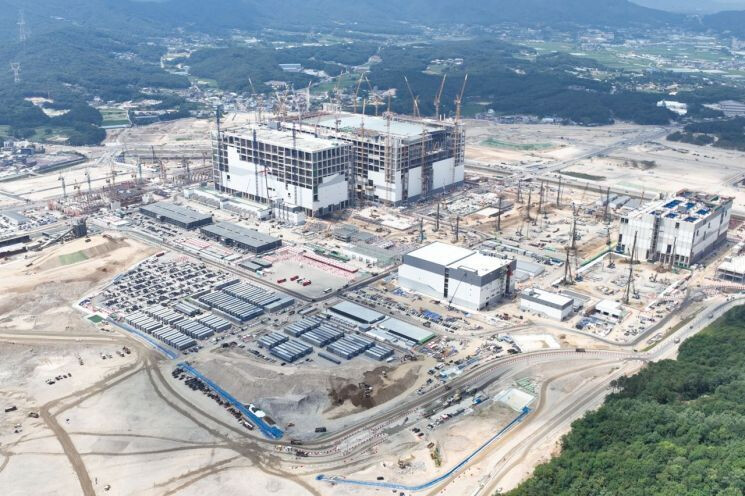
The Gwangju-Jeonnam Integrated Special City is set to begin site development next year with the goal of achieving the first mass production at the Gwangju Semiconductor Cluster by June 2030. Out of the 2.5 million pyeong surrounding the Gwangju Military Airport, the city plans to first organize 630,000 pyeong where development is immediately feasible, and establish initial power and water supply systems by the end of 2028 to support corporate factory construction. It is also pushing to establish a legal basis for special exceptions allowing infrastructure construction prior to national industrial complex designation, as well as financial support.
The Gwangju Metropolitan City held a press briefing on the 22nd to announce the current status and future plans for the Gwangju Semiconductor Cluster. The Gwangju Semiconductor Cluster is a project promoted in accordance with the government's plan to build four or more semiconductor fabs on a scale of 800 trillion won. Last July, approximately 8.26 million square meters around the Gwangju Military Airport was designated as a candidate site for a national industrial complex, and the Korea Land and Housing Corporation (LH) was selected as the preliminary project implementer.
The city plans to preferentially supply approximately 630,000 pyeong of the total site, including the site slated for ammunition depot relocation and areas for resolving civil complaints. The schedule involves initiating site development next year to conduct licensing, design, and partial site arrangement, followed by breaking ground in 2028. The preferentially supplied sites are subject to regulations concerning development restriction zones and military facilities, meaning institutional reorganization must precede the work. Accordingly, the city is petitioning to reflect prior-action exceptions in the Gwangju-Jeonnam Integrated Special Act and the Mega Special Zone Special Act so that grading, site arrangement, and infrastructure installation can proceed concurrently with the industrial complex designation procedures. The city is also pursuing an exemption from the preliminary feasibility study for the site development project by the end of this year.
Phase 1 infrastructure focuses on supplying the electric power and water necessary for Samsung Electronics and SK hynix to build one fab each. Substations for power supply are also scheduled to be built on the site. Power will be supplied in Phase 1 at 3.1 GW by December 2028, eventually expanding to 6.3 GW. The plan is to draw power from the Sinjangseong and Shingwangju substations and connect it to the industrial complex via an approximately 23-kilometer underground transmission line utilizing the Hwangryong River and Provincial Road No. 49.
On the 12th of last month, the Ministry of Climate, Environment and Energy, the Special City, Korea Electric Power Corporation (KEPCO), Samsung Electronics, and SK hynix signed a power supply agreement, and the exemption of the power grid project from the preliminary feasibility study was resolved at the Cabinet meeting on the 1st of this month. KEPCO is currently conducting the design, aiming to commence construction in June next year.
Water supply will be divided into initial, Phase 1, Phase 2, and final stages. The city plans to preferentially supply 150,000 tons per day by the end of 2028, expanding to 350,000 tons by the end of 2029, a cumulative 650,000 tons by the end of 2030, and a maximum of 1.06 million tons by the end of 2032. Initial volumes of 50,000 tons from Juam Dam and 100,000 tons from Boseonggang Dam will be secured utilizing existing purification and transmission facilities. While the water demand presented by corporations is at the level of 600,000 to 650,000 tons per day, the blueprint aims to proactively secure raw water in preparation for long-term fab expansions. Regarding the expansion of Dongbok Dam, a win-win consultative body involving related organizations and local residents was formed on the 18th, and a resident briefing session is scheduled for October. Following the preliminary feasibility study exemption for power and water projects, the Special City will also establish the legal basis to utilize integrated financial support resources. To reflect the basis for receiving related financial resources in the integrated special act, the city plans to push for a revision within the year.
Corporate tenancy agreements will be conducted as soon as LH's related research services are concluded. The city expects this to happen at the end of this year or early next year.
Through dedicated teams for Samsung Electronics and SK hynix, the Special City is receiving corporate requirements and consulting with relevant departments on licensing, infrastructure, and investment support.
The relocation of the military airport will proceed in parallel with the creation of the industrial complex. Following the selection of Muan as the relocation candidate site last month, the city aims to select the final relocation site within the year through the establishment of support plans, resident public hearings, resident voting, and applications for attraction. The new military airport aims for completion in December 2032.
While maintaining the framework of the existing "grant-in-exchange-for-cession" method, the Special City is demanding national financial support in consideration of the reduction in property value resulting from the industrial complex development on the former site. The city is also pushing for revisions to laws that establish the basis for early development of the industrial complex through prior cession of the former site and government funding.
Manpower training and settlement measures will be designed to encompass both downtown Gwangju and adjacent cities and counties. Estimating the required workforce for four fabs at 23,000 people, the city plans to build a talent cultivation system of about 25,000 people through 48 schools, including 22 local universities and 26 vocational high schools.
Settlement conditions will be improved by dividing them into short-term and mid-to-long-term strategies. During the construction phase, the city will investigate rental housing, vacancies in accommodation facilities, and unsold housing in Gwangju, Naju, Jangseong, Hampyeong, Damyang, Hwasun, and other areas to use them as worker accommodations. In the mid-to-long-term, the industrial complex and residential areas will be connected within a 30-minute living zone, while simultaneously expanding educational, medical, cultural, and tourism conditions.
The Special City plans to operate a settlement condition innovation task force composed of 20 public officials and external experts, and materialize action plans through the Semiconductor City Division and dedicated teams.
Kim Ki-hong, head of the Semiconductor Industry Support Division, stated, "We will design the project to broadly spread the achievements and dividends of the semiconductor industry by encompassing both downtown Gwangju and adjacent cities and counties within a 30-minute living zone."
[Copyright (c) Global Economic Times. All Rights Reserved.]