![[등록] 2026-09-01 15:48:31](/support/_updata/banner2/tl181982910_6749.png)


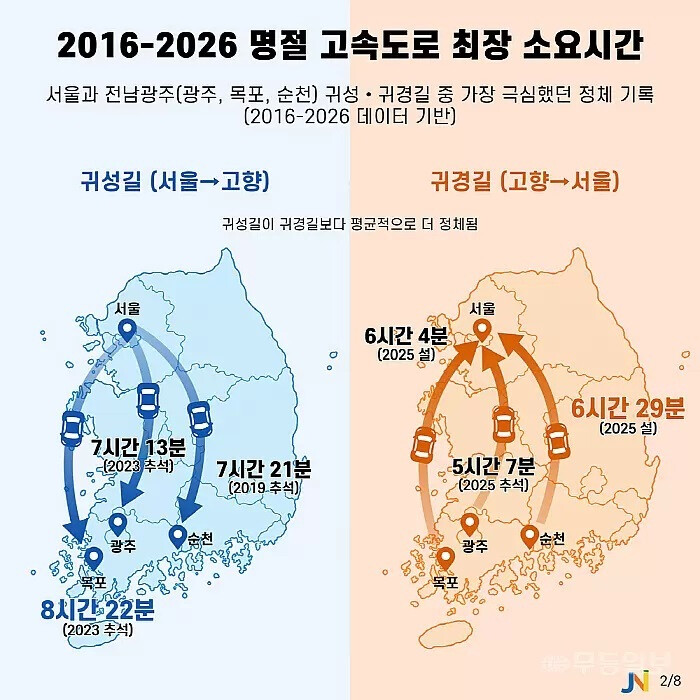
A recent analysis of travel times during holiday periods (Chuseok and Lunar New Year) over the past decade has revealed that traffic congestion is significantly more severe on the way to hometowns (Gyseong-gil) than on the return trip (Gyeonggwang-gil). The modes of transportation showed a clear trend of diversification from centering around passenger cars to public transportation and railways.
According to an infographic titled "Holidays Through Data" released by the Jeonnam Research Institute on the 22nd, highway congestion between Seoul and Gwangju/Jeonnam from 2016 to 2026 was more severe during the journey to hometowns than the return trip. The worst record for the trip home was the Seoul-Mokpo route during Chuseok in 2023, which took a staggering 8 hours and 22 minutes. During the same period, Seoul-Gwangju recorded 7 hours and 13 minutes (Chuseok 2023), and Seoul-Suncheon recorded 7 hours and 21 minutes (Chuseok 2019). On the other hand, the peak records for the return trip were around 6 hours and 29 minutes for Suncheon-Seoul and 6 hours and 4 minutes for Gwangju-Seoul, based on the Lunar New Year in 2025.
Looking at the average travel times before and after the holidays (3 days before and after), the peak travel time for going home was 298 minutes (the day before the holiday), which was 26 minutes longer than the peak travel time for the return trip of 272 minutes (the day of the holiday). However, when 2 or more days of buffer time were secured before the holiday, the travel time home was reduced by 72 minutes (from 400 minutes to 328 minutes). This reduction effect is 3.6 times greater than the reduction effect for the return trip when 2 buffer days are secured afterward (a 20-minute reduction).
Shifting Transportation Trends & Holiday Traffic Tips
Transportation methods for holidays are also changing. The proportion of passenger car usage peaked at 92.2% during the Lunar New Year in 2023, but then decreased to 78.1% during Chuseok in 2024. In contrast, public transportation usage increased significantly. Comparing Chuseok in 2022 and 2024, the proportion of bus usage surged from 3.4% to 7.4%, and railways from 2.6% to 8.5%. Based on the Lunar New Year holiday, the proportion of overseas travel also increased sixfold, from 0.6% in 2023 to 3.6% in 2025.
Looking at the changes in the number of holiday travelers by year (2022-2026), Chuseok generally showed a higher volume of movement than the Lunar New Year. During Chuseok in 2023, which coincided with recovery from the COVID-19 pandemic and a long holiday, the number of travelers reached a peak of 40.29 million. For the Lunar New Year holidays, the scale of movement has consistently maintained around 30 million people since COVID-19.
Meanwhile, the Jeonnam Research Institute also provided traffic tips for a safe and fast journey home. Tolls on national highways will be fully waived for 4 days from midnight on September 24 to 24:00 on September 27. Following the integration of KTX and SRT, a 10% discount on KTX fares is provided. Travelers are advised to check real-time congestion sections through ROAD PLUS or the National Transport Information Center before departure. In addition, people were urged to follow the "Bi-Teu-Bak-Seu" response rules (Turn on hazard lights, open the trunk, evacuate outside, and report via smartphone) to prevent secondary accidents in the event of a road accident.
[Copyright (c) Global Economic Times. All Rights Reserved.]