• 2026.08.12 (Wed)
  • All articles
  • LOGIN
  • JOIN
Global Economic Times
fashionrunwayshow2026
  • Synthesis
  • World
  • Business
  • Industry
  • ICT
  • Distribution Economy
  • Well+Being
  • Travel
  • Eco-News
  • Education
  • Korean Wave News
  • Opinion
  • Arts&Culture
  • Sports
  • People & Life
    • International Student Report
    • With Ambassador
  • Column
    • Cho Kijo Column
    • Cherry Garden Story
    • Ko Yong-chul Column
    • Kim Seul-Ong Column
    • Lee Yeon-sil Column
  • Photo News
  • New Book Guide
MENU
 
Home > Distribution Economy

Gas Prices Edge Lower on First Weekend of Price Cap Amid Middle East Tensions

Desk / Updated : 2026-03-16 07:46:21
  • -
  • +
  • Print


SEOUL — South Korea’s domestic fuel prices maintained a downward trend over the first weekend since the implementation of the "Petroleum Maximum Price System," although the pace of the decline has significantly slowed. As the nation grapples with the economic aftershocks of the conflict between the United States and Iran, the new price cap serves as a critical buffer for weary consumers.

Domestic Price Trends: A Slowing Descent
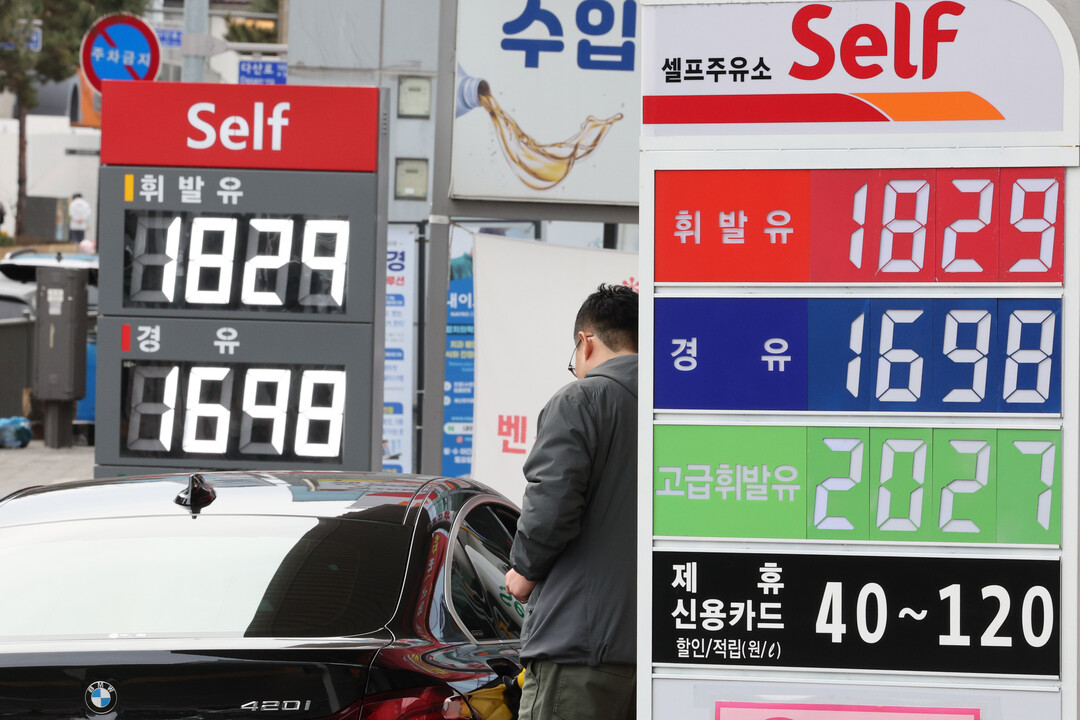
According to Opinet, the Korea National Oil Corporation's fuel price information service, the national average price for gasoline stood at 1,842.1 won per liter as of 9:00 AM on Sunday, March 15. This represents a modest decrease of 3.2 won from the previous day. Diesel prices followed a similar trajectory, falling by 4.4 won to settle at 1,843.6 won per liter.

In the capital, Seoul, where living costs typically outpace the national average, the decline was also evident. The average gasoline price in Seoul dropped to 1,865.2 won per liter (down 2.9 won), while diesel saw a more substantial dip of 16.2 won, reaching 1,854.6 won per liter.

This cooling period comes after a volatile week. Domestic pump prices reached a historic peak on March 10, triggered by the immediate fallout of the U.S.-Iran war. While the current price cap has successfully halted the vertical climb, industry experts note that the "drop" is becoming a "drip," as the magnitude of daily decreases continues to shrink.

International Volatility: The Hormuz Factor
Despite the slight relief at home, the international energy market remains a tinderbox. Crude oil prices saw an upward surge last week, fueled by the ongoing blockade of the Strait of Hormuz and reports of aggressive production cuts from major Middle Eastern oil producers.

Dubai crude, South Korea’s primary benchmark, surged to $123.5 per barrel, a staggering increase of $34.6 from the prior week. The impact was felt across all refined products:

-International Gasoline: Rose by $25.3 to $126.3.
-International Diesel: Jumped by $37.5 to $176.5.

The only factor preventing a total price explosion was the coordinated effort by the International Energy Agency (IEA). Member nations agreed on a strategic petroleum reserve release, which managed to cap the potential ceiling of the price spike.

The Two-Week Lag: A Storm on the Horizon?
The primary concern for South Korean policymakers and consumers is the "time lag" inherent in the oil supply chain. Changes in international oil prices typically take two to three weeks to manifest at local gas stations.

While the "Petroleum Maximum Price System" is currently shielding drivers from the worst of the volatility, the recent $30+ jump in Dubai crude is expected to exert immense upward pressure on domestic prices by early April. If the Middle East tensions do not subside, the government may face a difficult choice between subsidizing the gap or allowing the price cap to adjust upward to reflect the global reality.

Public Reaction and Market Outlook
At a local gas station in downtown Seoul on Sunday, citizens were seen taking advantage of the weekend lull to fill their tanks. "Every won counts these days," said one commuter. "The news says prices are down, but it still feels twice as expensive as last year. We are just hoping the war ends soon so things can go back to normal."

As the second week of the price cap begins, the Ministry of Economy and Finance is expected to monitor the situation closely. The focus will remain on whether the strategic reserves can stabilize the market long enough for the current geopolitical friction to ease.

[Copyright (c) Global Economic Times. All Rights Reserved.]

  • #globaleconomictimes
  • #micorea
  • #mykorea
  • #nammidonganews
  • #singaporenewsk
  • #Samsung
  • #Daewoo
  • #Hyosung
  • #Apple
  • #korea
Desk
Desk

Popular articles

  • South Korea to Tighten Rules on Single-Stock Leveraged Products; Minimum Deposit Raised to 30 Million Won

  • Rising Tide of 'AI Nationalism' and 'National Dividend': All Eyes on U.S. Political Moves

  • BTS Partners with the British Museum to Illuminate Korean Heritage Through 'Arirang' Gallery Trail

I like it
Share
  • Facebook
  • X
  • Kakaotalk
  • LINE
  • BAND
  • NAVER
  • https://www.globaleconomictimes.kr/article/1065566655093989 Copy URL copied.
Comments >

Comments 0

Weekly Hot Issue

  • Riot Games Hosts Largest-Ever TFT Festival at The Hyundai Seoul to Launch 'Sylvan Secrets' Set
  • MINISTRY OF EMPLOYMENT AND LABOR DIRECTS IMMEDIATE EXPANSION OF REST FACILITIES AT GIMPO AIRPORT AFTER UNANNOUNCED HEATWAVE INSPECTION
  • XAVIS Secures Contract to Supply Advanced X-Ray Inspection Systems to European Lines of Global Food Sauce Brand
  • Emma Expands Collaboration with Interior Design Experts to Present Sleep Space Solutions
  • Trump Criticizes U.S. Congressional AI Regulations as Threat to Tech Industry
  • Memory Chips Become Dominant Force in Global Semiconductor Industry, Expected to Account for 60% of Total Market This Year

Most Viewed

1
Planting Hope: Ethiopia’s Green Legacy and the Power of National Transformation
2
Japan Estimated to Have Spent ¥6–7 Trillion in Fresh Yen-Buying Intervention as US Joint Action Hints Emerge
3
The 16th Ethiopia-gil World Festival & Meskel Festival
4
South Korea’s July Exports Hit Record $98.9 Billion as Semiconductor Supercycle Powers Surge
5
Lube Base Oil Emerges as Export Lifesaver for South Korean Refiners Amid Middle East Conflict
광고문의
임시1
임시3
임시2

Hot Issue

MINISTRY OF EMPLOYMENT AND LABOR DIRECTS IMMEDIATE EXPANSION OF REST FACILITIES AT GIMPO AIRPORT AFTER UNANNOUNCED HEATWAVE INSPECTION

Riot Games Hosts Largest-Ever TFT Festival at The Hyundai Seoul to Launch 'Sylvan Secrets' Set

Nable Communications Secures 5G Private Network Upgrade Deal with LG Uplus

Ansan City Pay-as-You-Throw Trash Bag Abandoned in Japan Sparks Controversy in Kamikochi

Fashion Runway Show 2026

Global Economic Times
korocamia@naver.com
CEO : LEE YEON-SIL
Publisher : KO YONG-CHUL
Registration number : Seoul, A55681
Registration Date : 2024-10-24
Youth Protection Manager: KO YONG-CHUL
Singapore Headquarters
5A Woodlands Road #11-34 The Tennery. S'677728
Korean Branch
Phone : +82(0)10 4724 5264
#304, 6 Nonhyeon-ro 111-gil, Gangnam-gu, Seoul
Copyright © Global Economic Times All Rights Reserved
  • 향기네무료급식
  • BCB부천방송
  • 반달곰 프로젝트
Search
Category
  • All articles
  • Synthesis
  • World
  • Business
  • Industry
  • ICT
  • Distribution Economy
  • Well+Being
  • Travel
  • Eco-News
  • Education
  • Korean Wave News
  • Opinion
  • Arts&Culture
  • Sports
  • People & Life 
    • 전체
    • International Student Report
    • With Ambassador
  • Column 
    • 전체
    • Cho Kijo Column
    • Cherry Garden Story
    • Ko Yong-chul Column
    • Kim Seul-Ong Column
    • Lee Yeon-sil Column
  • Photo News
  • New Book Guide
  • Multicultural News
  • Jobs & Workers