

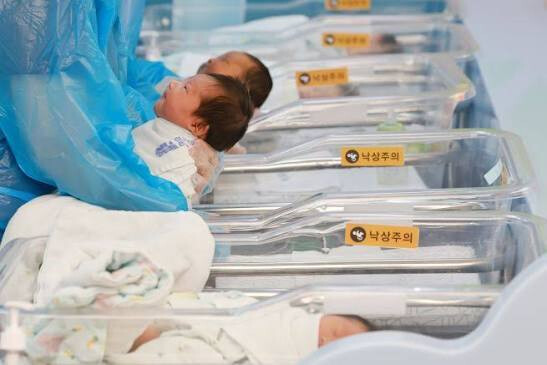
South Korea has recently experienced a meaningful, albeit cautious, turning point in its persistent demographic crisis. According to the 2025 birth statistics released by the Ministry of Data and Statistics, the country's total number of newborns reached 254,300 last year, marking a 6.7 percent increase—or an additional 16,000 babies—compared to the previous year. This upward trajectory marks the first time in four years that the nation's total fertility rate (TFR) has climbed back into the 0.8 range, landing at 0.80. This represents a consecutive two-year increase following the low of 0.72 recorded in 2023, signaling a slight recovery in national birth trends.
A closer look at the data reveals that the overall rebound was largely driven by an increase in first-born children. First-time births rose by 8.6 percent to 158,700, accounting for 62.4 percent of all newborns. Furthermore, over half of these first-time deliveries occurred within two years of marriage, highlighting a pattern where couples who choose to marry are promptly starting families. Conversely, subsequent births saw much more muted growth; second-born children rose by only 4.4 percent, while third-or-higher-order births inched up by a mere 0.5 percent. This underlines a growing societal reality where many households feel financially or structurally constrained, leading to the prevalent sentiment that having a second child is an impossible luxury.
Age-specific fertility dynamics underwent significant shifts as well. Childbearing trends continue to skew older due to prolonged trends of late marriage. The birth rate among women in their late thirties (ages 35–39) surged to a record high of 52.1 births per 1,000 women, an increase of 6.0 from the previous year. Similarly, women in their early forties experienced record-level fertility, while the early-twenties demographic saw a rare uptick. Consequently, the average age of mothers giving birth rose to 33.8 years, reflecting a steady delay in family planning over the past decade. Multiple births, such as twins and triplets, also hit a milestone, surpassing 6 percent of all deliveries for the first time.
Despite these domestic signs of recovery, South Korea continues to face deep-seated structural challenges. Regionally, disparities remain stark, with provinces like South Jeolla and Sejong reporting higher fertility rates around the 1.0 mark, while metropolitan centers like Seoul lag significantly behind at 0.63. More broadly, on an international scale, South Korea remains an extreme outlier. According to Organization for Economic Cooperation and Development (OECD) comparisons, the average fertility rate across its 38 member states stands at 1.40, leaving South Korea firmly at the absolute bottom as the only member nation with a fertility rate falling below 1.0. Experts note that while the recent rebound in first-time births and the 0.80 fertility rate offer a glimmer of hope, comprehensive long-term structural reforms addressing housing costs, grueling work culture, and education pressures will be essential to sustain any genuine demographic turnaround.
[Copyright (c) Global Economic Times. All Rights Reserved.]