

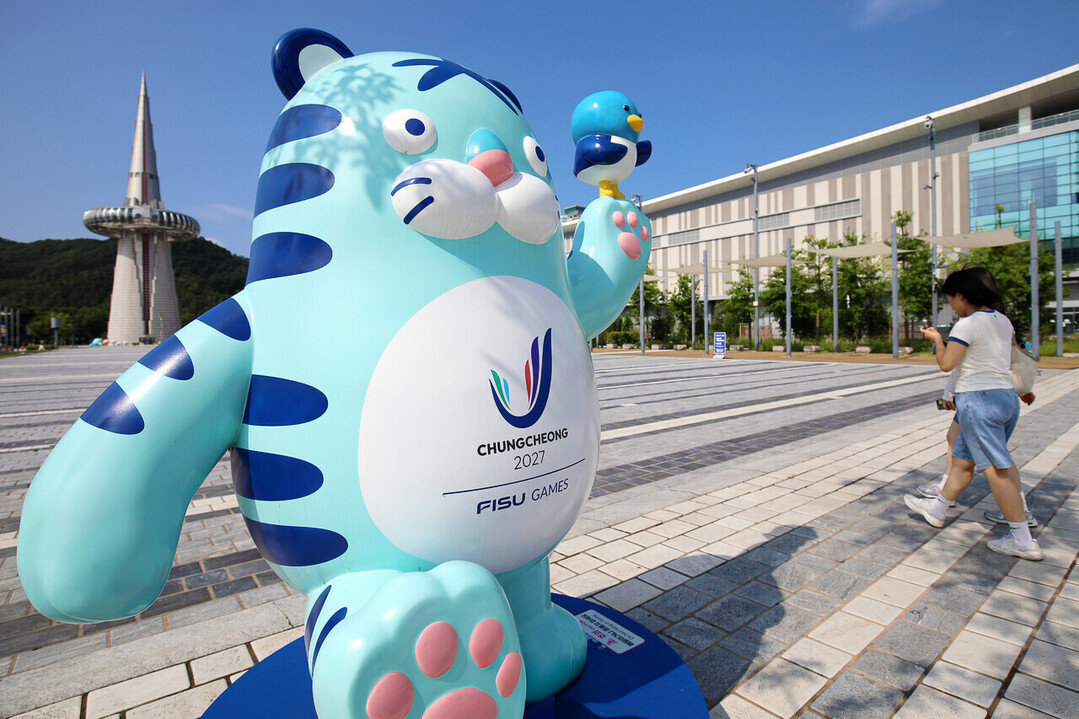
The 2027 Chungcheong Summer World University Games (Universiade) are establishing a new command structure with the inauguration of new Organizing Committee Chairman Yeom Hong-chul. With the leadership vacuum resolved, points are being raised that it is time for the four cities and provinces—Daejeon, Sejong, North Chungcheong, and South Chungcheong—to move as a "one team" once again. The remaining one year until the opening of the event is expected to go beyond simple event preparation and serve as a testing ground to prove the Chungcheong region's capacity for super-regional cooperation.
New Chairman Yeom takes office on the 1st and begins official duties. Previously, the four cities and provinces jointly recommended the former Daejeon Mayor as the next organizing committee chairman candidate, and the appointment was finalized through the organizing committee's resolution and approval by the Ministry of Culture, Sports and Tourism. With the leadership vacuum resolved a year ahead of the event, expectations are high that external negotiation capabilities targeting the government, National Assembly, and corporations, as well as policy coordination functions among local governments, will also get back on track.
The key topic emphasized by new Chairman Yeom ahead of his inauguration is "Chungcheong One Team." In a phone interview with this newspaper, he stated, "This is the first large-scale international sporting event in the Chungcheong region created by Daejeon, Sejong, South Chungcheong, and North Chungcheong coming together as one," adding, "Only when Chungcheong harmonizes as a single team can we complete the challenge."
This event cannot be handled by the administrative power of any single local government alone. Since stadiums and athlete villages are distributed across four cities and provinces, super-regional cooperation in all fields—such as transportation, accommodation, safety, and medical care—is essential. Establishing a single response system that transcends administrative boundaries is the key.
Urgent pending issues also need immediate resolution. The organizing committee has requested a 394 billion won increase in operating costs from the government, citing rising prices and labor costs. The main sponsor is also undecided. Securing financial resources, such as additional national and local budgets and attracting corporate sponsorships, is the top priority for the new leadership. New Chairman Yeom stated, "We will mobilize close cooperative systems with the National Assembly, local councils, and the heads of the four cities and provinces to concentrate our efforts on attracting sponsorships and securing budgets."
Event preparation has also entered the execution phase of welcoming actual participating countries. The organizing committee has sent official invitation letters to 164 member states of the International University Sports Federation (FISU), including North Korea, and has begun participant registration procedures. Given that it is held in mid-summer, proactively refining on-site medical and heatwave measures to prevent heat-related illnesses among large delegations and spectators is also essential.
Inducing the participation of the North Korean delegation is likewise an important variable. Since it is an issue that is difficult to decide in a short period depending on political changes, the organizing committee's policy is to continue persuasion efforts through close consultations with the government and international organizations such as FISU. New Chairman Yeom also emphasized, "As it is intertwined with political situations, ongoing efforts to encourage participation are necessary."
Above all, what is needed now is to revive the solidarity of the Chungcheong region demonstrated during the event's bidding process. While politicians, local governments, and civil society united to win the hosting rights during the bidding process, there are many evaluations that the momentum for joint response has weakened somewhat during the preparation process due to conflicting interests and financial burdens of each region.
This event is an opportunity to test Chungcheong-style super-regional cooperation in the field. If the international event operation systems established in transportation, safety, and medical care during the event are carried over into post-closing super-regional cooperation projects, they can serve as the foundation for the Chungcheong Megacity.
A political source stated, "The new organizing committee chairman's first task is to restore the organizing committee's centripetal force and bind the Chungcheong region as one," adding, "How strong a solidarity and execution capability the four cities and provinces show toward a common goal will be the core key determining the success of the event and the future of super-regional cooperation."
[Copyright (c) Global Economic Times. All Rights Reserved.]