![[등록] 2026-09-01 15:48:31](/support/_updata/banner2/tl181982910_6749.png)


(C) Oyeyeah
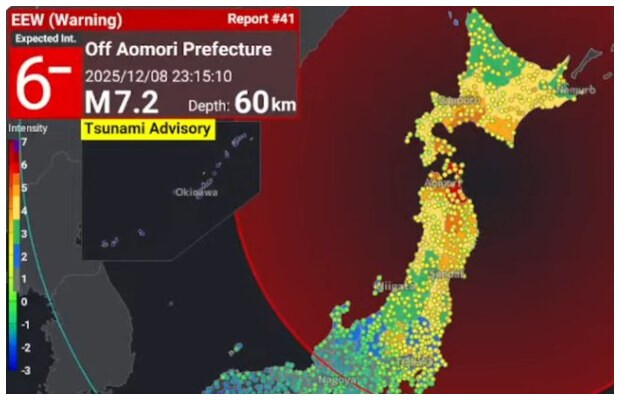
TOKYO – A powerful earthquake, initially reported as magnitude 7.2 and later revised to 7.6, struck off the coast of Aomori Prefecture in northern Japan on the evening of December 8th, triggering tsunami warnings and prompting an immediate, high-level government response.
In the wake of the sudden, large-scale seismic event, Japanese Prime Minister Sanae Takaichi urgently addressed reporters while entering the Prime Minister’s Official Residence. Takaichi confirmed that an Emergency Response Headquarters had been established at the residence to coordinate the disaster management efforts.
The Prime Minister, whose expression conveyed a sense of visible urgency and momentary shock, stated that she had immediately instructed officials to “accurately inform the public about the tsunami damage and evacuation information, take measures to prevent damage such as evacuation, and swiftly grasp the extent of the damage.” She emphasized the government’s commitment to collaborating closely with local municipalities to dedicate all efforts to emergency measures, including rescue and relief operations, to minimize casualties. Takaichi's brief statement, lasting approximately one minute, underscored the gravity of the situation before she proceeded directly to the Residence’s situation room.
The quake occurred around 11:15 PM JST (Japan Standard Time) with the epicenter located off the eastern coast of Aomori Prefecture at an estimated depth of 50 km. The strong tremors were felt across a wide area, including as far south as Tokyo, where residents reported significant shaking in high-rise apartment buildings.
Tsunami Threat and Government Directives
Following the earthquake, the Japan Meteorological Agency (JMA) and national broadcaster NHK issued urgent warnings. By 11:41 PM JST, a tsunami of up to 3 meters was forecast for the coast of Iwate Prefecture, located in Japan’s northeastern region, with warnings also issued for coastal areas of Hokkaido and Aomori. NHK immediately interrupted regular programming to broadcast emergency alerts, urgently imploring residents in the vicinity of the affected coastlines to evacuate to higher ground or designated evacuation buildings without delay.
Chief Cabinet Secretary Minoru Kihara followed the Prime Minister’s address with a midnight press conference. Kihara confirmed the tsunami warning for the Pacific coasts of Hokkaido, Aomori, and Iwate, reiterating the projected maximum wave height of 3 meters. He stressed the critical necessity for residents in the affected regions to "immediately evacuate to high ground or safe locations."
Kihara also confirmed that the government was actively monitoring all nearby nuclear power plants and had reported no immediate abnormalities, while continuing to check for any additional issues.
Coordinated Response and Public Safety Warnings
The Japanese government swiftly mobilized an Emergency Response Team composed of director-general-level officials from relevant ministries to focus on damage assessment and comprehensive emergency measures.
Chief Cabinet Secretary Kihara delivered a pointed warning to the public, advising those in areas that experienced strong shaking to remain vigilant regarding information disseminated via television, radio, and the internet. Crucially, he emphasized the recurring danger posed by subsequent waves, noting that “even after the initial earthquake and tsunami, the second and third waves may arrive larger,” urging the public to "not leave safe locations until the relevant warning is lifted."
The devastating magnitude 7.6 quake and the ensuing tsunami threat highlight Japan’s constant vulnerability to seismic activity, demanding rapid and decisive action from its highest leadership. The immediate establishment of the Emergency Response Headquarters signals the government's total commitment to prioritizing public safety and coordinating a unified response to this major natural disaster.
[Copyright (c) Global Economic Times. All Rights Reserved.]