• 2026.09.26 (Sat)
  • All articles
  • LOGIN
  • JOIN
Global Economic Times
[등록] 2026-09-01 15:48:31
  • Synthesis
  • World
  • Business
  • Industry
  • ICT
  • Distribution Economy
  • Well+Being
  • Travel
  • Eco-News
  • Education
  • Korean Wave News
  • Opinion
  • Arts&Culture
  • Sports
  • People & Life
    • International Student Report
    • With Ambassador
  • Column
    • Cho Kijo Column
    • Cherry Garden Story
    • Ko Yong-chul Column
    • Kim Seul-Ong Column
    • Lee Yeon-sil Column
  • Photo News
  • New Book Guide
MENU
 
Home > World

Flashpoint in the Gulf: U.S. HIMARS Fire Toward Iran from Bahraini Soil, Signalling Shift to All-Out War

Pedro Espinola Special Correspondent / Updated : 2026-03-15 08:33:15
  • -
  • +
  • Print


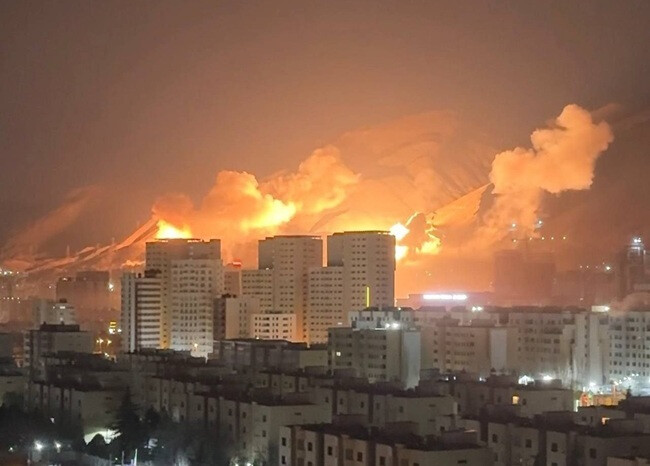
MANAMA, Bahrain — The geopolitical landscape of the Middle East shifted violently this week as evidence emerged that U.S. forces stationed in Bahrain have begun launching offensive strikes directly at Iranian territory. This development marks a definitive end to the "strategic restraint" previously exercised by Gulf nations and threatens to pull the entire region into a catastrophic total war.

The Smoking Gun in Northern Bahrain
According to a definitive investigative report by the New York Times (NYT) released on March 13, 2026, verified video footage confirms that two missiles were launched from northern Bahrain toward Iran on March 7. Following a meticulous frame-by-frame analysis by military experts, the mobile launch platform was identified as the M142 High Mobility Artillery Rocket System (HIMARS)—a centerpiece of the U.S. military’s precision-strike capability.

While the Bahraini government recently received approval to acquire HIMARS, experts noted that the Royal Bahraini Army has yet to reach operational status with the system. This points directly to the U.S. Navy’s 5th Fleet, headquartered in Bahrain, as the active party behind the launch. When pressed for comment, the Pentagon maintained a stance of "strategic ambiguity," refusing to confirm or deny the operation.

The End of "Host-Country Neutrality"
For decades, Gulf monarchies including Saudi Arabia and the UAE have walked a tightrope, hosting U.S. bases while strictly forbidding them from being used as launchpads for attacks against Iran. This caution was rooted in the fear of Tehran’s "asymmetric retaliation."

However, that silence has been shattered. The catalyst appears to be a series of escalating provocations from Tehran. According to Bahraini officials, Iran has launched over 100 missiles and 191 drones at the island nation since the onset of the current conflict. While most were intercepted, recent strikes have devastated critical infrastructure, including desalination plants and refineries. The tension reached a breaking point on March 10, when a 29-year-old Bahraini woman was killed during an Iranian airstrike on the capital, Manama.

A Convergence of Resentment and Strategy
Bahrain’s decision to allow—or at least look the other way during—U.S. offensive operations stems from a deep-seated animosity toward Iranian interference. As a Sunni-led monarchy governing a Shia-majority population, Bahrain has long viewed Tehran's efforts to incite sectarian strife as its primary existential threat.

"The gloves are off," noted one regional security analyst. "By facilitating these strikes, Bahrain is signaling that the cost of Iranian aggression has finally outweighed the fear of its retaliation. They are doubling down on their 'blood alliance' with Washington."

The Brink of Total War
The repercussions of this shift are immediate and perilous. Tehran has repeatedly warned that any nation providing "soil or airspace" for U.S. aggression will be treated as a direct combatant. Following the HIMARS launch, Iranian officials issued a chilling statement: "Those who open their gates to the Great Satan will be the first to burn in the fire they helped ignite."

As the U.S. begins to activate its strategic assets across the Gulf to curb Iran's ambitions in the Strait of Hormuz, the conflict is no longer a contained proxy war. With the "red lines" of Gulf neutrality erased, the world now watches with bated breath to see if this missile trail in the Bahraini sky is the opening salvo of a much larger, darker chapter in Middle Eastern history.

[Copyright (c) Global Economic Times. All Rights Reserved.]

  • #globaleconomictimes
  • #micorea
  • #mykorea
  • #nammidonganews
  • #singaporenewsk
  • #Samsung
  • #Daewoo
  • #Hyosung
  • #Apple
  • #korea
Pedro Espinola Special Correspondent

Popular articles

  • 10 Minutes Before Flood: “Run to High Ground Right Now”… 900 Students’ Lives Saved by Urgent Response

  • China’s AI Industry Pivots from Model Development to Token-Driven Monetization via AI Agents

  • Saudi Arabia Faces a Dilemma Amid Houthi Offensives and Ineffective Regional Pacts

I like it
Share
  • Facebook
  • X
  • Kakaotalk
  • LINE
  • BAND
  • NAVER
  • https://www.globaleconomictimes.kr/article/1065569521357494 Copy URL copied.
Comments >

Comments 0

Weekly Hot Issue

  • Beyond Drug Smuggling, Signs of "Domestic Manufacturing"… Special Measures Must Be Established 
  • Geoje, Still Scarred by Flood Damage, Receives 'Chuseok Warmth' from Across the Country Over 2 Billion Won Donated Since Disaster; 380,000 Items Worth 1.1 Billion Won in Relief Supplies
  • Season-Over Lee Jung-hoo: Only the Burden of a 33.5 Billion Won Price Tag Remains for the 2026 Season
  • Public Criticism on Stage... The Dignity of a Senior Singer Missed by Shim Soo-bong 
  • 'Slump in Results Followed by Asylum Scandal' – North Korean Delegation Shaken in Nagoya
  • Xi Jinping Arrives in Washington… Begins 3-Day State Visit to the U.S.

Most Viewed

1
Desperate Pursuit of HBM: China’s AI Chip Sector Faces Crippling Bottlenecks as Gray Market Prices Soar
2
Chuncheon to Light Up the "Lights of Ethiopia": The 16th Ethiopia Road World Coffee Festival & Meskel Festival Opens on September 25
3
The Era of "Working AI" Has Arrived: Why OpenAI's GPT-6 Astra is a Blessing for Samsung Electronics and SK Hynix
4
 Iran and Gulf Nations to Hold First Ministerial Meeting in Salalah for Hormuz Navigation
5
Surging LNG Prices Forebode a Freezing Winter amid Middle East Conflict
광고문의
임시1
임시3
임시2

Hot Issue

South Korea and U.S. Leaders Hold Pivotal Summit in New York

From a Symbol of Security to a Space for Healing... Walking Paju's Veiled 'Re:DMZ' Forest

Pocheon Hantan River Garden Festa

A Different Side of Gyeonggi Province Seen While Running… Autumn Running Courses Recommended by 'Run Gyeonggi'

Fashion Runway Show 2026

Global Economic Times
korocamia@naver.com
CEO : LEE YEON-SIL
Publisher : KO YONG-CHUL
Registration number : Seoul, A55681
Registration Date : 2024-10-24
Youth Protection Manager: KO YONG-CHUL
Singapore Headquarters
5A Woodlands Road #11-34 The Tennery. S'677728
Korean Branch
Phone : +82(0)10 4724 5264
#304, 6 Nonhyeon-ro 111-gil, Gangnam-gu, Seoul
Copyright © Global Economic Times All Rights Reserved
  • 향기네무료급식
  • BCB부천방송
  • 반달곰 프로젝트
Search
Category
  • All articles
  • Synthesis
  • World
  • Business
  • Industry
  • ICT
  • Distribution Economy
  • Well+Being
  • Travel
  • Eco-News
  • Education
  • Korean Wave News
  • Opinion
  • Arts&Culture
  • Sports
  • People & Life 
    • 전체
    • International Student Report
    • With Ambassador
  • Column 
    • 전체
    • Cho Kijo Column
    • Cherry Garden Story
    • Ko Yong-chul Column
    • Kim Seul-Ong Column
    • Lee Yeon-sil Column
  • Photo News
  • New Book Guide
  • Overseas Koreans
  • Multicultural News