![[등록] 2026-09-01 15:48:31](/support/_updata/banner2/tl181982910_6749.png)


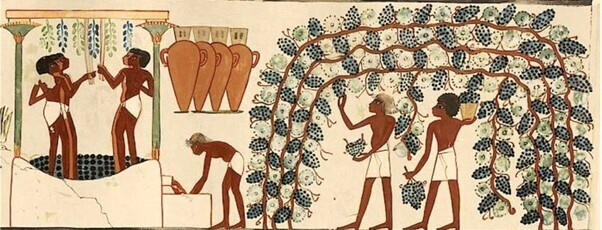
(C) West wall of the Tomb of Nakht
Egypt is widely known among Koreans as a land of ancient wonders—home to the Sphinx, the Pyramids, the Nile River, and Luxor. Yet far fewer people are aware that this land was also one of the world’s earliest wine-producing regions, with a history of winemaking dating back to around 3000 BCE. Archaeological evidence indicates that Egypt was a central hub of early wine civilization, where viticulture and winemaking techniques were already being developed in a highly systematic manner.
In ancient Egypt, wine was far more than a simple beverage. It was regarded as a sacred offering to the gods and a divine drink reserved for pharaohs and the nobility. Wall paintings discovered in royal tombs and temples vividly depict scenes of grape harvesting and wine production. Moreover, archaeologists have uncovered ancient wine storage vessels—known as amphorae—marked with inscriptions detailing the place of origin, the producer, the grape variety, and even the harvest year. These inscriptions bear a striking resemblance to modern wine labels, demonstrating that ancient Egyptian society already recognized and managed concepts of wine quality and provenance.
However, this rich winemaking tradition declined dramatically over time, particularly during the Islamic era. Religious and social transformations led to the gradual disappearance of wine production, and Egypt’s long-established wine culture faded into history. Although commercial wine production resumed in the early 20th century,
subsequent nationalization significantly weakened both quality and productivity, making it difficult for Egyptian wines to gain recognition on the international stage.
Amid this historical backdrop, a new chapter for Egyptian wine began along the Red Sea coast in El Gouna. El Gouna is a coastal resort city known for marine sports, tourism, and its vibrant international community, with a large foreign resident population and an open, cosmopolitan atmosphere. It was here that EGVBEV (Egyptian International Beverages Company) launched its winemaking operations in 2005, aiming to lead the revival of Egyptian wine.
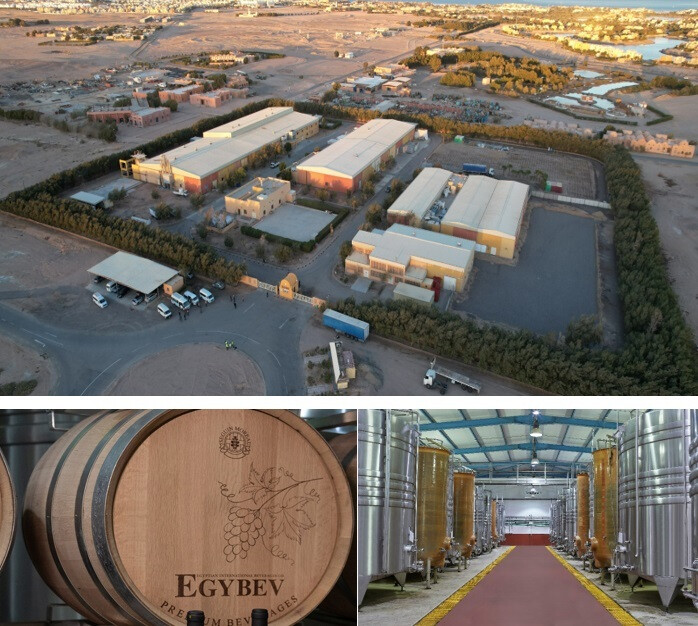
(C) Photos: Location of El Gouna, EGVBEV winery exterior and interior
To produce high-quality wines, EGVBEV introduced a wide range of international grape varieties from France and the Mediterranean region, while cultivating vineyards in the fertile soils of the Nile Delta near Alexandria. At the same time, the company sought to reconnect with Egypt’s ancient heritage by rediscovering a native grape variety known as Banati. Using this indigenous grape, EGVBEV began producing white wines that symbolically bridge Egypt’s ancient past with its modern winemaking revival. This effort has been widely recognized as a defining representation of contemporary Egyptian wine.
As a result of consistent quality improvements and innovation, wines under the Jardin du Nil and Beausoleil d’Egypt brands have earned accolades at prestigious international wine competitions, attracting growing global attention. After being largely forgotten for centuries, Egyptian wine is gradually reclaiming its place in the global wine market.
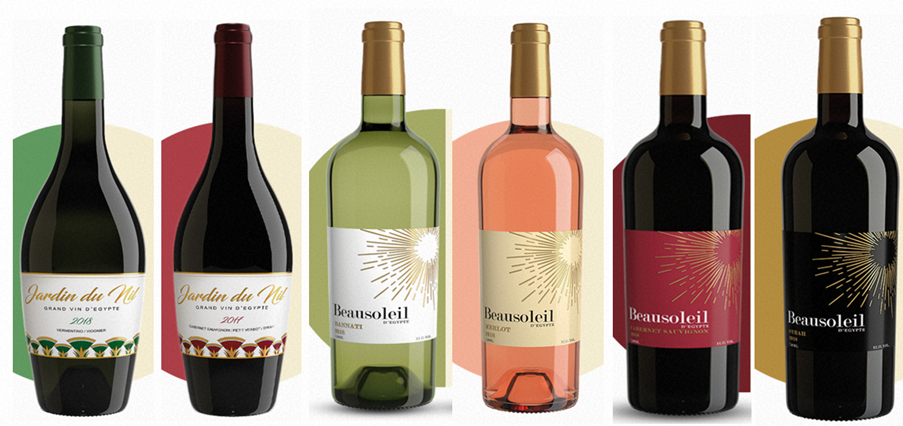
In the Korean wine market, traditional European wines from countries such as France and Italy, alongside New World wines from Chile, the United States, and Australia, continue to dominate. Within this landscape, wines produced in Egypt—the birthplace of one of the world’s earliest civilizations—offer consumers a unique gastronomic experience and an opportunity to expand their understanding of wine history and culture. These wines represent more than a new country of origin; they offer the rare experience of “drinking history.”
Currently, Egyptian wines are exclusively imported into Korea by “wineafrica” (wineafrica.co.kr), and distribution channels remain relatively limited. Nevertheless, the distinctive storytelling behind Egyptian wine, combined with its increasingly validated quality, is quietly attracting attention among wine enthusiasts. For those seeking to explore new dimensions of the wine world, Egyptian wine presents a compelling and worthwhile discovery.
[Copyright (c) Global Economic Times. All Rights Reserved.]