

The Donald Trump administration of the United States has officially stated that there is no change in its policy toward North Korea and that it remains firmly committed to achieving the “complete denuclearization of North Korea.”
In response to a written inquiry from the Kyunghyang Shinmun on August 26 (local time) regarding the U.S. stance on North Korea’s denuclearization, a U.S. State Department spokesperson stated, “The United States remains committed to the complete denuclearization of North Korea.” Another U.S. official also responded to a separate written query asking whether the denuclearization goal had changed, asserting, “There is no change whatsoever in U.S. policy.”
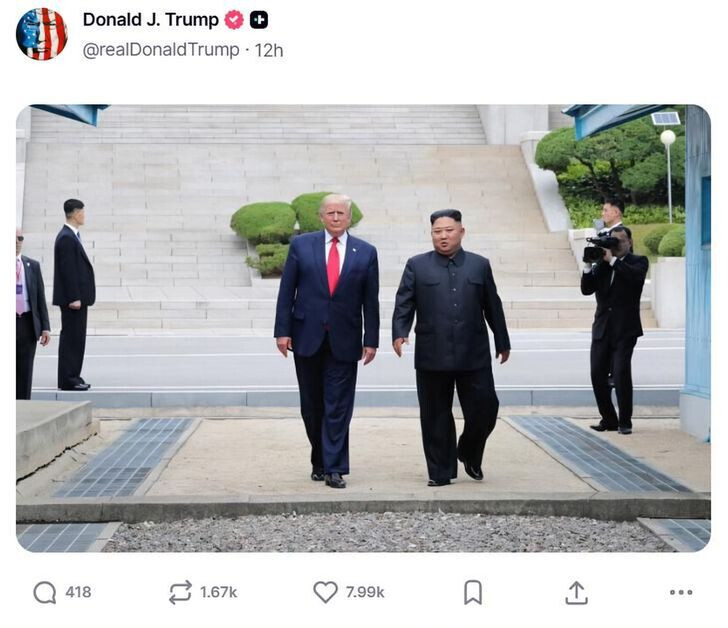
This official confirmation comes in the wake of mounting concerns within South Korea that Washington might be tacitly accepting North Korea as a nuclear state. These worries were sparked after President Donald Trump recently ordered a reduction in the South Korea-U.S. joint military exercise, “Ulchi Freedom Shield” (UFS), and extended an olive branch by expressing his intent to meet North Korean leader Kim Jong-un “within the year.”
Adding to the speculation, President Trump publicly mentioned for the first time on the 19th that North Korea possesses 57 “very powerful nuclear weapons.” Furthermore, when asked by a reporter whether his goal in resuming relations with Kim Jong-un was still denuclearization, Trump avoided a direct answer, stating, “I don’t want to talk about that.”
This evasive response was widely interpreted as Trump temporarily withholding his stance on the denuclearization issue, especially amid ongoing speculation that Pyongyang might demand official recognition as a nuclear-armed state as a prerequisite for holding a summit. Consequently, the latest statements from the State Department and U.S. officials are drawing significant attention as the first official clarifications following the scaling back of joint military drills and Trump’s ambiguous remarks.
In alignment with Washington's position, South Korea’s Ministry of Foreign Affairs also reiterated on the 25th that both Seoul and Washington share a unified objective regarding the North’s denuclearization. During a regular briefing, Ministry Spokesperson Park Doo-sun stated, “As outlined in the joint explanatory statement from the South Korea-U.S. summit last November, both countries consistently maintain their shared goals of peace, stability, and denuclearization on the Korean Peninsula.”
Background and Strategic Context
To understand the broader implications of these developments, it is essential to examine the historical trajectory of U.S.-North Korea summits and nuclear negotiations. The diplomatic landscape has evolved significantly since the landmark 2018 Singapore summit between President Trump and Chairman Kim Jong-un. While Trump has historically favored a top-down leadership diplomacy approach, critics and foreign policy experts have frequently debated whether this strategy prioritizes short-term political breakthroughs over long-term, irreversible arms control or complete denuclearization.
Recent geopolitical dynamics, including tightening military cooperation between Pyongyang and Moscow as well as ongoing tensions on the Korean Peninsula, have further complicated international security calculations. The Trump administration’s recent tactical adjustments—such as moderating joint exercises while signaling a willingness for high-level dialogue—reflect a delicate balancing act. Washington appears to be keeping the diplomatic door open for engagement to manage regional stability and deter provocations, while simultaneously reiterating its formal commitment to the ultimate objective of a denuclearized Korean Peninsula to reassure regional allies like South Korea.
[Copyright (c) Global Economic Times. All Rights Reserved.]