![[등록] 2026-09-01 15:48:31](/support/_updata/banner2/tl181982910_6749.png)


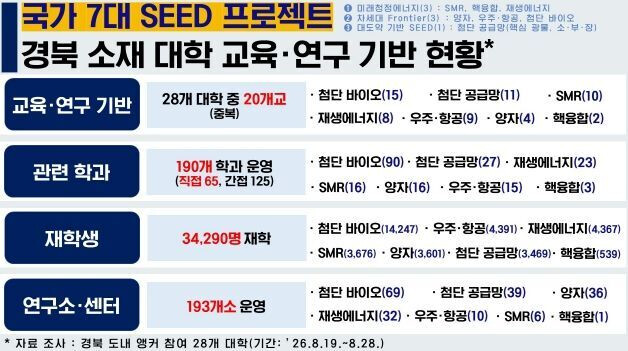
Following the South Korean government's official announcement of the "7 Major SEED Projects Report Meeting"—held on August 12 at the Blue House under the presidency to secure new national growth engines in the post-AI era—Gyeongbuk Province has announced that its local universities are exceptionally well-equipped with the necessary educational and research infrastructure to support these strategic initiatives.
The national "7 Major SEED Projects" initiative is a visionary state-led strategy designed to nurture core advanced technologies that serve as the fundamental seeds of innovation, economic resilience, and national security. The initiative focuses heavily on seven pivotal high-tech domains: Small Modular Reactors (SMRs), nuclear fusion, renewable energy, quantum technology, aerospace, advanced biotechnology, and advanced supply chains encompassing critical minerals, materials, parts, and equipment (often referred to as 'Sobujang'). These fields represent critical next-generation frontiers intended to safeguard the country's economic sovereignty and technological leadership over the next 10 to 20 years amidst mounting global challenges such as climate change, supply chain volatility, and the sweeping AI revolution.
Recognizing that top-tier academic and research capabilities serve as the ultimate catalyst for the success of these SEED projects, Gyeongbuk Province swiftly initiated a comprehensive internal investigation. The survey targeted 28 anchor universities within the region operating under the Regional Innovation System (RISE) framework. The evaluation meticulously examined related academic departments, student enrollments, and active research institutes or centers across the region.
The survey results revealed that 20 out of the 28 evaluated universities possess robust, direct foundations aligned with the national SEED sectors. Specifically, the region boasts an impressive academic and research ecosystem comprising 65 directly related departments, 190 broad-spectrum related departments, a dedicated student body totaling 34,290 individuals, and 193 specialized research institutes and centers. This extensive infrastructure demonstrates Gyeongbuk's readiness to immediately absorb national strategic mandates and translate them into practical workforce development and technological breakthroughs.
Building upon this solid foundation, Gyeongbuk Province plans to establish a systematic, university-led talent cultivation and research support framework to foster a thriving high-tech educational ecosystem. As part of its strategic implementation, the province will integrate SEED-related programs into the restructuring of its anchor RISE projects, strengthen budgetary support for existing related initiatives, and actively apply for upcoming national SEED project public contest programs. By synergizing regional academic strengths with national funding, the province aims to create a self-sustaining cycle of innovation.
Gyeongbuk Provincial Governor Lee Cheol-woo emphasized the profound significance of these initiatives, stating, "In a rapidly shifting technological landscape, securing the next-generation economic drivers for the next 10 to 20 years is of paramount importance. Gyeongbuk will actively step up at the local government level to build future growth foundations, ensuring the successful implementation of both the government's 3 major Mega projects and the 7 major SEED projects."
Governor Lee further underscored, "By fully leveraging our well-established educational and research infrastructure across local universities, we will prioritize nurturing advanced talent led by higher education institutions and fostering collaborative research ecosystems connected with industry enterprises. Through these concerted efforts, Gyeongbuk will strive to become South Korea's ultimate hub of future growth dynamics—a vibrant region where young people naturally gather and build their futures."
Contextual Background and Broader Implications:
The national 7 Major SEED Projects arrive at a critical juncture when traditional manufacturing and standard IT paradigms are no longer sufficient to guarantee economic dominance. Advanced economies worldwide are heavily subsidizing foundational technologies, treating scientific research capacity as a matter of national security. Gyeongbuk Province, traditionally known as a powerhouse for heavy industry and energy infrastructure (including nuclear power plants in operation), possesses unique geographical and industrial advantages that align seamlessly with capital-intensive sectors like SMRs, nuclear fusion, and advanced materials.
By mobilizing its 20 competent universities and nearly 200 research centers, Gyeongbuk is not merely responding to a central government policy directive; it is redefining its regional economic identity. Transitioning from a manufacturing-centric economy to an intellectual property and high-tech talent hub requires deep synergy between academia, regional governance, and private enterprise. The province’s proactive mapping of its academic assets ensures that state investments will yield immediate returns in human capital, preventing regional brain drain and attracting high-tech corporations seeking proximity to skilled talent and research facilities. Ultimately, Gyeongbuk's strategy serves as a prominent model for regional autonomy and specialized growth, proving that local educational ecosystems can successfully drive national technological sovereignty in the twenty-first century.
[Copyright (c) Global Economic Times. All Rights Reserved.]