• 2026.11.11 (Wed)
  • All articles
  • LOGIN
  • JOIN
Global Economic Times
[등록] 2026-09-01 15:48:31
  • Synthesis
  • World
  • Business
  • Industry
  • ICT
  • Distribution Economy
  • Well+Being
    • Pet Life
    • Halal Horizon
  • Travel
  • Eco-News
  • Education
  • Korean Wave News
  • Opinion
  • Arts&Culture
  • Sports
  • People & Life
    • International Student Report
    • With Ambassador
  • Column
    • Cho Kijo Column
    • Cherry Garden Story
    • Ko Yong-chul Column
    • Kim Bong-seon's Photo Column
    • Kim Seul-Ong Column
    • Lee Yeon-sil Column
  • Photo News
  • New Book Guide
MENU
 
Home > Well+Being

Beer, Liquor, Wine… Do Health Risks Vary by Alcohol Type?

Kim Sungmoon Reporter / Updated : 2026-11-01 11:17:51
  • -
  • +
  • Print

Research suggests that not only how much you drink, but also the type of alcohol you consume, can influence its impact on health.

However, experts advise caution, noting that this study may not fully reflect the average drinking patterns of Koreans, and that differences in health outcomes could stem from drinkers' lifestyles or socioeconomic characteristics.

According to a recent issue of the international journal Nutrition Journal, a joint research team from South Korea, China, the United States, and Europe analyzed the relationship between alcohol consumption volume, beverage types, and mortality risk among 340,924 adults aged 40 to 70 registered in the UK Biobank.

The average follow-up period was 13.4 years, during which a total of 22,381 deaths were recorded. Causes of death included 11,063 cancer cases, 4,288 cardiovascular disease cases, and 7,030 from other causes.

The researchers categorized participants into four groups based on pure alcohol intake: "rarely drinks," "low-intake group," "moderate-intake group," and "high-intake group."

The "rarely drinks" group consumed 20g or less of pure alcohol per week for both men and women. The high-intake group was defined as consuming more than 40g per day for men and more than 20g per day for women. Converted into beer with an alcohol content of 5%, this translates to men drinking more than roughly 1,000mL and women drinking more than about 500mL per day.

The analysis revealed that the high-intake group had a 24% higher overall mortality risk compared to the "rarely drinks" group. Specifically, cardiovascular disease mortality risk increased by 14%, and cancer mortality risk by 36%.

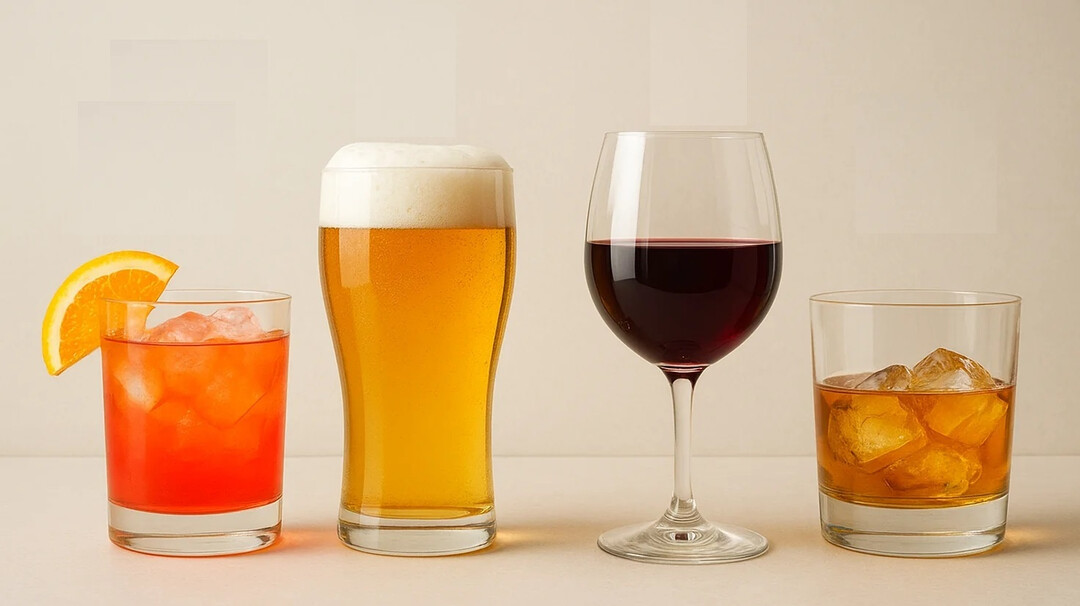
Notably, distinct differences in mortality risk emerged depending on the type of alcohol consumed.

Individuals who heavily consumed beer and cider (apple-fermented wine) showed a 51% higher overall mortality risk, a 47% higher cardiovascular disease mortality risk, and a 66% higher cancer mortality risk compared to those who rarely drank those beverages. Even in the low-intake group, cancer mortality risk increased by 7%.

Distilled spirits such as whiskey and vodka showed a correlation with increased mortality risk even at low drinking levels. The low-intake group for distilled spirits had an 8% higher overall mortality risk, a 9% higher cardiovascular disease mortality risk, and a 7% higher cancer mortality risk than the "rarely drinks" group. In the moderate-or-higher intake groups, these figures spiked by 62%, 51%, and 55%, respectively.

In contrast, wine showed a different pattern. Individuals who consumed wine in small amounts had an 11% lower overall mortality risk, a 14% lower cardiovascular disease mortality risk, and an 8% lower cancer mortality risk compared to those who rarely drank wine.

Among moderate wine drinkers, the overall mortality risk was 8% lower, and the cardiovascular disease mortality risk was 21% lower. However, heavy wine consumption still increased cancer mortality risk by 10%.

The research team suggested that the relatively lower mortality risks observed with wine could potentially be linked to antioxidants like resveratrol found in red wine. Nevertheless, they noted that wine drinkers often tend to have higher dietary quality, as well as differences in lifestyles and socioeconomic status compared to fans of other alcohol types, meaning it cannot be definitively concluded that wine itself lowered the mortality risk.

[Copyright (c) Global Economic Times. All Rights Reserved.]

  • #Cherry Garden
  • #HalalFood
  • #Halal
  • #Petlife
  • #Halalhorizone
  • #Hormuz Impasse
  • #globaleconomictimes
  • #micorea
  • #mykor
Kim Sungmoon Reporter

Popular articles

  • Alteogen Expands Growth Horizon with In-House Production and Sales Beyond Its 83% Platform-Driven Revenue

  • 30-Year Senior-Junior Duos to In-House Couples: Building AI Services All Night Without Knowing How to Code

  • Daejeon Secures 6 Spots in "2026 Defense Innovation Enterprise 100", Cementing Status as a High-Tech Defense Hub

I like it
Share
  • Facebook
  • X
  • Kakaotalk
  • LINE
  • BAND
  • NAVER
  • https://www.globaleconomictimes.kr/article/1065579129013910 Copy URL copied.
Comments >

Comments 0

Weekly Hot Issue

  • Inha University Caught in Campus Culture Clash Over Proposed Rhee Syng-man Statue Revival
  • Honoring a Legacy: Poet Oh Dong-chun Recognized for Lifelong Dedication to Hangul and Sijo Poetry
  • Bongeunsa Temple to Host 2026 Patriotic Buddhism Cultural Festa
  • South Korea Confronts a Growing Health Crisis as Adult Obesity Rates Surge
  • Pain of Chosei Coal Mine Meets Japanese Readers: Moon Young-sook Publishes Japanese Edition of 'Black Sea'
  • Beyond the Trillion-Dollar Mark: China’s Trade Surplus and the Debate Over Global Economic Dominance

Most Viewed

1
US Army Conducts Rare Temporary Burial Drills to Prepare for Worst-Case Large-Scale War Scenarios
2
World Citizens are Flying Directly to Busan... The Era of 4 Million Foreigners is Just Around the Corner
3
Eating 100g of Baechu Kimchi Daily Linked to Lower High-Cholesterol Risks
4
Meeting Christmas Early!… Busan Dessert Sales Event "Daldal The Market" Held
5
November Shopping Festival Sparks Retail War in South Korea: Where to Find the Best Deals
체리가든 스토리
nutri huevos
로타리
동포저널

Hot Issue

Jensen Huang Faces Shareholder Class Action and Leadership Scrutiny Amid Espionage Allegations Involving Former Associate

Disgraced South Korean Scientist Hwang Woo-suk Becomes UAE Citizen

Is South Korea Heading Toward France's Path? Aging Population and Fiscal Pressures Looming Ahead

Fashion Runway Show 2026

Let’s recycle the old blankets in Jeju Island’s closet instead of incinerating them.

Global Economic Times
korocamia@naver.com
CEO : LEE YEON-SIL
Publisher : KO YONG-CHUL
Registration number : Seoul, A55681
Registration Date : 2024-10-24
Youth Protection Manager: KO YONG-CHUL
Singapore Headquarters
5A Woodlands Road #11-34 The Tennery. S'677728
Korean Branch
Phone : +82(0)10 4724 5264
#304, 6 Nonhyeon-ro 111-gil, Gangnam-gu, Seoul
Copyright © Global Economic Times All Rights Reserved
  • News K
  • 반달곰 프로젝트
  • 광고문의
Search
Category
  • All articles
  • Synthesis
  • World
  • Business
  • Industry
  • ICT
  • Distribution Economy
  • Well+Being 
    • 전체
    • Pet Life
    • Halal Horizon
  • Travel
  • Eco-News
  • Education
  • Korean Wave News
  • Opinion
  • Arts&Culture
  • Sports
  • People & Life 
    • 전체
    • International Student Report
    • With Ambassador
  • Column 
    • 전체
    • Cho Kijo Column
    • Cherry Garden Story
    • Ko Yong-chul Column
    • Kim Bong-seon's Photo Column
    • Kim Seul-Ong Column
    • Lee Yeon-sil Column
  • Photo News
  • New Book Guide
  • Overseas Koreans
  • Multicultural News