• 2026.11.11 (Wed)
  • All articles
  • LOGIN
  • JOIN
Global Economic Times
[등록] 2026-09-01 15:48:31
  • Synthesis
  • World
  • Business
  • Industry
  • ICT
  • Distribution Economy
  • Well+Being
    • Pet Life
    • Halal Horizon
  • Travel
  • Eco-News
  • Education
  • Korean Wave News
  • Opinion
  • Arts&Culture
  • Sports
  • People & Life
    • International Student Report
    • With Ambassador
  • Column
    • Cho Kijo Column
    • Cherry Garden Story
    • Ko Yong-chul Column
    • Kim Bong-seon's Photo Column
    • Kim Seul-Ong Column
    • Lee Yeon-sil Column
  • Photo News
  • New Book Guide
MENU
 
Home > Well+Being

“If You Always Throw Away Half a Head of Blackened Cabbage”… Do This Before Putting It in the Fridge

Eunsil Ju Reporter / Updated : 2026-10-24 11:27:01
  • -
  • +
  • Print

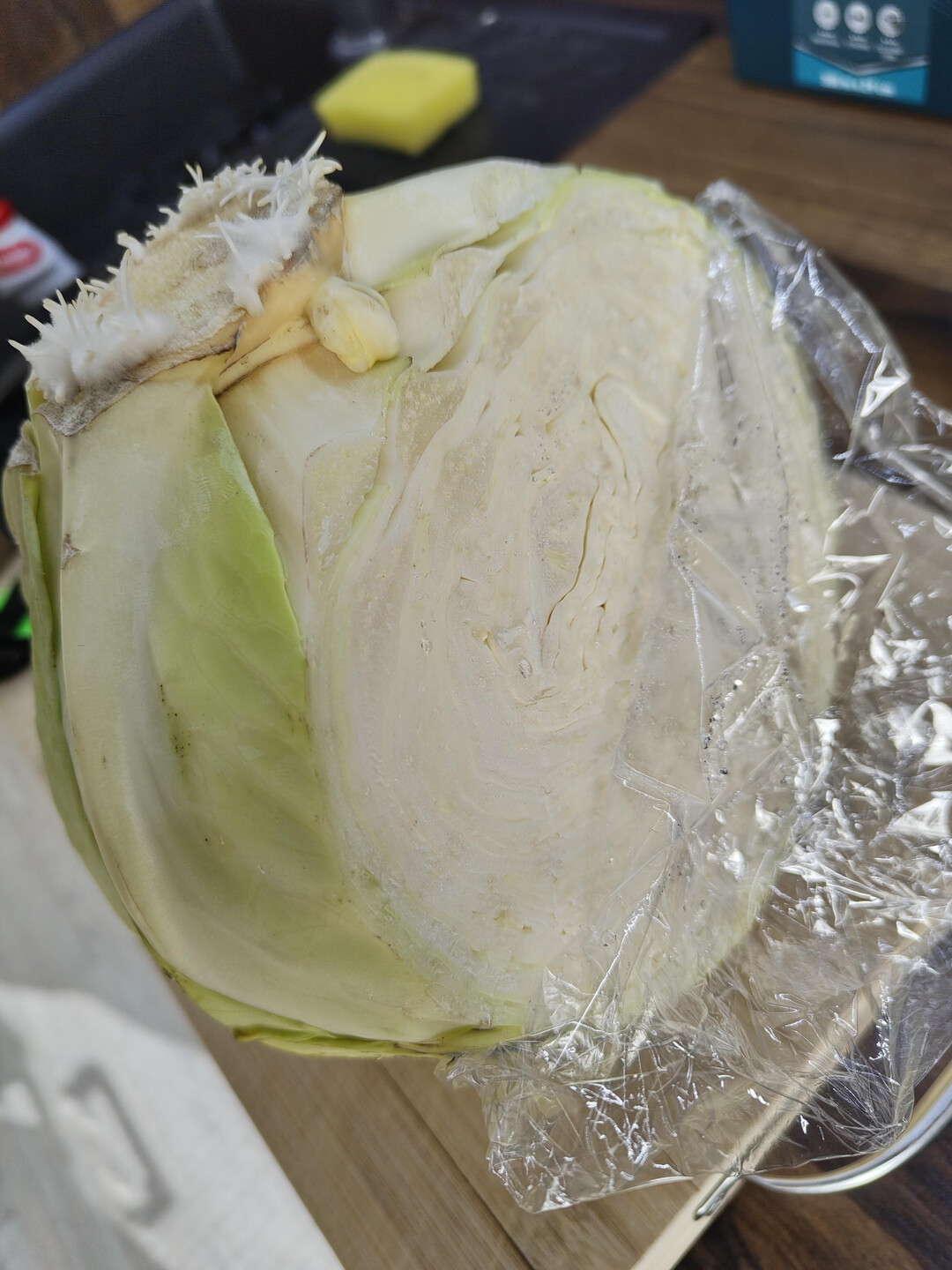
Cabbage is a vegetable that is rarely consumed all at once when bought as a whole head. Many of you have likely cut a head in half for stir-fries or salads, stored it in the fridge, and ended up throwing it away a few days later because the cross-section dried out and changed color. When this happens, it's time to change how you store cut cabbage. Covering the cut surface with a kitchen towel and putting it in a bag for refrigeration helps reduce moisture loss. Mike Markowitz, an associate professor in the College of Culinary Arts at Johnson & Wales University, advised in an article for the American lifestyle and cooking media outlet Martha Stewart earlier this year that cut cabbage should be stored in the refrigerator in an airtight container or bag if you want to keep it fresh for a longer time. He explained that areas with frequent temperature fluctuations, like the refrigerator door, should be avoided, and cut cabbage is best used within three days if possible.

When cabbage is cut, its internal tissues, previously protected by the outer leaves, come into direct contact with air. As moisture escapes, the leaves dry out, and the cut surface easily browns. The Postharvest Technology Center at the University of California, Davis, also explains that browning can occur during storage when fresh cabbage is finely cut or shredded. The storage method is simple. First, after cutting the cabbage, gently wipe away any moisture on the surface with a kitchen towel. Cover the entire cut surface with a dry kitchen towel, place it in a plastic bag or an airtight container, and store it in the vegetable compartment of the refrigerator. It is best to replace the kitchen towel with a new one if it becomes damp. At this time, it is better to wash the cabbage when you are ready to use it rather than washing it beforehand. This is because residual moisture can easily make the surface soggy. American culinary experts also recommend avoiding unnecessary moisture during storage and prepping only as much as needed at the time of use.

Wherever it shines, Starbucks RTD

However, a kitchen towel does not completely prevent cabbage from browning. Covering the cut surface and placing it in a bag is a practical everyday storage tip to minimize moisture loss. The storage period may vary depending on the type and freshness of the cabbage, as well as the refrigerator temperature. It is safest to aim to consume cut cabbage within three days and avoid eating it if signs of spoilage appear, such as an odor, mushiness, or stickiness. If you haven't cut the cabbage yet, another method is to peel off only as many leaves as you need. When storing it whole, do not unnecessarily peel away the outer leaves, and place the cabbage in a bag or container for refrigeration. According to data from the University of California, Davis, low temperatures and high relative humidity are important for maintaining quality when storing cabbage for a long time. While it is convenient to shred the entire head of cabbage at once, a larger cut surface area can accelerate moisture loss and discoloration. American culinary experts also recommend cutting cabbage as close to the time of use as possible. If you buy a whole head and need to store it for a long time, it is more advantageous to keep it whole and slice off only what you need for cooking.

If you want to keep leftover cabbage for even longer, freezing is also an option. However, since thawed cabbage loses its crunchy texture, it is better suited for cooked dishes like soups, stews, or stir-fries rather than salads. Culinary experts recommend blanching the cabbage for 1 to 2 minutes before freezing, cooling it in ice water, thoroughly removing the moisture, and placing it in an airtight freezer bag.

[Copyright (c) Global Economic Times. All Rights Reserved.]

  • #Cherry Garden
  • #HalalFood
  • #Halal
  • #Petlife
  • #Halalhorizone
  • #Hormuz Impasse
  • #globaleconomictimes
  • #micorea
  • #mykor
Eunsil Ju Reporter
Eunsil Ju Reporter

Popular articles

  • Eating 100g of Baechu Kimchi Daily Linked to Lower High-Cholesterol Risks

  • "No Rest Even After Work"… The 63 Million American Adults Trapped in an Endless Cycle of Caregiving

  • Beyond Product Sales to Services… The Opening of a New 'K-Beauty Intermediation' Industry

I like it
Share
  • Facebook
  • X
  • Kakaotalk
  • LINE
  • BAND
  • NAVER
  • https://www.globaleconomictimes.kr/article/1065579957345782 Copy URL copied.
Comments >

Comments 0

Weekly Hot Issue

  • Inha University Caught in Campus Culture Clash Over Proposed Rhee Syng-man Statue Revival
  • Honoring a Legacy: Poet Oh Dong-chun Recognized for Lifelong Dedication to Hangul and Sijo Poetry
  • Bongeunsa Temple to Host 2026 Patriotic Buddhism Cultural Festa
  • South Korea Confronts a Growing Health Crisis as Adult Obesity Rates Surge
  • Pain of Chosei Coal Mine Meets Japanese Readers: Moon Young-sook Publishes Japanese Edition of 'Black Sea'
  • Beyond the Trillion-Dollar Mark: China’s Trade Surplus and the Debate Over Global Economic Dominance

Most Viewed

1
US Army Conducts Rare Temporary Burial Drills to Prepare for Worst-Case Large-Scale War Scenarios
2
World Citizens are Flying Directly to Busan... The Era of 4 Million Foreigners is Just Around the Corner
3
Eating 100g of Baechu Kimchi Daily Linked to Lower High-Cholesterol Risks
4
Meeting Christmas Early!… Busan Dessert Sales Event "Daldal The Market" Held
5
November Shopping Festival Sparks Retail War in South Korea: Where to Find the Best Deals
체리가든 스토리
nutri huevos
로타리
동포저널

Hot Issue

Jensen Huang Faces Shareholder Class Action and Leadership Scrutiny Amid Espionage Allegations Involving Former Associate

Disgraced South Korean Scientist Hwang Woo-suk Becomes UAE Citizen

Is South Korea Heading Toward France's Path? Aging Population and Fiscal Pressures Looming Ahead

Fashion Runway Show 2026

Let’s recycle the old blankets in Jeju Island’s closet instead of incinerating them.

Global Economic Times
korocamia@naver.com
CEO : LEE YEON-SIL
Publisher : KO YONG-CHUL
Registration number : Seoul, A55681
Registration Date : 2024-10-24
Youth Protection Manager: KO YONG-CHUL
Singapore Headquarters
5A Woodlands Road #11-34 The Tennery. S'677728
Korean Branch
Phone : +82(0)10 4724 5264
#304, 6 Nonhyeon-ro 111-gil, Gangnam-gu, Seoul
Copyright © Global Economic Times All Rights Reserved
  • News K
  • 반달곰 프로젝트
  • 광고문의
Search
Category
  • All articles
  • Synthesis
  • World
  • Business
  • Industry
  • ICT
  • Distribution Economy
  • Well+Being 
    • 전체
    • Pet Life
    • Halal Horizon
  • Travel
  • Eco-News
  • Education
  • Korean Wave News
  • Opinion
  • Arts&Culture
  • Sports
  • People & Life 
    • 전체
    • International Student Report
    • With Ambassador
  • Column 
    • 전체
    • Cho Kijo Column
    • Cherry Garden Story
    • Ko Yong-chul Column
    • Kim Bong-seon's Photo Column
    • Kim Seul-Ong Column
    • Lee Yeon-sil Column
  • Photo News
  • New Book Guide
  • Overseas Koreans
  • Multicultural News