![[등록] 2026-09-01 15:48:31](/support/_updata/banner2/tl181982910_6749.png)


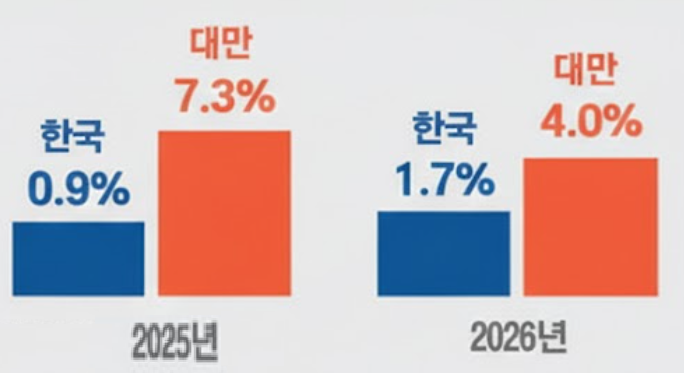
The Asian Development Bank (ADB) has revised its economic growth forecast for South Korea this year to 3.2%, marking a 0.6 percentage point increase from its previous projection of 2.6% in July. On the same day, Taiwan’s growth forecast for the year was dramatically bumped up from 9.5% to 11.0%. While both economies cited the booming exports of semiconductors and artificial intelligence (AI) as the core drivers for these upward revisions, the gap in their projected growth rates has widened significantly to 7.8 percentage points.
In its "Asian Development Outlook (ADO) September Supplement" released on September 23, the ADB raised South Korea’s growth forecast for two consecutive periods, moving from 2.6% in July to 3.2% now. This represents a cumulative upward adjustment of 1.3 percentage points over a span of five months. The ADB grounded this positive outlook on the resilient trends observed in manufacturing Purchasing Managers' Indexes (PMIs) and Business Survey Indexes (BSIs) during July and August. However, the growth forecast for next year was only slightly revised upward from 2.0% to 2.3%, falling nearly 1 percentage point short of this year’s pace. As key downside risks, the ADB highlighted escalating geopolitical tensions, heightened volatility in global financial markets, and the potential implementation of additional tariffs by the United States.
With this latest upgrade, the ADB’s projection for South Korea matches that of the Korea Development Institute (KDI) at 3.2%. It sits 0.1 percentage point lower than the Bank of Korea's forecast of 3.3% issued last month, yet remains higher than the government’s projection of 3.0% and those of the OECD and IMF, both at 2.6%. Projections for next year, however, display a wide divergence across forecasting bodies. The Bank of Korea (2.9%) and the IMF (2.5%) are more optimistic than the ADB (2.3%), whereas the KDI (2.2%), the South Korean government (2.2%), and the OECD (1.9%) maintain more conservative views. Meanwhile, inflation forecasts for South Korea remain unchanged from July at 2.7% for this year and 2.2% for next year.
The most striking highlight of this ADB report is undoubtedly Taiwan. The ADB’s 11.0% growth forecast for Taiwan aligns closely with the 11.05% projection released last month by Taiwan’s Directorate-General of Budget, Accounting and Statistics (DGBAS). The DGBAS has steadily raised its outlook three consecutive times this year, from 7.71% in February to 9.64% in May, and now to double digits. If these figures hold, Taiwan is on track to record its highest annual growth rate since 1988, marking its second consecutive year of robust expansion following last year's 8.76% and achieving its first-ever double-digit growth rate in history.
Taiwanese authorities explained that stronger-than-expected global demand for AI infrastructure investment is fueling a broad-based boom that extends beyond exports into private consumption and private investment. This indicates that the semiconductor-led export surge is permeating deeply into the broader domestic economy, boosting consumer spending and corporate capital expenditures alike. Looking ahead, Taiwan’s growth for next year is projected at 6.04% by local authorities and 5.0% by the ADB.
While both South Korea and Taiwan attribute their upward revisions primarily to soaring AI semiconductor exports, experts point out a structural difference in how these benefits transmit through their respective economies. In a previous assessment last month, the KDI noted that while South Korea's semiconductor boom is clearly visible in exports and facility investment, its spillover into private consumption remains modest because income growth has been heavily concentrated within the semiconductor sector itself. This contrasts sharply with Taiwan's scenario, where authorities report synchronized strength across exports, investments, and consumption alike.
The primary risk factors identified by both nations also heavily overlap. Taiwanese authorities cited Middle Eastern geopolitical tensions, fluctuating energy prices, U.S. tariff policies, and the sustainability of global corporate AI investments as key variables. These largely mirror the geopolitical tensions, financial market volatility, and U.S. tariff risks identified by the ADB for South Korea. Ultimately, the sustainability of the global AI investment cycle has emerged as a shared lifeline and vulnerability for both economies.
Driven by these semiconductor and AI supply chain dynamics, the growth forecast for the advanced economies group in the Asia-Pacific region, which includes South Korea and Taiwan, was revised upward by 0.5 percentage points to 3.1% for this year. Other regional powerhouses also saw substantial increases, with Singapore jumping from 3.2% to 5.0% and Hong Kong moving from 3.0% to 4.2%. Conversely, advanced economies less tightly bound to the current tech boom, such as Japan (0.7%) and Australia (2.0%), saw no changes to their forecasts, underscoring that tech-centric supply chain participation is dictating the current economic divergence across the region.
[Copyright (c) Global Economic Times. All Rights Reserved.]