![[등록] 2026-09-01 15:48:31](/support/_updata/banner2/tl181982910_6749.png)


The Sejong Special Self-Governing City (Mayor Cho Sang-ho) is conducting a comprehensive investigation of farmlands through December in alignment with the government's subsequent improvement directions for farmland investigations.
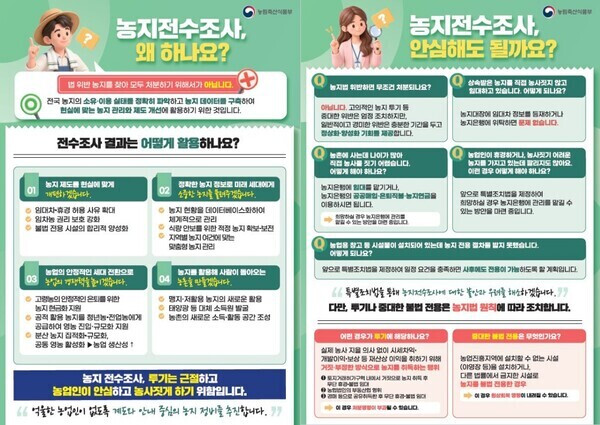
In this investigation, the city plans to respond firmly to clear speculative activities, while providing opportunities for explanation and self-correction for minor violations inevitably occurring in rural realities.
Previously, the Ministry of Agriculture, Food and Rural Affairs and the ruling party agreed during a consultative meeting on the 21st to take action against illegal acts for speculative purposes in accordance with laws and principles, while establishing measures to normalize violations caused by inheritance, aging, and customary lease agreements.
Accordingly, the government plans to pursue the enactment of a special measure act to secure the necessary grounds for entrusting farmland to the Korea Rural Community Corporation (Farmland Bank), protecting tenant farmers, deferring disposition, and permitting retroactive conversion of curable illegally converted farmlands.
In particular, inherited and retired-farmer farmlands as well as customarily leased farmlands will be normalized through Farmland Bank consignment, and improvements will be made so that farmlands difficult to cultivate due to old age or unfavorable farming conditions can also have their management rights entrusted to the Farmland Bank.
For curable illegal conversion facilities such as agricultural warehouses that do not conflict with the Farmland Act and other statutes, the city also plans to review requirements, impose farmland preservation charges, and permit retroactive conversion.
Sejong City also plans to respond by distinguishing between speculative violations and minor violations arising from rural realities, applying the same criteria as the government.
For acts of acquiring farmland through false or fraudulent methods to gain market profits or development profits, and serious illegal conversions such as establishing campsites or storage yards within agricultural promotion zones, necessary measures such as disposition orders or restoration to original state will be pursued in accordance with relevant laws.
On the other hand, for farmlands difficult to cultivate due to old age or illness, or customary lease agreements, the city will check the circumstances of owners and cultivators, and provide prior guidance on self-correction methods permitted under current laws, such as resuming cultivation, transitioning to legitimate lease agreements, or consigning to the Farmland Bank.
Matters requiring institutional improvements, such as the enactment of special measure acts, will be processed in accordance with legal standards to be established in the future.
The city completed basic investigations on 52,954 parcels (6,291 hectares) of farmland within its jurisdiction from May to July, and is conducting in-depth investigations through December targeting 35,890 selected parcels (4,165 hectares).
During the in-depth investigation, officials in charge of towns and townships (eup and myeon) and farmland inspectors from the National Agricultural Products Quality Management Service will verify the sites.
The city plans to comprehensively review explanation materials from owners and cultivators and actual utilization status rather than concluding whether a violation occurred based solely on investigation results.
In addition, by gathering opinions from farmers and agricultural organizations in the future, the city plans to directly petition the ruling party and government to reflect field opinions in institutional improvements, including relaxing farmland lease systems, preparing farmland market stabilization measures, securing flexibility in farmland disposition procedures, relaxing capital gains tax reduction systems, and easing farmland loan regulations.
Kim Hoe-san, Director-General of the Urban-Rural Integration Bureau, stated, "Sejong City will do its utmost to ensure that opinions from the field are sufficiently reflected. We will provide sufficient opportunities for explanation and self-correction so that bona fide farmers and actual cultivators do not suffer disadvantages, and strive to ensure that difficulties in the field lead to institutional improvements."
[Copyright (c) Global Economic Times. All Rights Reserved.]