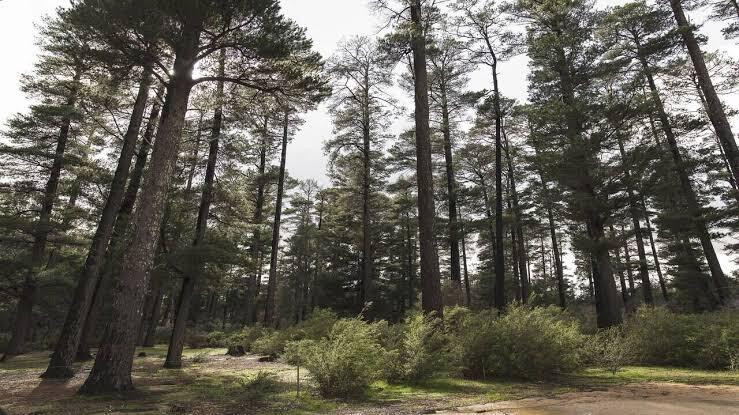
POHANG — Forests across the Pohang region are turning a desolate red as a devastating combination of pine wilt disease and climate change decimates the area's pine trees. This crisis is pushing local forestry workers, who have relied on pine trees for their livelihoods, to the brink of financial ruin, prompting urgent calls for government intervention.
According to a recent aerial and drone survey conducted by the Pohang city government, an estimated 4.8 million dead pine trees have been identified across local forests. Experts warn that given the distribution of pine and maritime pine trees throughout the region, this goes far beyond a localized issue—the local pine forest ecosystem has reached a critical "ecological tipping point" where its structural balance is collapsing.
As the pine ecosystem unravels, the fallout is rapidly spreading from traditional pine mushroom (songi) harvesters to commercial landscape tree nurseries. In the Pohang region, a significant overlap exists between these two groups, as many landscape business operators also harvest pine mushrooms in the autumn.
The hardest hit are the mushroom farmers who harvest during the autumn season. Data from the Pohang City Forestry Cooperative, the region's largest pine mushroom market, reveals that total mushroom auction volumes plummeted to just 973 kilograms by late October. This represents a staggering 90 percent drop compared to 11,151 kilograms three years ago, effectively wiping out the foundation of local pine mushroom production.
High-value landscape pines are also suffering catastrophic damage. Dead, brown pine trees are increasingly common sights along urban streets and roadways. Furthermore, prized ornamental pines that were being cultivated and prepared for shipment in nurseries are now dying en masse.
Industry insiders note that a large number of Pohang's landscape nursery operators depend on autumn mushroom foraging to supplement their income. With annual revenues instantly wiped out and decades-old physical assets perishing, these workers face unprecedented financial ruin.
At one landscape nursery in Pohang's Sin-gwang township, over 130 rare and premium pine trees cultivated over decades have withered and died. The estimated total damage reaches billions of Korean won, including a top-grade jinbaek (Chinese juniper/pine variety) valued at 150 million won alone.
Following a professional appraisal requested by the nursery to determine the cause of death, specialists concluded that pine wilt disease, compounded by global warming and prolonged droughts, was the decisive factor. Rising temperatures and extended dry spells weakened the trees' natural immune systems, accelerating both nematode infections and fatal moisture deprivation.
In the landscaping industry, pine trees represent an absolute core asset, accounting for the vast majority of nursery revenue and farm equity. Because shaping a single tree requires decades of meticulous labor and capital, mature specimens command prices ranging from tens of millions to hundreds of millions of won. However, as climate adaptation limits are breached, even these prized ornamental trees are perishing rapidly.
Critics point out that current forestry authorities' prevention policies remain narrowly focused on clearing dead trees in public forests, leaving specialized forestry households—who have poured massive capital and labor into mushroom and nursery cultivation—trapped in a institutional blind spot with virtually no disaster compensation or structural support.
"With our annual mushroom harvest gone and decades of hard-earned nursery assets dying off, we are completely devastated," said Mr. Hong (68), who has long combined mushroom foraging with running a landscape nursery in Sin-gwang. "Despite this being a climate-induced disaster, government and municipal support for compensation or transition to alternative tree species is drastically lacking."
He added, "Even if we wanted to sell our cultivation land to escape, the real estate downturn has frozen transactions. And wanting to switch to climate-resilient alternative species is impossible because we lack the necessary funds to replant."
Amid escalating desperation, a group of 17 affected forestry workers plans to visit the Pohang City Council to highlight the dire conditions on the ground—specifically the mass die-off of landscape trees and the plunge in mushroom production—while strongly urging the establishment of support measures for alternative crop transitions and disaster relief.
[Copyright (c) Global Economic Times. All Rights Reserved.]