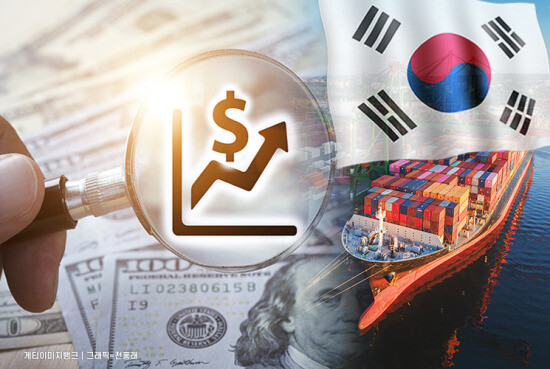
The Bank of Korea (BOK) has sharply revised up its economic growth forecast for South Korea next year from 2.9% to 4.1%. The growth outlook for this year was also raised from 3.3% to 3.9%.
In its revised economic outlook released on the 26th, the BOK raised its real Gross Domestic Product (GDP) growth forecast for next year by 1.2 percentage points, from 2.9% to 4.1%. If realized, this will mark the first time the economy has grown in the 4% range since 2021 (4.7%).
After initially projecting next year's growth rate at 1.9% in November last year, the BOK lowered it to 1.8% in February, then raised it to 2.1% in May and 2.9% in August, before skipping the 3% range altogether to jump into the 4% range this time.
The upward revision for next year's growth outlook is the largest since the BOK began issuing next-year growth forecasts in December 2008. The previous record was in December 2009, right after the global financial crisis, when the BOK raised its forecast for the following year by 1.0 percentage point from 3.6% to 4.6%. In May 2021, as the economic recovery gained momentum following the COVID-19 pandemic, the BOK also raised its current-year growth forecast by 1.0 percentage point from 3.0% to 4.0%.
On a quarterly basis, the BOK expects real GDP to grow 1.2% in the fourth quarter of this year, followed by solid growth of 1.5% in Q1, 0.6% in Q2, 1.0% in Q3, and 0.7% in Q4 of next year.
In its report, the BOK's Research Department stated, "Next year, exports and investments are expected to continue their strong upward trend based on robust AI investment demand, while consumption recovery will gradually strengthen due to improved income conditions and expanded fiscal spending." It added, "Combined with the growth-enhancing effect of the IT sector's expanding share in the economy, the high growth rate of 4.1% per annum will continue."
By factor, while persistent geopolitical uncertainties (-0.1%p) were cited as a downward factor, the semiconductor boom and its spillover effects (+1.2%p), an expanded budget scale (+0.05%p), and the postponement of semiconductor tariff impositions (+0.05%p) contributed to the upward revision.
The BOK significantly raised its forecast for next year's goods export growth from 4.6% in August to 8.0%, while also raising projections for construction investment (1.9% → 2.4%), facilities investment (4.7% → 7.2%), and private consumption (2.3% → 2.4%).
The BOK's growth forecast for next year is the highest even when compared to major domestic and international institutions that have significantly raised their outlooks this month. Earlier this month, the International Monetary Fund (IMF) raised South Korea's growth forecast for next year from 2.8% to 3.3%, and the Korea Development Institute (KDI) raised its projection from 2.2% to 3.9% in its 'Second Half of 2026 Economic Outlook.'
For this year, the BOK raised its real GDP growth forecast to 3.9%, up 0.6 percentage points from its August projection. While renewed tensions in the Middle East (-0.05%p) and stock market corrections (-0.1%p) acted as downward factors, a much stronger-than-expected semiconductor boom (+0.75%p) served as an upward driver.
The BOK raised this year's goods export growth forecast from 9.7% to 10.9% and facilities investment from 6.8% to 7.9%. Conversely, growth forecasts were lowered for private consumption (from 2.1% to 1.8%) and construction investment (from 0.2% to 0.1%). In the fourth quarter, although consumption is recovering slowly due to stock market corrections, quarter-on-quarter growth is projected to reach 1.2% as IT-led exports and investments remain strong.
The BOK projected that the number of employed persons this year will increase by 130,000, which is 10,000 fewer than its previous forecast. As the positive effects of the economic recovery spill over from the IT sector to other industries, employment growth next year is expected to reach 200,000, unchanged from the previous projection.
On the same day, the BOK raised its current account surplus forecast for this year from $450 billion to $500 billion, and next year's projection from $430 billion to $540 billion. However, the surplus for 2028 is expected to narrow to $360 billion compared to the 2026–2027 period.
The BOK maintained this year's consumer price inflation forecast at 2.7%, while edging up next year's outlook by 0.1 percentage point from 2.3% to 2.4%. The inflation forecast for 2028 was set at 2.1%. The BOK explained, "Inflation is expected to rise 2.7% this year and 2.4% next year as the pass-through of accumulated cost shocks continues and demand pressures gradually expand, though the pace of increase next year will be somewhat slower than this year due to global oil price trends."
Looking ahead to 2028, the BOK expects economic growth to moderate to 3.0% as the growth rate of semiconductor exports gradually slows down.
[Copyright (c) Global Economic Times. All Rights Reserved.]