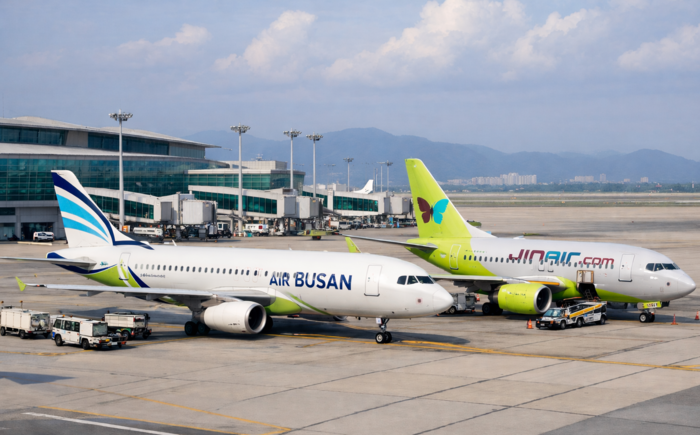
BUSAN, South Korea — While Hanjin Group and the city of Busan officially named the southern port city as the headquarters for the newly integrated low-cost carrier (LCC) under Jin Air, industry observers warn that the move will yield minimal economic impact unless accompanied by a substantive transfer of personnel, aircraft, and decision-making authority.
Following the joint announcement on Thursday designating Busan as the corporate home for the merged entity—comprising Jin Air, Air Busan, and Air Seoul—questions have shifted from legal registration to operational reality. Busan sought the headquarters to safeguard its regional aviation presence and establish Gimhae International Airport, alongside the upcoming Gadeokdo New Airport, as a major aviation hub. However, analysts note that merely shifting a company’s legal domicile often fails to deliver tangible regional growth.
Under South Korean tax law, local corporate income taxes for companies operating across multiple municipalities are distributed based on employee headcount and building floor space rather than the registered address of the headquarters. Data from the Korea Workers’ Compensation & Welfare Service as of late 2025 underscores the current imbalance: out of 3,906 employees across the three airlines, only 27.6% (1,080) work in Busan, the vast majority of whom belong to Air Busan. Conversely, nearly 90% of Jin Air’s 2,188 employees are concentrated in Seoul, while Air Seoul’s entire 419-person workforce is based in Incheon. Without significant staffing adjustments, Busan’s annual corporate tax share from the merged carrier is projected to remain modest, between 700 million and 1.6 billion won ($500,000 to $1.1 million).
Economists point out that the true regional stimulus lies in payroll rather than tax revenue. Based on Jin Air’s average annual salary of 82 million won, relocating just 400 to 800 employees from the capital region to Busan would inject roughly 33 billion to 66 billion won in direct household income into the local economy each year.
Yet achieving such a transfer faces stiff internal resistance. Shortly after the announcement, Jin Air’s pilots' union issued a statement expressing strong concern over potential forced relocations and disruptions to employees' living conditions in the Seoul metropolitan area. The union demanded guarantees that existing flight bases at Incheon and Gimpo airports remain fully operational without indirect penalties for staff who stay in the capital.
South Korea’s corporate landscape offers cautionary precedents of "paper relocations." When steel giant POSCO Holdings moved its registered headquarters to Pohang in 2023, most of its core workforce remained in Seoul. Similarly, defense manufacturer Poongsan maintains its legal registration in Gyeonggi Province while operating its actual management headquarters out of central Seoul.
Aviation experts emphasize that an airline's true base of operations is defined by where its flight and cabin crews are stationed, where heavy maintenance hangars are built, and where network planning—the division responsible for route allocation and fleet deployment—is housed. If administrative consolidation pulls support staff to Seoul and crew bases toward Incheon, Busan could end up losing economic ground despite holding the title of headquarters.
Addressing these concerns, Hanjin Group reiterated its commitment to regional development, stating that the headquarters designation marks the starting point for building Gimhae and Gadeokdo airports into a genuine secondary hub in close partnership with Busan City.
[Copyright (c) Global Economic Times. All Rights Reserved.]