![[등록] 2026-09-01 15:48:31](/support/_updata/banner2/tl181982910_6749.png)


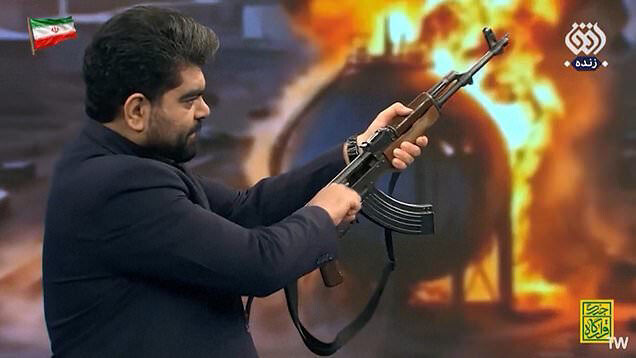
TEHRAN — In an unprecedented and highly provocative escalation of state-media rhetoric, an Iranian state broadcaster has demonstrated the field operation of military assault rifles live on television, at one point training the weapon directly at the national flag of the United Arab Emirates (UAE). The broadcast has ignited intense international scrutiny and raised deep concerns among geopolitical analysts, who interpret the display as a sign that Tehran may be moving toward an aggressive posture of comprehensive civilian militarization under the weight of sustained American and Israeli pressure.
The controversial sequence was aired during a broadcast on the "Ofogh" (Horizon) channel, an official outlet operated by the Islamic Republic of Iran Broadcasting (IRIB). According to comprehensive monitoring reports compiled by the West Asia News Agency (WANA), the program featured an officer from the Islamic Revolutionary Guard Corps (IRGC) who appeared in full combat fatigues and a tactical mask. The officer proceeded to conduct a highly detailed, step-by-step instructional seminar on the mechanical operation, disassembly, and tactical deployment of a Kalashnikov (AK-series) assault rifle.
The live demonstration functioned as an interactive workshop, wherein the program’s main anchor, Hossein Hosseini, performed hands-on exercises under the direct supervision of the IRGC officer. Viewers watched as the host learned to strip and reassemble the combat firearm, chamber live ammunition into magazines, manipulate the firing mechanism, and perform safety checks on the receiver room. After completing the physical drill, Hosseini assumed a firing stance, aiming the assault weapon toward the ceiling to simulate live discharge.
Moments later, the broadcast crossed a clear diplomatic threshold. As a graphic of the United Arab Emirates flag was superimposed onto the studio monitor, Hosseini deliberately aligned the rifle’s iron sights with the foreign banner and pulled the trigger. The explicit simulation of lethal force against a neighboring Gulf state has triggered an immediate wave of condemnation across social media networks, where the footage has spread extensively.
Foreign policy experts suggest that the broadcast serves as an indirect but unmistakable diplomatic warning to the UAE. Tehran and Abu Dhabi have maintained a long-standing, volatile relationship characterized by unresolved maritime boundary disputes and structural diplomatic friction. By broadcasting an explicit simulation of an armed assault against the Emirati flag, state authorities are signaling their readiness to confront regional adversaries who are perceived to be aligning with Western containment strategies.
Crucially, this rhetoric is not isolated to a single network. Simultaneously, during a prime-time broadcast on IRIB Channel 3, prominent news anchor Mobina Nasiri took to the airwaves holding a rifle. In an impassioned address, Nasiri announced her absolute readiness to enter active combat theaters alongside other civilian women under the banner of the "Jan-Fada" (Life-Sacrificers) mobilization movement. "If the supreme leadership or national security necessitates it, I, along with millions of Iranian women, will deploy to the front lines," she declared dynamically.
The "Jan-Fada" campaign represents a highly coordinated, state-sanctioned domestic propaganda initiative designed to demonstrate national unity and unyielding resistance against the United States and Israel. State television networks have asserted that more than 31 million Iranian citizens have formally registered their intent to participate in the defense campaign, signaling an expansive mobilization framework intended to prepare the population for an imminent state of emergency.
International security analysts and Western intelligence observers argue that these aggressive broadcasts reflect a growing anxiety within the top echelons of the Iranian government regarding the potential resumption of direct American military operations in the region. By normalising the handling of heavy weaponry on public television, Tehran aims to cultivate a siege mentality, thereby fortifying internal solidarity and domestic cohesion against external threats.
Nevertheless, some independent defensive analysts have characterized the broadcasts as a somewhat crude and unrefined exercise in saber-rattling. They warn that the normalization of automatic weapons on mainstream public television poses severe long-term risks to domestic stability, while further isolating Iran on the international stage by breaching established diplomatic protocols of state broadcasting.
[Copyright (c) Global Economic Times. All Rights Reserved.]