![[등록] 2026-09-01 15:48:31](/support/_updata/banner2/tl181982910_6749.png)


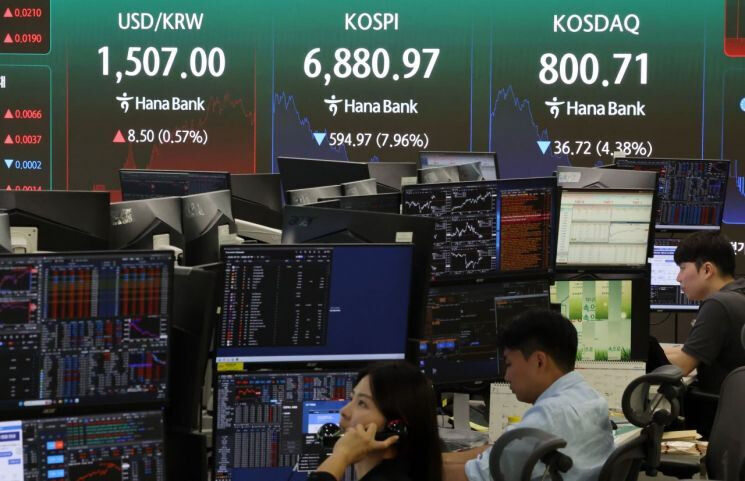
SEOUL — South Korean financial markets suffered one of their most turbulent trading sessions in recent history on Tuesday, July 28, 2026, as an aggressive sell-off concentrated in semiconductor equities triggered a historic market contraction. The benchmark Korea Composite Stock Price Index (KOSPI) cratered by over 11% during intraday trading, temporarily breaching the critical 6,000-point ceiling to reach a low of 5,992.91 points before mounting a minor technical rebound.
The market severity prompted financial regulators and the Korea Exchange (KRX) to implement emergency stabilization protocols. Program sell offer executions were halted through "sidecar" activations, while circuit breakers were triggered across both the main KOSPI and tech-heavy KOSDAQ boards to mitigate cascading systemic liquidations.
Anatomy of the Intraday Collapse
The trading day opened under heavy foreign selling pressure following overnight declines in global semiconductor and technology indices. The KOSPI initiated trading down 355.48 points (5.26%) at 6,400.27. Rather than attracting institutional dip-buyers, sell orders accelerated rapidly throughout the morning, driving leveraged positions into mandatory margin liquidations.
By 15:26 KST, the KOSPI was recorded at 6,028.54 points, representing a steep decline of 727.21 points (10.76%) relative to the previous closing session. At its lowest point, the index reached 5,992.91 points, down 11.29% for the day. This marked a historic moment as the 6,000-point threshold gave way under relentless market pressure.
KOSDAQ Breaches 700 Level First Time in 15 Months
The junior KOSDAQ index experienced a parallel collapse, trading at 703.51 (down 8.02%) by mid-afternoon. Intraday levels reached a bottom of 697.45 points (-8.81%), marking the first time the index dropped below the 700-point mark since April 16 of the previous year—a period of nearly 15 months.
Small and medium-sized enterprise (SME) technology suppliers, fabless design firms, and secondary battery equipment manufacturers bore the brunt of indiscriminate institutional dumping and algorithmic stop-loss executions.
[Copyright (c) Global Economic Times. All Rights Reserved.]