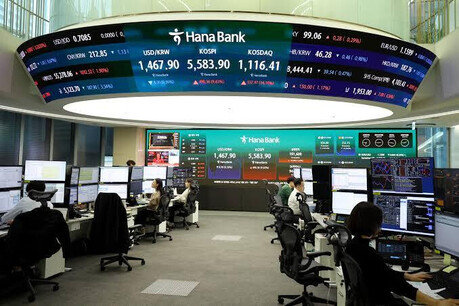



TAIPEI / BEIJING — Growing skepticism over the profitability of massive artificial intelligence investments has triggered a severe sell-off across Greater China, forcing Taiwanese regulators to intervene with emergency market curbs while eroding $1.7 trillion in Chinese tech market value over the past five months.
Mirroring a sharp downturn on Wall Street—where the Nasdaq Composite tumbled 5.28% and the S&P 500 fell 3.70% on Friday—Asian semiconductor and technology shares bore the brunt of investor anxiety over high valuations and delayed AI monetization.
Taiwan Enacts Emergency Short-Sale Limits
In Taipei, the benchmark Taiex index suffered its steepest weekly drop on record, plunging 17.5% (7,641.83 points) to close at 36,033.29 on Friday. Industry bellwethers Taiwan Semiconductor Manufacturing Co. (TSMC) and Foxconn both slid 4.76% in the final session of the week.
To arrest the freefall, Taiwan’s Financial Supervisory Commission (FSC) announced on Saturday that it will impose a ban on short-selling below the previous session’s closing price across all listed and over-the-counter equities starting Monday. It marks the first time Taipei has deployed broad short-sale price restrictions since the August 2015 global market turmoil triggered by China's stock market crash.
$1.7 Trillion Evaporates from Chinese Tech
In mainland China, global tech headwinds collided with persistent domestic economic fragility. The tech-heavy ChiNext index dropped 8.82% last week, extending its slide to nearly 50% below its late-June peak. Combined trading turnover on the Shanghai and Shenzhen exchanges also sank to a 16-month low earlier in the week.
Market data indicates that roughly $1.7 trillion in market capitalization has been wiped out across three major Chinese tech gauges since late June. While optimism surrounding domestic AI breakthroughs—such as DeepSeek—and state-backed chip initiatives previously fueled a rally, investor sentiment has soured amid tightening U.S. export controls on overseas AI computing access and compressed corporate margins.
Beijing Clamps Down Amid Retail Backlash
Facing deepening market gloom, Beijing has moved aggressively to manage public narratives. On Friday, the China Securities Regulatory Commission (CSRC) and public security authorities announced penalties against individuals accused of spreading fabricated market rumors, including AI-generated false reports of an initial public offering (IPO) freeze and unfounded claims of steep internet tax hikes.
State media followed suit, with the People’s Daily publishing a commentary dismissing foreign reports of China's "deflation trap" and overcapacity. However, the state-backed optimism drew sharp pushback on Chinese social media platforms like Weibo, where retail investors nursing heavy losses questioned official assurances and challenged authorities to back their words with a market recovery.
Economists note that weak macroeconomic fundamentals continue to weigh on equities. Following October data showing misses across industrial output, retail sales, and fixed-asset investment, analysts at UBS Securities warned that China’s export resilience remains insufficient to offset weak domestic demand.
[Copyright (c) Global Economic Times. All Rights Reserved.]