

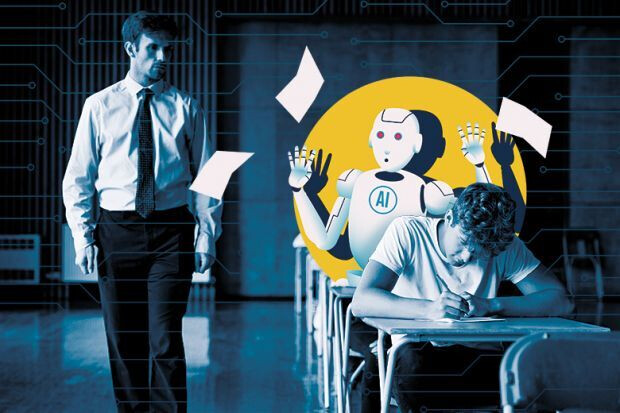
The misuse of artificial intelligence during academic evaluations has escalated into a worldwide crisis, prompting major universities and education boards to overhaul their testing protocols after unprecedented spikes in top scores.
At Brown University in the United States, economics professor Roberto Serrano transitioned his midterm exam to a take-home format earlier this year to ease student anxiety following a campus shooting the previous December. However, the class average skyrocketed to an anomalous 96 out of 100. Suspecting widespread reliance on generative AI after comparing student submissions with AI-generated responses, Serrano mandated an in-person final exam, warning that the midterm grades would be voided if the score distributions did not align. Consequently, 18 students dropped the course and nine skipped the final. The remaining 59 students saw their average plummet to 48.6, resulting in 19 failures.
A similar disruption occurred at the National Autonomous University of Mexico (UNAM), which introduced an online format for the first phase of its entrance exam to accommodate applicants outside the capital. Despite strict anti-cheating protocols that disqualified roughly 3,000 of the 158,000 test-takers, the proportion of candidates scoring over 100 out of 120 surged nearly fivefold from the historical average of 3.5% to 16.3%, while the number of perfect scores tripled. Determining that digital monitoring was insufficient, university officials ordered an in-person retake for approximately 58,000 qualifying applicants.
Hardware-based cheating is also emerging as a threat. During the second round of medical school entrance exams at National Taiwan University in June, an applicant was disqualified for using AI-equipped smart glasses. Proctors grew suspicious when the student, wearing a hat and thick-rimmed glasses under the guise of feeling cold, repeatedly stared at the exam paper and pulled it close to their face. Upon inspection, the frames were found to be severely overheated from processing data.
In the United Kingdom, the Office of Qualifications and Examinations Regulation (Ofqual) reported that AI-related plagiarism cases during the summer 2025 GCSE, AS, and A-level exams rose to 100, up from 85 the previous year. Ofqual Chief Regulator Ian Bauckham warned students that submitting AI-generated work could lead to the revocation of all exam grades—a consequence he described as "life-changing." Last week, Bauckham urged examination boards to train invigilators to detect "new risks" posed by wearable technology ahead of the 2027 testing cycle.
[Copyright (c) Global Economic Times. All Rights Reserved.]