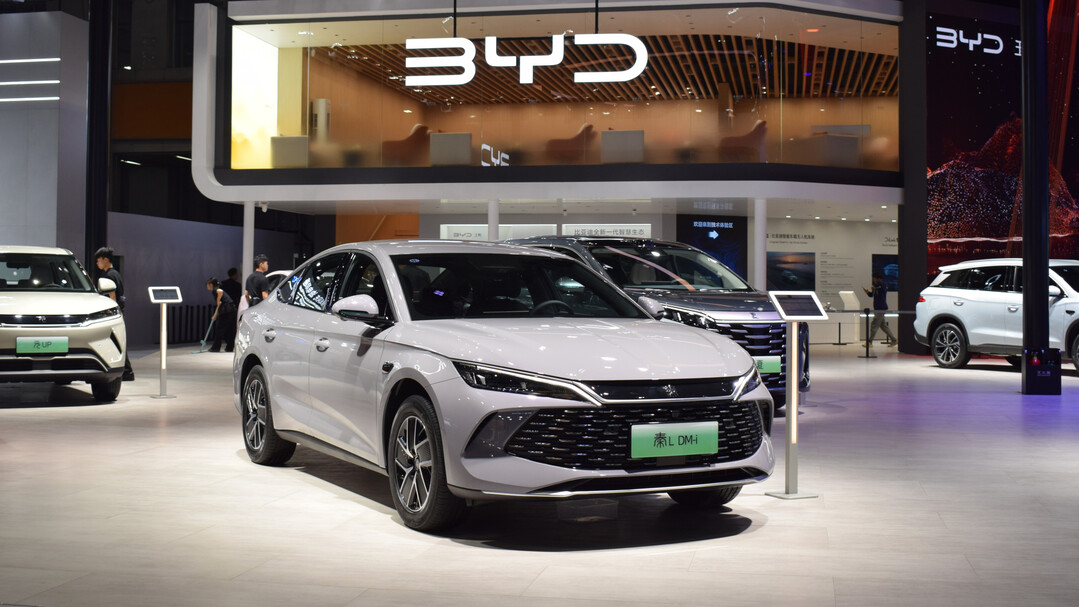
SEOUL — Chinese electric vehicle (EV) giant BYD has aggressively revised its full-year overseas sales target upward by 40%, highlighting a broader tectonic shift in the global automotive industry. While Chinese manufacturers rapidly expand their footprint through cost competitiveness and advanced software capabilities, legacy European automakers are struggling with plunging sales and severe financial headwinds in China.
According to industry reports citing Chinese economic media outlet Yicai, BYD’s Brand and Public Relations General Manager, Li Yunfei, announced that the company aims for approximately 1.8 million overseas sales this year. This marks a staggering 40% increase from its initial target of 1.3 million vehicles and a 73% surge compared to the previous year's total of 1.04 million units.
BYD’s international momentum has grown at an extraordinary pace. Overseas sales accounted for a mere 3% of the company's total volume in 2022, but that proportion jumped to 22.6% last year and reached 40% between January and October of this year. This puts the company well within reach of the 50% overseas sales ratio envisioned by Chairman Wang Chuanfu two years ago.
To boost profitability, BYD is increasingly pushing high-end models abroad. In July, the company launched its premium brand "Denza" in the United Kingdom, pricing the vehicle at roughly 1.3 million yuan—about three times its domestic selling price in China. According to Daiwa Securities, BYD management recently informed investors that they expect to achieve an average net profit of 20,000 yuan (approximately $2,800) per vehicle in overseas markets by the end of the year.
China’s Auto Exports Reach Record Highs
BYD is not alone in its international expansion. Data from China’s General Administration of Customs shows that China’s total automobile exports from January to October reached 9.736 million units, already surpassing the previous year’s annual record of 8.32 million.
During this period, Geely Automobile witnessed an explosive 168% surge in exports, while Chery and SAIC posted strong double-digit growth rates of 64.8% and 54.0%, respectively. Europe, the world’s second-largest automotive market after the United States, has become a primary battleground. Chinese hybrid vehicle exports to the European Union are projected to hit 800,000 units this year, up sharply from 100,000 in 2024 and 300,000 last year.
This export pivot is largely driven by sluggish domestic demand. Between January and October, passenger car sales within China plummeted 22.3% year-on-year to 14.97 million units, prompting domestic automakers to aggressively target foreign markets.
Trade Barriers and Localization Strategies
In response to the influx of Chinese vehicles, international regulators are stepping up protective measures. The European Union has capped annual Chinese hybrid vehicle imports at 350,000 units, while Brazil has raised import tariffs on electric and hybrid vehicles to 35%.
However, Chinese automakers have preemptively established local production hubs to bypass trade barriers. BYD commenced operations at its new Brazilian factory this year and is slated to launch production at its Hungarian facility before the year ends. Competitors including Chery, Geely, Hongqi, Leapmotor, and XPeng are similarly expanding manufacturing footprints across Europe.
Legacy European Brands Lose Ground in China
Conversely, traditional European carmakers are rapidly losing independent viability in the Chinese market. A prime example is Italy’s Maserati, which is pursuing a strategic partnership with tech giant Huawei. Under this framework, Huawei will provide core software and technological expertise, JAC Motors will handle vehicle design and manufacturing, and Maserati will supply the brand identity and global sales network. Industry experts note that outsourcing core EV technology and complete vehicle production to a Chinese partner is an exceptionally rare move for a luxury marque.
Maserati’s dramatic shift stems from a steep collapse in performance caused by shrinking sales in China, which was once its largest market. Maserati's global shipments last year fell to 7,900 units—an 85% plunge from its 2017 peak—driven heavily by its Chinese sales collapsing by roughly 90% from 14,498 units down to just 1,431 over the same period.
Financial strain is also hitting other European joint ventures in China. FAW-Volkswagen, a major joint venture between the German automotive group and its Chinese partner, has reportedly canceled employee performance bonuses for both last and this year. According to financial media outlets, these bonuses typically account for 40% to 45% of total annual compensation for affected staff. The drastic cost-cutting measure reflects worsening operational pressures, underscored by a 27% year-on-year decline in sales during the first eight months of the year. In an effort to revitalize its standing, Volkswagen has partnered with Chinese EV startup XPeng to develop exclusive electric vehicles tailored specifically for the Chinese market.
[Copyright (c) Global Economic Times. All Rights Reserved.]