

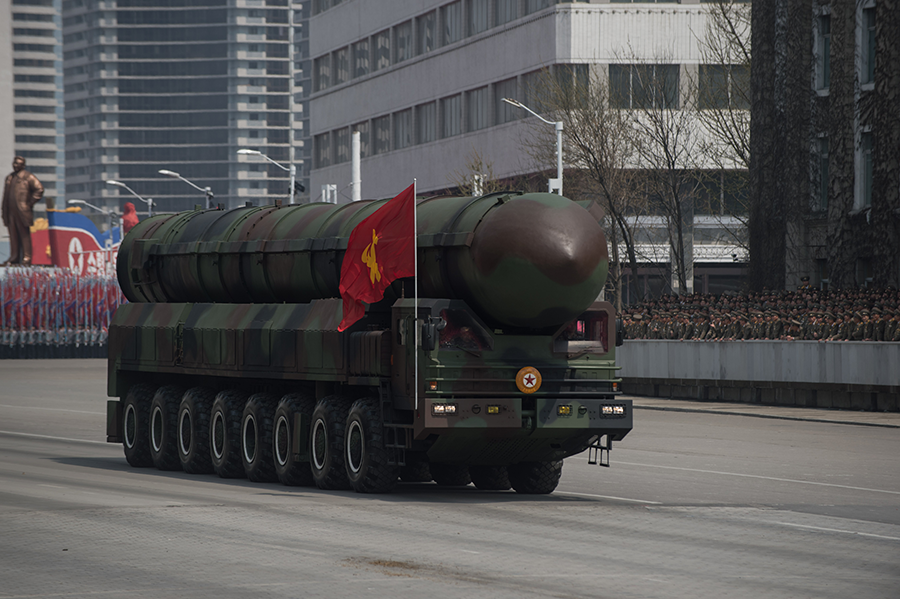
WASHINGTON — In a move that signals a significant departure from traditional U.S. foreign policy, President Donald Trump has publicly acknowledged North Korea as a nuclear-armed state, marking the first time a U.S. leader has explicitly quantified the regime’s arsenal at "57 very powerful" nuclear weapons. This disclosure, made during remarks at the White House on August 19, 2026, suggests that the administration’s strategy is pivoting away from the long-standing, elusive goal of complete denuclearization toward a more pragmatic focus on arms control, specifically the restriction of North Korea's nuclear warhead stockpile and future production capabilities.
When pressed by reporters on whether "complete denuclearization" remained the ultimate goal of his administration’s engagement with Pyongyang, President Trump pointedly avoided a direct response. "I don’t want to talk about that," he remarked, instead highlighting his personal rapport with North Korean leader Kim Jong Un. The President emphasized their "excellent" relationship, contrasting his approach with that of his predecessors, and stated his intention to meet with the North Korean leader later this year.
This assessment, while consistent with various independent estimates—such as those from the Stockholm International Peace Research Institute (SIPRI), which suggests a count of around 60 assembled warheads—was met with skepticism in Seoul. South Korean Defense Minister Ahn Gyu-back officially disputed the U.S. President’s figures, stating during a parliamentary session on August 20 that the ROK government estimates North Korea possesses between 80 and 120 nuclear warheads. Minister Ahn emphasized that while the reality of North Korea’s capabilities is undeniable, Seoul "cannot officially acknowledge" the North as a legitimate nuclear state under the current international framework.
The shift in rhetoric from the White House comes amid heightened tensions surrounding joint U.S.-South Korean military exercises, which President Trump recently ordered to be "substantially reduced," citing them as "insulting" to Kim Jong Un. North Korean officials, however, have maintained a cautious stance. Kim Yo Jong, sister of the North Korean leader and a senior official in the Workers' Party, stated on August 19 that she was "completely unaware" of any recent communication between the two leaders. While she dismissed the significance of the scaled-back military drills, she confirmed that the personal bond between the two leaders remains "excellent," leaving the door open for potential diplomatic re-engagement.
Security experts interpret President Trump’s precise mention of "57" weapons as a deliberate signal. By focusing on a specific number, the administration appears to be laying the groundwork for a new type of negotiation—one that centers on a "freeze" or "cap" on North Korea's nuclear inventory, rather than the total abandonment of a program that Pyongyang now considers a core component of its national security.
As the international community watches these developments, the consensus among analysts is that the focus of North-U.S. diplomacy is rapidly moving toward arms control. By treating North Korea as a de facto nuclear power, the Trump administration may be seeking a manageable, albeit controversial, resolution to the standoff, prioritizing long-term stability and the containment of further proliferation over the total dismantling of an arsenal that the regime has shown no willingness to relinquish. Whether this revised approach will yield tangible results remains to be seen, particularly as Pyongyang continues to prioritize the strengthening of its nuclear forces in both quality and quantity.
[Copyright (c) Global Economic Times. All Rights Reserved.]