(C) Gemini Image
With the US midterm elections taking place on the 3rd of next month (local time), South Korea’s calculation regarding the future trade policy of the Donald Trump administration is expected to grow more complex.
The prevailing view is that even if the Democratic Party secures a majority in Congress, the US stance on domestic industry protection and supply chain restructuring is unlikely to change significantly. It is anticipated that tariffs targeting South Korea will remain in place and the burden of US investments will persist.
For South Korea, it appears necessary to closely monitor changes across the entire trade environment—not only whether tariffs will be reduced, but also pressure for investment in the US and non-tariff barriers—and prepare countermeasures.
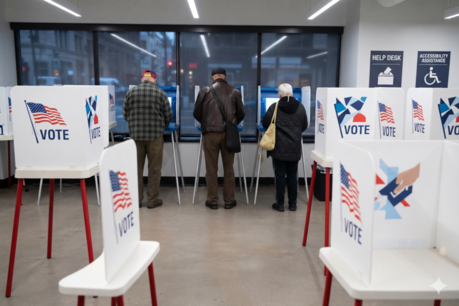
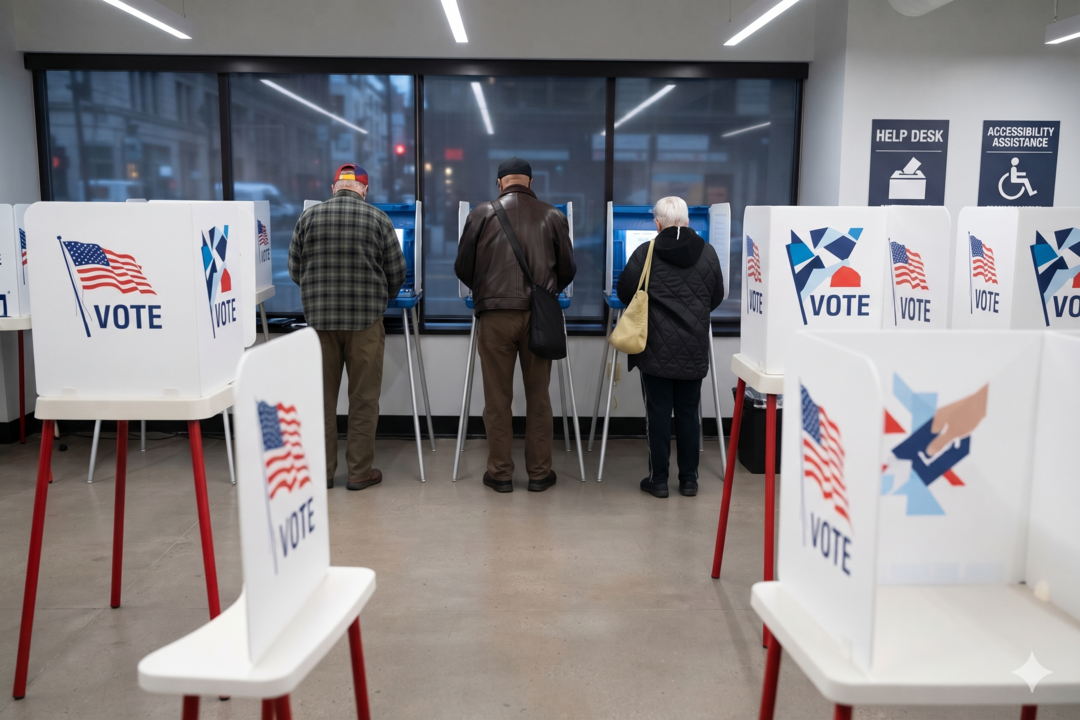
According to foreign media on the 31st, the US will elect all 435 members of the House of Representatives and 35 of the 100 members of the Senate on November 3. Currently, the Republican Party holds a majority in both the Senate and the House, but the balance of congressional power could shift depending on the election outcome.
If Republicans maintain their majorities in both the Senate and the House, Trump’s trade policy is likely to maintain its current trajectory.
Conversely, if the Democrats secure a majority in even one chamber, congressional checks on President Trump's governance are expected to strengthen, which could impact the implementation process of trade policies.
For South Korea, concerns are raised that a Republican rout could affect tariff impositions and US investment projects.
First, potential changes to existing tariff policies can be considered. Currently, South Korea and the US signed a strategic investment MOU worth $350 billion, which lowered reciprocal tariffs from 25% to 15% and includes $200 billion in investments and $150 billion in shipbuilding cooperation.
As the first US investment project, the Encinal gas-fired combined cycle power plant in Texas, US, has been finalized, and the second project is set to push forward the construction of eight large-scale nuclear reactors in the US.
The problem is that the tariff framework currently applied to South Korea differs from the agreement reached during last year's bilateral tariff negotiations. This is because the US Supreme Court ruled in February of this year that reciprocal tariffs were unconstitutional and void, causing the 15% reciprocal tariff applied to Korea to lose its legal effect.
Since then, the US has imposed a tariff of about 12.5% combined with Most-Favored-Nation (MFN) tariffs on certain South Korean items as a result of Section 301 investigations related to forced labor-produced imports, and is awaiting the announcement of investigation results regarding structural overproduction and excess capacity.
One concerning scenario is if the Democrats win a congressional majority and the Trump administration—rather than maintaining existing tariff policies—utilizes separate legal grounds such as Section 301 of the Trade Act and Section 232 of the Trade Expansion Act to impose additional tariffs.
In this event, trade uncertainties for South Korea could grow further, and impacts such as ▲weakened export price competitiveness, ▲deteriorated corporate profitability, ▲increased pressure to expand local US investments, and ▲contraction of domestic production and investment are expected to occur.
In particular, since South Korea has already agreed to massive investments on the premise of tariff reductions with the US, if the tariff agreement breaks down, it is pointed out that not only will export companies face a heavier burden, but the viability of the $350 billion investment agreement could also be shaken.
There are also opinions that if Democrats seize control of Congress, verification processes regarding project selection procedures for US investments could be intensified. Congress could raise issues regarding projects that have low job creation effects in the US or concentrate benefits in specific regions and companies.
For South Korea, this means a situation may arise where it must go beyond simply calculating the possibility of investment returns and present investment projects with economic effects that the US Congress and local communities can accept, thereby passing congressional verification.
Specifically, demands may emerge for: ▲specifying construction and operational schedules for South Korean corporate production facilities in the US, ▲expanding local US hiring and utilization of partner companies, ▲building supply chains for strategic industries within the US, and ▲expanding technology transfer and R&D cooperation.
Trade experts view that even if Democrats take control of Congress, the Trump administration’s trade policy stance will not change drastically. However, they analyze that differences may appear in policy implementation methods due to strengthened congressional checks and in negotiations for individual investment projects.
Seo Jin-kyo, head of the GSnJ Institute, advised, "Since President Trump’s tariff policies stem from executive orders, even if the Democratic Party secures a congressional majority, there is unlikely to be major changes regarding tariffs and US investments. Considering that the House of Representatives holds heavy influence in trade policy, it will be necessary to step up outreach to the US Congress moving forward."
Seo added, "Unlike Republicans, Democrats do not take unilateral actions. They also tend to tighten the screws meticulously in trade negotiations and other areas. To persuade them, South Korea must respond with logical reasoning regarding why tariffs should be lowered and why US investments were made in this manner."
Koo Ki-bo, a professor of global commerce at Soongsil University, predicted, "The stance on tariff policies and US investments is likely to be maintained. Pressure regarding investments in the Alaska liquefied natural gas (LNG) project is likely to ease, and negotiations for the 1st and 2nd investment projects are unlikely to be heavily impacted."
Regarding the 2nd investment project, Professor Koo forecasted, "While South Korea has been negotiating with the goal of building two Korean-type APR1400 reactor units out of the eight large-scale nuclear reactors to be built in the US, considering the hardline stance Democrats have frequently shown on trade fronts, they are highly likely to push entirely for eight US-type AP1000 reactors."
[Copyright (c) Global Economic Times. All Rights Reserved.]