• 2026.03.01 (Sun)
  • All articles
  • LOGIN
  • JOIN
Global Economic Times
fashionrunwayshow2026
  • Synthesis
  • World
  • Business
  • Industry
  • ICT
  • Distribution Economy
  • Well+Being
  • Travel
  • Eco-News
  • Education
  • Korean Wave News
  • Opinion
  • Arts&Culture
  • Sports
  • People & Life
    • International Student Report
    • With Ambassador
  • Column
    • Cho Kijo Column
    • Cherry Garden Story
    • Ko Yong-chul Column
    • Kim Seul-Ong Column
    • Lee Yeon-sil Column
  • Photo News
  • New Book Guide
MENU
 
Home > Distribution Economy

The "K-Shaped" Paradox: Why South Korea’s Recovery Isn't Igniting Inflation

Global Economic Times Reporter / Updated : 2026-02-28 05:47:16
  • -
  • +
  • Print


(C) The Adecco Group


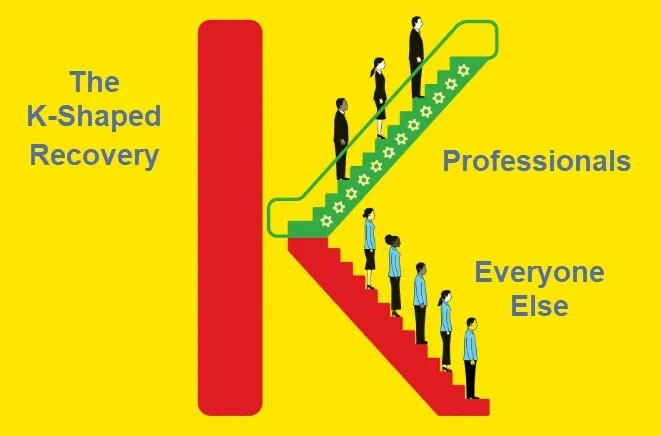
SEOUL — South Korea is currently witnessing a stark economic divergence that is rewriting the rules of traditional macroeconomics. While the nation’s headline GDP shows signs of a robust recovery, the "warmth" of this growth is failing to spread across the broader economy, leading to a surprising suppression of inflationary pressures.

According to a recent report by the Bank of Korea (BOK) titled "The Impact of Sectoral Growth Differentiation on Inflation," the widening gap between the booming IT sector and the stagnant non-IT sectors—often referred to as a K-shaped recovery—is acting as a structural brake on price increases.

The Great Divergence: IT vs. The Rest
The data highlights a massive structural rift. In the latter half of 2024, the growth gap between the IT manufacturing sector (led by semiconductors) and other sectors stood at 5.0 percentage points. Fast forward to the third quarter of 2025, and that gap has ballooned to a staggering 9.5 percentage points.

The BOK forecasts a 2.0% growth rate for the current year. However, Jeong Won-seok, Deputy Director of the BOK’s Inflation Dynamics Team, warns that this figure is deceptive. "If you strip away IT manufacturing, the rest of the economy is limping along at a growth rate in the low-to-mid 1% range," Jeong noted.

The Consumption Trap: Why Wealth Isn't Spending
Traditional economic theory suggests that growth leads to higher income, which boosts consumption and drives up prices (demand-pull inflation). However, the K-shaped model breaks this chain through two primary "leakages":

Concentrated Income Growth: Between 2023 and 2024, the top 20% (the 5th quintile) of households saw an average income increase of 7.36 million KRW, vastly outperforming all other income brackets.
Declining Marginal Propensity to Consume (MPC): The BOK found that high-income earners have a significantly lower MPC than middle- and low-income groups. Instead of spending their windfall, the wealthy are funneling excess income into savings or asset accumulation (real estate and stocks).
The report also cites OECD data from 26 countries, confirming that nations with higher Gini coefficients (greater income inequality) tend to have flatter Phillips Curves. This means that even as the economy grows, the sensitivity of inflation to that growth diminishes.

The Wage Ceiling and Sectoral Stagnation
The labor market tells a similar story of fragmentation. While salaries in the semiconductor and IT sectors have surged, wages in the non-IT manufacturing and construction sectors have plateaued or even declined.

Regular vs. Temporary: Wages for regular employees continue to rise, but temporary and day-laborer wages entered a downward trend in late 2024, exacerbated by a slump in the construction industry.
Company Size: Large-scale enterprises are offering significant pay hikes, while small-and-medium enterprises (SMEs)—which employ the vast majority of the South Korean workforce—are struggling to keep pace.
Because the high-wage IT sector employs a relatively small percentage of the total workforce, the aggregate upward pressure on national wages remains muted.

Outlook: The Road Ahead
The Bank of Korea concludes that for inflation to reach target levels through demand-side pressure, a recovery in the non-IT sectors is essential. Conversely, the primary "cost-side" variable will remain the global price of semiconductors.

As the K-shaped trend shows no signs of reversing, policymakers face a delicate balancing act: managing a "rich" macro-economy that feels "poor" to the average consumer, all while navigating a low-inflation environment that belies the strength of the nation's tech giants.

[Copyright (c) Global Economic Times. All Rights Reserved.]

  • #Korea
  • #Seoul
  • #Hallyu
  • #USA
  • #Economy
  • #Busoness
  • #Global
  • #World
  • #Consumer
  • #Export
  • #Import
  • #Hanguel
  • #Travel
  • #Tour
  • #Food
Global Economic Times Reporter
Reporter Page

Popular articles

  • A New Milestone for Ukraine’s Post-War Reconstruction: The Birth of ISVP

  • War Memorial Association Launches Youth Education Program Idea Contest

  • South Korea’s First Mass-Produced Micro-Satellite Successfully Launched and Linked

I like it
Share
  • Facebook
  • X
  • Kakaotalk
  • LINE
  • BAND
  • NAVER
  • https://www.globaleconomictimes.kr/article/1065559533617769 Copy URL copied.
Comments >

Comments 0

Weekly Hot Issue

  • Kim Yo-jong Appointed as WPK General Affairs Director; Kim Ju-ae’s ‘Sniper’ Debut Signals Solidified Succession
  • Man Builds Record-Breaking Toothpick Skyscraper: A Testament to Patience and Glue
  • "The Painting on the 10,000 Won Bill": Foreign Fans Rushing to Acquire Korean Currency
  • The Fourth Anniversary of the Ukraine War: Between International Conflict and Civil Narrative — A Historical Mirror of Choice
  • Middle East on the Brink: Iran Signals ‘De Facto’ Blockade of Strait of Hormuz Following U.S.-Israeli Airstrikes
  • "A Graveyard for Journalists": CPJ Reports Record 129 Journalists Killed Last Year, Two-Thirds by Israeli Forces

Most Viewed

1
A New Milestone for Ukraine’s Post-War Reconstruction: The Birth of ISVP
2
2026, The Grand Year of Hangeul Celebration — The River of History Where Five Streams Converge
3
Revised and Expanded Edition of ‘Failure of Negotiations with North Korea: Truth and Solutions’ Published
4
Mexican currency and the powerful history behind its designs
5
Commentary That Douses the Joy of Victory: A Twisted Perspective
광고문의
임시1
임시3
임시2

Hot Issue

"The Painting on the 10,000 Won Bill": Foreign Fans Rushing to Acquire Korean Currency

Middle East on the Brink: Iran Signals ‘De Facto’ Blockade of Strait of Hormuz Following U.S.-Israeli Airstrikes

IT Telecom Clinches V2X Supply Deal for New York State Autonomous Driving Project

Buddhist Wisdom Meets AI: Japan Unveils ‘Buddharoid’ to Combat Monk Shortage

Let’s recycle the old blankets in Jeju Island’s closet instead of incinerating them.

Global Economic Times
korocamia@naver.com
CEO : LEE YEON-SIL
Publisher : KO YONG-CHUL
Registration number : Seoul, A55681
Registration Date : 2024-10-24
Youth Protection Manager: KO YONG-CHUL
Singapore Headquarters
5A Woodlands Road #11-34 The Tennery. S'677728
Korean Branch
Phone : +82(0)10 4724 5264
#304, 6 Nonhyeon-ro 111-gil, Gangnam-gu, Seoul
Copyright © Global Economic Times All Rights Reserved
  • 에이펙2025
  • APEC2025가이드북TV
  • 독도는우리땅
Search
Category
  • All articles
  • Synthesis
  • World
  • Business
  • Industry
  • ICT
  • Distribution Economy
  • Well+Being
  • Travel
  • Eco-News
  • Education
  • Korean Wave News
  • Opinion
  • Arts&Culture
  • Sports
  • People & Life 
    • 전체
    • International Student Report
    • With Ambassador
  • Column 
    • 전체
    • Cho Kijo Column
    • Cherry Garden Story
    • Ko Yong-chul Column
    • Kim Seul-Ong Column
    • Lee Yeon-sil Column
  • Photo News
  • New Book Guide
  • Multicultural News
  • Jobs & Workers