• 2026.03.02 (Mon)
  • All articles
  • LOGIN
  • JOIN
Global Economic Times
fashionrunwayshow2026
  • Synthesis
  • World
  • Business
  • Industry
  • ICT
  • Distribution Economy
  • Well+Being
  • Travel
  • Eco-News
  • Education
  • Korean Wave News
  • Opinion
  • Arts&Culture
  • Sports
  • People & Life
    • International Student Report
    • With Ambassador
  • Column
    • Cho Kijo Column
    • Cherry Garden Story
    • Ko Yong-chul Column
    • Kim Seul-Ong Column
    • Lee Yeon-sil Column
  • Photo News
  • New Book Guide
MENU
 
Home > World

Embracing the Void: Why Japan’s Youth are Stepping into Coffins to Find Life

Hee Chan Kim Reporter / Updated : 2026-03-01 06:18:11
  • -
  • +
  • Print


(C) AOL.com


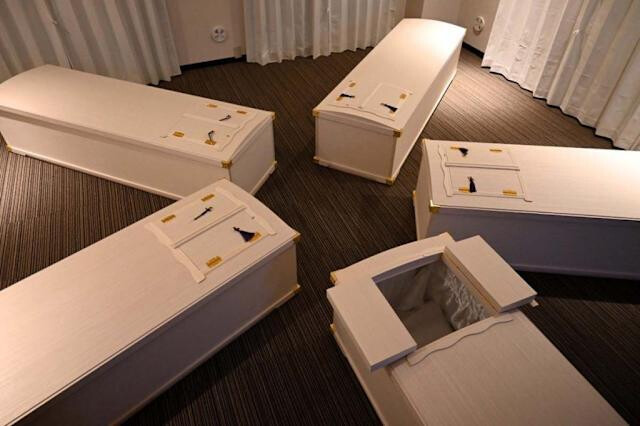
In the bustling heart of Tokyo, a new form of "wellness" is taking a surprisingly macabre turn. While most young professionals spend their weekends at cafes or gyms, a growing number of Japanese youth are opting for a more silent retreat: a 30-minute stay inside a literal coffin.

The Rise of "Coffin Meditation"
The practice, known locally as "Coffin Meditation" (Kanoke-Meiso), has transitioned from a niche funeral industry gimmick to a mainstream psychological trend. Facilities like "Meiso Kukan Kanokein," designed by the creative firm Grave Tokyo, are leading the charge. Unlike the grim, wooden boxes associated with mourning, these modern coffins are often vibrant, colorful, and customizable.

For approximately 20,000 KRW ($15 USD), participants can spend half an hour in a controlled environment. The experience offers several layers of customization:

The Environment: Choice between an open or fully enclosed coffin.
Sensory Input: Options for healing ambient music, ceiling projections of nature, or absolute silence.
The Goal: To simulate the finality of death in order to gain a fresh perspective on life.

A "Reversible Death" to Prevent an Irreversible One
The timing of this trend is significant. Japan has long struggled with high suicide rates among its youth and the phenomenon of Hikikomori (social withdrawal). Designers like Mika Ko-fuse view these coffins not as symbols of despair, but as "safe spaces" for existential reflection.

"I wanted people to feel that death isn't necessarily something to be terrified of," Fuse explained. "By experiencing a 'reversible death' in a coffin, many find their suicidal ideations or overwhelming anxieties diminishing. It serves as a reset button for the soul."

Psychological Impact and Expert Insight
The feedback from participants, particularly university students, has been overwhelmingly positive. Many report a "cleansing" feeling, noting that the physical confinement allows them to shut out the noise of a hyper-competitive society and focus inward.

Professor Aya Seike, a specialist in social medicine at Ritsumeikan University, supports this approach. "Confronting death is a vital exercise in re-evaluating life," Seike noted during a recent seminar. "When you realize the boundaries of your existence, the trivial worries of daily life lose their power, and the desire to live more authentically grows stronger."

The Cultural Context: From Shukatsu to Wellness
This trend is an evolution of Japan’s Shukatsu (end-of-life planning) culture. While Shukatsu was originally intended for the elderly to ease the burden on their families, the younger generation has repurposed it. For them, death is no longer a taboo topic to be ignored until old age; it is a mirror used to reflect their current values and mental health needs.

As Japan continues to navigate the pressures of the modern era, the coffin has ironically become a womb-like space—a place where one can die for a moment, only to be "reborn" with a renewed sense of purpose.

[Copyright (c) Global Economic Times. All Rights Reserved.]

  • #Korea
  • #Seoul
  • #Hallyu
  • #USA
  • #Economy
  • #Busoness
  • #Global
  • #World
  • #Consumer
  • #Export
  • #Import
  • #Hanguel
  • #Travel
  • #Tour
  • #Food
Hee Chan Kim Reporter

Popular articles

  • AI Vision: New Neuromorphic Chip Detects Motion 4 Times Faster Than Human Eye

  • Shinsegae Department Store Hits Record 7.4 Trillion KRW in Sales, Driven by Strategic "Landmark" Investments

  • New Frontier in Hospital Infection Control: Korean Researchers Unlock Pre-emptive Immune Defense

I like it
Share
  • Facebook
  • X
  • Kakaotalk
  • LINE
  • BAND
  • NAVER
  • https://www.globaleconomictimes.kr/article/1065561396084101 Copy URL copied.
Comments >

Comments 0

Weekly Hot Issue

  • Samsung’s 5-Year Obsession with Clarity: The Dawn of the ‘Privacy Display’
  • Thinking Twice: KAIST Unveils Brain-Inspired AI That Predicts Its Own Mistakes
  • President Lee Embarks on State Visit to Singapore and Philippines, Aiming to Expand AI Cooperation
  • South Korea’s Daily Exports Hit Record $3.5B as AI Semiconductor Boom Fuels 13th Month of Surplus
  • Homeplus Rehabilitation Triggers Structural Shift in Korea's Retail "Big 3"
  • Samsung Electronics Unveils Vision for 'AI-Driven Factories' by 2030: A Paradigm Shift in Global Manufacturing

Most Viewed

1
2026, The Grand Year of Hangeul Celebration — The River of History Where Five Streams Converge
2
A New Milestone for Ukraine’s Post-War Reconstruction: The Birth of ISVP
3
Mexican currency and the powerful history behind its designs
4
Revised and Expanded Edition of ‘Failure of Negotiations with North Korea: Truth and Solutions’ Published
5
Commentary That Douses the Joy of Victory: A Twisted Perspective
광고문의
임시1
임시3
임시2

Hot Issue

President Lee Embarks on State Visit to Singapore and Philippines, Aiming to Expand AI Cooperation

Buffett’s Final Report Card: Berkshire Hathaway Operating Profits Plunge Amid Asset Write-downs

Samsung Electronics Unveils Vision for 'AI-Driven Factories' by 2030: A Paradigm Shift in Global Manufacturing

Oil Hits $130 Amid Prolonged Hormuz Blockade: How Will Global Markets React?

Let’s recycle the old blankets in Jeju Island’s closet instead of incinerating them.

Global Economic Times
korocamia@naver.com
CEO : LEE YEON-SIL
Publisher : KO YONG-CHUL
Registration number : Seoul, A55681
Registration Date : 2024-10-24
Youth Protection Manager: KO YONG-CHUL
Singapore Headquarters
5A Woodlands Road #11-34 The Tennery. S'677728
Korean Branch
Phone : +82(0)10 4724 5264
#304, 6 Nonhyeon-ro 111-gil, Gangnam-gu, Seoul
Copyright © Global Economic Times All Rights Reserved
  • 에이펙2025
  • APEC2025가이드북TV
  • 독도는우리땅
Search
Category
  • All articles
  • Synthesis
  • World
  • Business
  • Industry
  • ICT
  • Distribution Economy
  • Well+Being
  • Travel
  • Eco-News
  • Education
  • Korean Wave News
  • Opinion
  • Arts&Culture
  • Sports
  • People & Life 
    • 전체
    • International Student Report
    • With Ambassador
  • Column 
    • 전체
    • Cho Kijo Column
    • Cherry Garden Story
    • Ko Yong-chul Column
    • Kim Seul-Ong Column
    • Lee Yeon-sil Column
  • Photo News
  • New Book Guide
  • Multicultural News
  • Jobs & Workers