


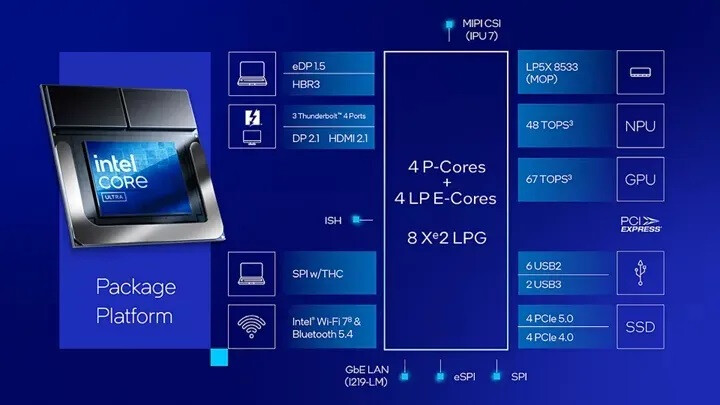
Intel's Core Ultra 200V platform, codenamed "Lunar Lake," is positioned as an all-in-one solution for the AI PC era. This new chip, with its harmonious blend of a Neural Processing Unit (NPU), Graphics Processing Unit (GPU), and Central Processing Unit (CPU), offers a compelling combination of thin and light design with all-day battery life, making it a pivotal force in the rapidly evolving PC market.
AI has become a transformative force across various industries, and the PC market is at the forefront of this shift, with a growing focus on AI PCs. While GPUs have historically led AI innovation, their limitations in mobile PC environments—primarily high power consumption and heat generation—have highlighted the need for more efficient alternatives. This is where the concept of "Copilot+ PCs," equipped with dedicated NPUs, has gained significant traction. At the same time, ongoing optimizations by both Intel and AMD have made GPU-based AI acceleration more widespread. Against this backdrop, Intel's Core Ultra 200V is emerging as a versatile AI platform designed to deliver a complete PC experience for the AI age.
The Perfect Ingredients for a Versatile AI PC
The Core Ultra 200V series, part of Intel's "Core Ultra 2" family, is particularly noteworthy. Even by traditional PC standards, the Lunar Lake processors stand out for their exceptional power efficiency and cutting-edge architecture. With a low Thermal Design Power (TDP) of 17W (up to 37W), they manage to deliver performance on par with chips that consume significantly more power. This efficiency, combined with their ability to support "all-day computing" on a single charge, has made them extremely popular in the thin-and-light premium laptop market.
A key element in the shift to AI PCs is the Neural Processing Unit (NPU). The Core Ultra 200V series is currently the only Intel processor to feature a 4th-generation Movidius-based NPU, providing over 40 TOPS (tera-operations per second) of performance. This allows it to meet the strict requirements for Microsoft's "Copilot+ PCs," enabling powerful on-device AI features like image generation, real-time translation, and advanced search functions such as "Recall" and "Click-to-Do."
The Power of the GPU and On-Device Memory
Although the NPU often takes the spotlight, the GPU remains a crucial component for real-world AI applications. The Core Ultra 200V series is the first Intel processor to integrate an Arc series GPU based on the 2nd-generation Xe architecture, codenamed "Battlemage." This new architecture boosts graphics performance by about 50% over the previous generation and, more importantly for AI, includes Xe Matrix Extension (XMX) engines.
The XMX engines are specifically designed for matrix calculations, which are fundamental to AI workloads. They provide a processing width of 2048 bits, four times wider than standard vector engines, which can dramatically accelerate AI performance. In fact, a significant portion—about 67 TOPS, or 53%—of the Core Ultra 200V's total platform AI performance of 120 TOPS comes directly from the GPU.
The integrated Arc GPU's on-device memory is another major advantage. Traditionally, Intel's integrated graphics could dynamically allocate up to half of the system's memory. With the latest drivers, this has been relaxed, allowing the Core Ultra 200V to use up to 18GB of memory on systems with 32GB of RAM. This massive memory pool allows the integrated graphics to handle models that would typically require a high-end external GPU. For example, the 13GB quantized version of OpenAI's gpt-oss 20B model can be run smoothly on a 32GB Core Ultra 200V system, a feat that would normally require an external graphics card with at least 16GB of dedicated memory.
A Comprehensive AI Ecosystem
Intel's software support is steadily improving. Optimized versions of major frameworks like PyTorch are available, and the company supports market standards such as ONNX in addition to its own OpenVINO. Apps like "AI Playground" now support models like "gpt-oss" and Microsoft's Phi-3.5, which can be run exclusively on the NPU, offering developers and users multiple pathways to utilize AI without being tied to a single vendor's ecosystem like CUDA.
While many people currently use cloud-based AI, which relies on remote servers for processing, on-device AI offers distinct benefits. It enhances data security, eliminates network latency, and removes concerns about ongoing service costs. While external GPUs from competitors like NVIDIA offer immense power, they are often too bulky, power-hungry, and costly for thin-and-light laptops.
The Core Ultra 200V, on the other hand, provides a compelling mix of performance, efficiency, and integrated AI capabilities. Compared to similar AMD processors, Intel’s integrated graphics demonstrate a clear advantage in AI-specific calculations. By seamlessly integrating the CPU, GPU, and NPU, the Core Ultra 200V series is set to define a new standard for a PC experience that is both powerful and accessible in the age of AI.
[Copyright (c) Global Economic Times. All Rights Reserved.]